Nylon and polyester are the two most widely produced synthetic fibers in global textile manufacturing — and the question of which is better has no universal answer. Nylon outperforms polyester in abrasion resistance, stretch recovery, and hand feel. Polyester outperforms nylon in UV resistance, color fastness, dimensional stability, and cost. Both are available in an enormous range of fabric constructions, weights, and functional finishes. The right choice depends entirely on your specific application, performance requirements, end market, and price point. This guide provides a direct, specification-level comparison of nylon and polyester across every performance dimension that matters for garment manufacturing and wholesale fabric sourcing — so buyers can make the correct specification decision for their product without ambiguity.
The Fundamental Difference — What Makes Nylon and Polyester Different
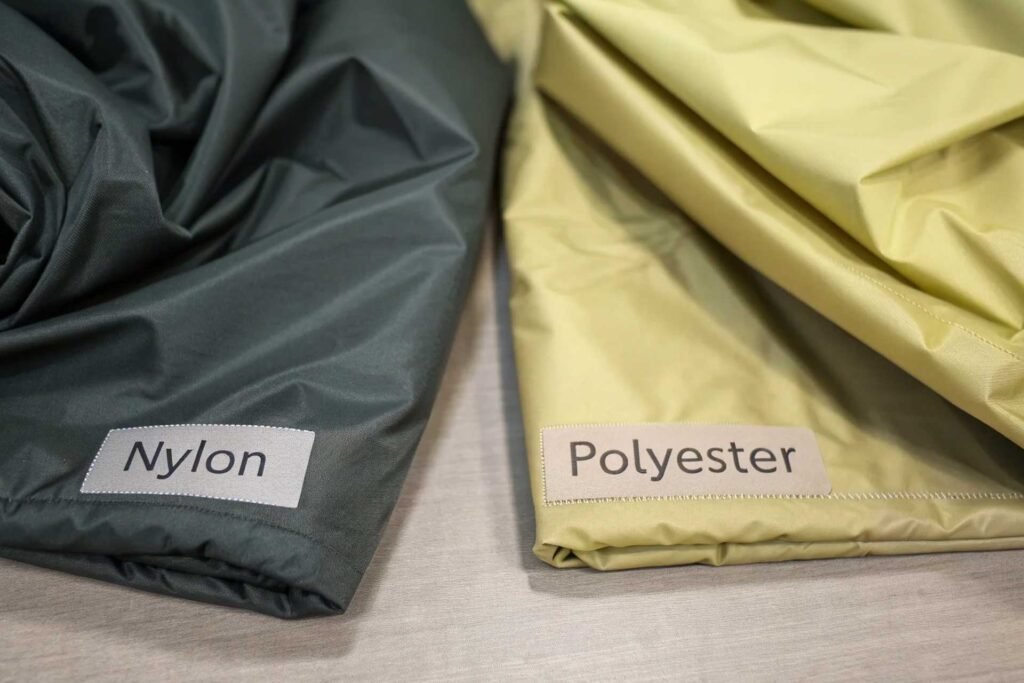
Nylon and polyester are both synthetic polymer fibers, but their chemical structures produce fundamentally different performance profiles.
Nylon (Polyamide) Nylon is a polyamide polymer — its molecular chains contain amide linkages (-CO-NH-) that give the fiber exceptional toughness, flexibility, and resistance to mechanical stress. Nylon was the first fully synthetic fiber produced commercially (1938, DuPont) and remains the benchmark for abrasion resistance and mechanical durability among common apparel fibers.
Key molecular properties that affect fabric performance:
- Amide linkages absorb a small amount of moisture (~4%) — giving nylon slightly better breathability than polyester
- High molecular chain flexibility — producing superior stretch recovery and resistance to repeated stress
- Lower UV stability than polyester — nylon degrades faster under prolonged UV exposure without treatment
Polyester (Polyethylene Terephthalate — PET) Polyester is a polyester polymer — its molecular chains contain ester linkages (-COO-) that give the fiber exceptional dimensional stability, resistance to stretching, and chemical resistance. Polyester is the world's most produced textile fiber and dominates global apparel manufacturing through its combination of performance, versatility, and low cost.
Key molecular properties that affect fabric performance:
- Ester linkages are highly hydrophobic — polyester absorbs virtually no moisture (~0.4%), making it fast-drying but less breathable than nylon
- High molecular chain rigidity — producing excellent wrinkle resistance and dimensional stability but lower stretch recovery than nylon
- Superior UV stability — polyester maintains its strength and color under prolonged UV exposure significantly better than nylon
Performance Comparison — Every Dimension That Matters
| Performance Factor | Nylon | Polyester | Winner |
|---|---|---|---|
| Abrasion resistance | Excellent — highest of common apparel fibers | Good | Nylon |
| Tensile strength | Excellent | Very good | Nylon (marginal) |
| Stretch recovery | Excellent | Good | Nylon |
| Moisture absorption | ~4% | ~0.4% | Nylon |
| Breathability | Medium | Low | Nylon |
| Drying speed | Medium | Fast — dries faster than nylon | Polyester |
| UV resistance | Lower — degrades under sustained UV | Higher — excellent UV stability | Polyester |
| Color fastness | Good | Excellent | Polyester |
| Wrinkle resistance | Good | Excellent | Polyester |
| Dimensional stability | Good | Excellent | Polyester |
| Chlorine resistance | Good — suitable for swimwear | Moderate — degrades in chlorine | Nylon |
| Hand feel | Soft, smooth, silk-like | Varies — can feel more synthetic | Nylon |
| Weight at same denier | Heavier than polyester | Lighter than nylon | Polyester |
| Dyeability | Requires acid dyes — more complex | Disperse dyes — simpler process | Polyester |
| Cost per meter | 15–30% higher than polyester | Lower | Polyester |
| Environmental — recyclability | Recyclable (Nylon 6 more easily) | Widely recycled (rPET available) | Draw |
The summary: Nylon wins on mechanical performance — abrasion resistance, stretch recovery, and hand feel. Polyester wins on practical commercial performance — UV resistance, color fastness, dimensional stability, and cost. Neither fiber is universally superior — the correct choice depends on the application.
Application-by-Application Decision Guide
Activewear and Sportswear → Nylon for premium; polyester for standard
Both fibers are widely used in activewear, but they serve different market segments. Premium activewear — yoga wear, high-performance sportswear, fitted training garments — specifies nylon for its superior abrasion resistance, softer hand feel, and better stretch recovery in nylon-spandex constructions. The fabric holds its shape and surface appearance through intensive use and repeated washing better than polyester at equivalent construction.
Standard activewear and sportswear — gym T-shirts, casual training shorts, budget leggings — specifies polyester for its lower cost, excellent color vibrancy, and adequate performance for moderate physical activity. Polyester activewear with moisture-wicking finish performs well for most everyday fitness applications.
Recommended nylon spec: 80–150 GSM nylon spandex knit, 4-way stretch, moisture-wicking finish. Recommended polyester spec: 100–180 GSM polyester spandex knit, 4-way stretch, moisture-wicking finish.
Swimwear → Nylon is the correct specification
Nylon outperforms polyester specifically in swimwear for two reasons that have no practical workaround. First, nylon has significantly better chlorine resistance than polyester — chlorinated pool water degrades polyester fiber significantly faster than nylon, causing polyester swimwear to lose its shape and surface appearance much faster than equivalent nylon construction. Second, nylon's superior stretch recovery in nylon-spandex constructions maintains the close fit and shape retention that competitive and recreational swimwear requires through repeated wearing and washing.
Recommended spec: 80–180 GSM nylon spandex, 20–30% spandex content, 4-way stretch, chlorine-resistant construction.
Outdoor and Technical Garments → Nylon for high-abrasion; polyester for UV-exposed
For technical outdoor garments where fabric abrasion against rock, vegetation, or equipment is a real use condition — climbing pants, hiking shell jackets, trail running shorts — nylon's abrasion resistance advantage translates directly to longer garment service life. Nylon shell jackets and hiking trousers maintain their surface appearance and structural integrity through sustained outdoor use significantly better than equivalent polyester constructions.
For outdoor garments with high UV exposure — sun protection shirts, outdoor workwear, garden and agricultural garments — polyester's superior UV stability is the critical advantage. Polyester maintains its strength and color under sustained sunlight exposure significantly better than nylon. For UPF (ultraviolet protection factor) rated garments, polyester is the standard base fiber.
Recommended nylon spec: 40–120 GSM nylon ripstop or plain weave, DWR finish for shell jackets; 150–200 GSM nylon for hiking trousers. Recommended polyester spec: 100–160 GSM polyester plain weave or knit, UPF treatment for sun protection garments.
Bags and Backpacks → Nylon for premium; polyester for standard and budget
The bag market splits along exactly the same lines as activewear. Premium backpacks, technical outdoor packs, and laptop bags specify nylon — typically 420D or 600D nylon Oxford with PU coating or TPU laminate — for its superior abrasion resistance, lighter weight at equivalent denier, and softer surface texture. Everyday backpacks, school bags, promotional bags, and luggage specify polyester — typically 600D polyester Oxford with PU coating — for its lower cost and adequate performance for standard bag applications.
Recommended nylon spec: 420D–600D nylon Oxford, PU or TPU coating. Recommended polyester spec: 600D polyester Oxford, PU coating.
Workwear and Uniforms → Polyester or polyester-blend is the standard specification
For workwear and institutional uniforms, polyester and polyester-blend fabrics (TC, TR) dominate for three practical reasons: lower cost for volume orders, better color fastness through repeated industrial washing, and superior dimensional stability. Pure nylon workwear fabric exists but is rarely specified for standard uniform programs where the cost premium over polyester is not justified by the performance requirements.
Exception: high-abrasion workwear applications — knee reinforcements, seat panels, high-wear pocket areas — sometimes specify nylon fabric for specific panels where abrasion resistance is the critical requirement, combined with polyester base fabric for the garment body.
Recommended spec: 65/35 TC twill or TR twill, 180–240 GSM for standard uniforms; nylon reinforcement panels for high-wear areas in heavy-duty workwear.
Curtains, Home Textiles, and Upholstery → Polyester is the correct specification
For home textile applications with significant UV exposure — curtains, outdoor cushion covers, garden furniture fabric — polyester's UV stability advantage is decisive. Nylon curtains and soft furnishings would fade and degrade significantly faster than polyester equivalents under window-level UV exposure. Polyester is also lower cost and has better color vibrancy for home textile applications where appearance is the primary specification driver.
Recommended spec: 100–300 GSM polyester woven or knit for home textiles; 200–320 GSM polyester Oxford or canvas for outdoor upholstery.
Nylon vs Polyester — Sustainability Comparison
Both fibers are petroleum-derived synthetics with similar environmental footprints in primary production. However, the recycled fiber market has developed differently for each.
Recycled polyester (rPET) The most widely available recycled synthetic fiber globally. rPET is produced from post-consumer PET plastic bottles — a large, established supply chain that makes rPET broadly available at competitive pricing. GRS (Global Recycled Standard) certified rPET is standard in sustainable fashion and workwear programs. Most major apparel brands now offer rPET options across their product ranges.
Recycled nylon (Econyl and equivalents) Recycled nylon — notably Econyl, produced from fishing nets, carpet waste, and industrial nylon — is available but at higher cost and lower supply volume than rPET. Econyl-certified recycled nylon is specified by premium sustainable swimwear and activewear brands where the combination of nylon's performance properties and recycled content certification is a product positioning requirement.
For buyers with sustainability requirements:
- rPET polyester: most accessible and cost-effective recycled synthetic option — widely available, GRS certified, suitable for most commercial applications
- Recycled nylon: premium option for swimwear and performance activewear where nylon's performance advantages justify the additional cost and sourcing complexity
Cost Comparison
Nylon fabric consistently costs 15–30% more per meter than equivalent polyester fabric at the same denier and construction. This premium is consistent across all fabric types — nylon Oxford costs more than polyester Oxford at the same denier; nylon spandex knit costs more than polyester spandex knit at the same GSM.
The cost premium is justified in applications where nylon's specific performance advantages — abrasion resistance, stretch recovery, chlorine resistance, hand feel — are specification requirements. It is not justified in applications where polyester delivers equivalent performance for the end use.
| Application | Cost Justification for Nylon Premium |
|---|---|
| Swimwear | Yes — chlorine resistance, stretch recovery essential |
| Premium activewear | Yes — abrasion resistance, hand feel differentiate product |
| Technical outdoor bags | Yes — abrasion resistance extends product life |
| Standard workwear | No — polyester delivers equivalent performance |
| Curtains and home textiles | No — polyester UV resistance is superior |
| Promotional bags | No — polyester cost efficiency is the priority |
| Everyday backpacks | Marginal — depends on price point positioning |
Nylon vs Polyester in Blended Fabrics
Both nylon and polyester are widely used as blend components with natural fibers and with each other.
Nylon-polyester blends Combining nylon and polyester in a single fabric — typically 70/30 or 80/20 nylon-to-polyester — produces a fabric that partially captures nylon's abrasion resistance and hand feel alongside polyester's color fastness and UV stability at lower cost than 100% nylon. Used in mid-market activewear and outdoor fabric where the full nylon cost premium is not justified but some nylon performance advantage is desired.
Nylon-spandex and polyester-spandex The dominant stretch fabric constructions for activewear and swimwear. Nylon-spandex at 90/10 is the standard swimwear specification; polyester-spandex at 92/8 is the standard everyday activewear specification. Both are available across the full GSM range from lightweight (80 GSM) to heavyweight (300 GSM).
Nylon-cotton and polyester-cotton blends Polyester-cotton (TC) blends dominate workwear and uniform production — combining cotton's breathability with polyester's dimensional stability and wash durability. Nylon-cotton blends are less common in apparel but used in some technical workwear applications where nylon's abrasion resistance is combined with cotton's comfort.
Key Specifications to Confirm When Sourcing
| Specification | Nylon Fabric | Polyester Fabric |
|---|---|---|
| Fiber content | Nylon % confirmed by lab test | Polyester % confirmed by lab test |
| Denier | 40D–1680D depending on application | 40D–1680D depending on application |
| Construction | Woven or knit, weave type | Woven or knit, weave type |
| GSM | Physical sample verified | Physical sample verified |
| Color fastness — washing | Minimum Grade 4 | Minimum Grade 4 |
| Color fastness — light | Minimum Grade 3–4 | Minimum Grade 4–5 for outdoor |
| Chlorine resistance | Confirm for swimwear | Confirm — lower than nylon |
| UV resistance | Confirm treatment for outdoor | Generally good without treatment |
| Stretch recovery | For spandex blends — 90%+ | For spandex blends — 90%+ |
| Certifications | OEKO-TEX, GRS recycled | OEKO-TEX, GRS rPET |
| Width | 144cm standard | 144cm standard |
| MOQ | 500m stock / 1500m+ custom | 500m stock / 1500m+ custom |
Frequently Asked Questions
Is nylon stronger than polyester? In abrasion resistance — yes, nylon is significantly stronger. In tensile strength — nylon has a marginal advantage. In dimensional stability and resistance to stretching — polyester is stronger. The practical implication: nylon resists wear and mechanical damage better in applications with friction and repeated stress; polyester holds its shape and dimensions better in applications requiring stability through washing and UV exposure.
Which is better for activewear — nylon or polyester? Both are widely used. Nylon is better for premium activewear where abrasion resistance, soft hand feel, and superior stretch recovery in nylon-spandex constructions justify the cost premium. Polyester is better for standard activewear where cost efficiency, excellent color fastness, and adequate stretch performance are the primary requirements. Most volume commercial activewear production uses polyester; premium and technical performance products use nylon.
Is nylon or polyester better for the environment? Both are petroleum-derived synthetic fibers with similar environmental footprints in primary production. Recycled polyester (rPET) has a larger and more accessible supply chain than recycled nylon, making it the more practical sustainable option for most commercial applications. Recycled nylon (Econyl) is available for premium applications where nylon's performance properties are required alongside recycled content certification.
Why is nylon more expensive than polyester? Nylon raw material production is more chemically complex and energy-intensive than polyester production. Nylon 6 and Nylon 6,6 — the two main commercial nylon types — require more processing steps than PET polyester from the same petroleum feedstock. The 15–30% cost premium reflects this production complexity rather than any supply scarcity.
Can nylon and polyester fabrics be washed together? Yes — both fibers are machine washable and compatible in the same wash load. Both should be washed in cold or warm water (not hot) to prevent heat damage, particularly for spandex-blend constructions where high heat degrades the elastane component. Neither fiber bleaches well — avoid chlorine bleach for both nylon and polyester fabrics.
What is the minimum order for wholesale nylon and polyester fabric? Standard MOQ for stock nylon and polyester fabric in regular colors is 500 meters per color. Custom dyeing and functional finishing requires 1,500–2,000 meters minimum. Special constructions start from 3,000 meters. Free swatches available before bulk commitment.
Source Wholesale Nylon and Polyester Fabric from XINGYE TEXTILE
XINGYE TEXTILE supplies wholesale nylon fabric and polyester fabric — across the full range of constructions, denier specifications, and functional finishes — direct from our production facility in China. We serve activewear brands, swimwear manufacturers, bag producers, workwear suppliers, and wholesale fabric buyers worldwide with factory-direct pricing, flexible MOQ from 500 meters, and full technical documentation.
Contact our sourcing team with your application, fiber preference, construction, GSM, quantity, and destination for a formal quotation within 24 hours.
→ Browse Nylon / Polyamide Fabric → Browse Fabric for Activewear → Browse Fabric for Swimwear → Browse Fabric for Bags → Read: Is Nylon Fabric Breathable? → Read: Best Waterproof Fabric for Bags → Read: Nylon vs Polyester in Waterproof Laminates → Request a Free Swatch → Get a Wholesale Quote