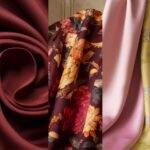
Velvet is defined by its construction — a cut-pile woven fabric with a dense, soft surface nap — not by its fiber content. The same velvet construction can be produced in silk, cotton, polyester, ice silk, gold thread blends, and mixed fiber compositions, each producing a completely different performance profile, price point, and application suitability. Choosing the wrong velvet composition for your garment, upholstery, or home textile application is a costly mistake that affects not just the hand feel and appearance of the finished product, but its durability, care requirements, production behavior, and compliance with buyer specifications. This guide provides a direct, specification-level comparison of the main velvet fabric types — covering fiber properties, GSM ranges, production considerations, application mapping, and wholesale sourcing information — to help manufacturers and buyers make the right choice for their specific product requirements.
What Is Velvet Fabric? The Construction Behind the Comparison
Before comparing fiber types, understanding velvet's construction is essential — because it is the construction, not the fiber, that gives velvet its defining characteristics.
Velvet is produced on a special loom that simultaneously weaves two layers of fabric face-to-face, connected by pile yarns running between them. The double fabric is then cut apart — the pile yarns are severed in the middle — producing two separate pieces of velvet, each with an upright cut-pile surface. This cut pile is what creates velvet's characteristic soft, dense nap and its distinctive play of light and shadow as the pile changes direction.
The pile construction determines four fundamental velvet properties regardless of fiber type:
Pile height and density. The length of the cut pile yarns and how densely they are packed determines how plush and soft the velvet feels. Higher pile density at the same GSM produces a more luxurious hand feel — but also requires more fiber per square meter, increasing cost.
Pile direction and shading. Velvet pile has a natural direction — it lies flat when stroked in one direction and stands up when stroked against the pile. This directional property means that all garment and upholstery panels must be cut with pile running in the same direction, or color differences between panels will be visible in the finished product.
Crushing and recovery. Velvet pile can be crushed by sustained pressure — sitting, folding, or packing — and may not fully recover its original height and uniformity. Recovery behavior varies significantly between fiber types and is one of the most important practical differences between silk, cotton, and polyester velvet.
Light reflection and depth of color. The dense pile surface absorbs and reflects light differently from flat woven fabrics, producing the characteristic color depth and shimmering quality of velvet. Different fibers reflect light differently — silk velvet has the most lustrous reflection; cotton velvet the most matte and natural; polyester velvet sits between the two depending on the yarn type used.
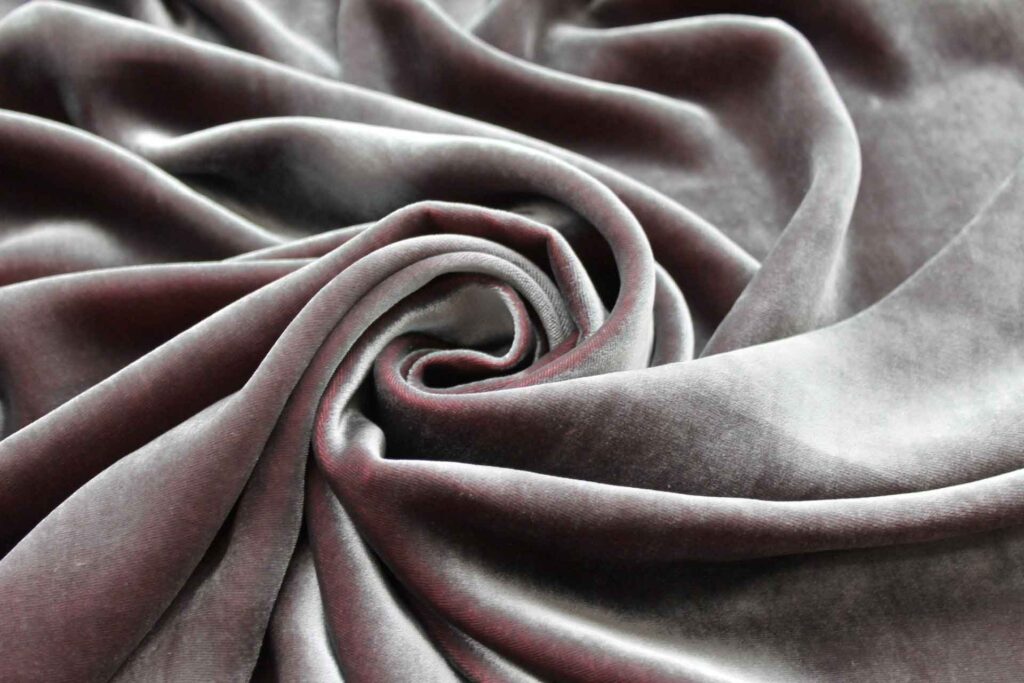
silk velvet fabric
Silk Velvet — The Original and Most Luxurious
Silk velvet is the original velvet construction — historically produced with silk pile on a cotton or silk base, it is the benchmark against which all other velvet types are measured. Genuine silk velvet is rare, expensive, and technically demanding to produce and work with — but its performance characteristics are unmatched by any synthetic alternative.
Performance properties:
Unparalleled drape. Silk fiber's natural properties — extreme fineness, light weight, and low friction between filaments — give silk velvet the most fluid, flowing drape of any velvet type. Silk velvet garments move and fall with a natural grace that polyester and cotton velvet cannot replicate, which is why silk velvet remains the specification for the highest-end fashion garments and couture applications.
Exceptional luster. Silk's triangular cross-section reflects light in multiple directions simultaneously, producing the characteristic shimmering quality that gives silk velvet its distinctive visual depth. The pile of silk velvet appears to change color as the viewer's angle changes — a visual property called 'shot' effect — that synthetic alternatives can only partially approximate.
Lightweight at high softness. Despite its extreme softness and luster, silk velvet is significantly lighter than cotton velvet at equivalent pile density. A silk velvet evening gown drapes and flows in a way that an equivalent cotton velvet garment — which would be substantially heavier — cannot match.
Production challenges: Silk velvet is the most demanding velvet type to cut, sew, and press. The pile crushes easily under presser foot pressure during sewing, requiring specialized presser feet and careful handling. Cutting must be done single-ply with a sharp blade in the correct pile direction. Pressing requires a needle board or velvet board to avoid crushing the pile — conventional pressing will permanently flatten the surface.
Cost: The highest of all velvet types — raw silk material cost plus the technical complexity of silk velvet production places it in premium territory. Used primarily in luxury fashion, couture, and high-end ceremonial applications.
Best for: Evening wear, couture garments, luxury accessories, ceremonial and occasion wear, premium fashion applications where the unique drape and luster of silk are part of the product identity.
GSM range: 180–320 GSM depending on pile height and base construction.
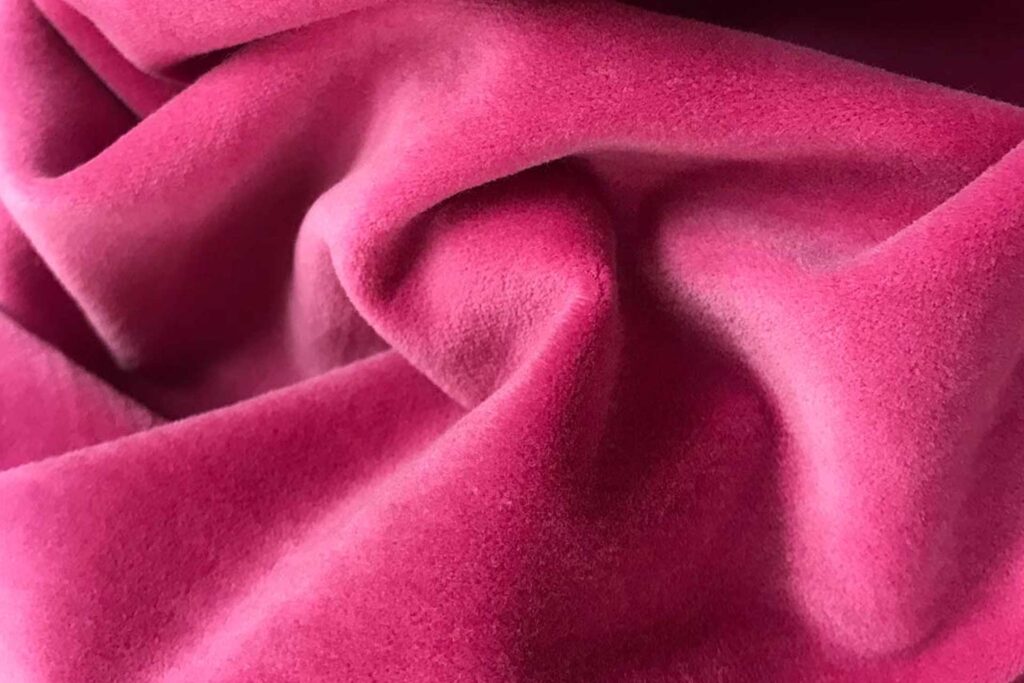
cotton velvet fabric
Cotton Velvet — Natural Comfort and Matte Richness
Cotton velvet — produced with cotton pile on a cotton base — is the most widely produced natural fiber velvet globally. It delivers the breathability, softness, and natural fiber credentials of cotton in a pile construction, producing a fabric with a distinctive matte richness that is warmer and more casual in character than silk velvet's formality.
Performance properties:
Natural breathability and moisture absorption. Cotton velvet breathes significantly better than polyester velvet — the cotton pile absorbs moisture and allows air circulation through the pile structure. This makes cotton velvet appropriate for garments worn against the skin in warm conditions, and for upholstery in environments where breathability affects comfort.
Matte, rich surface appearance. Cotton velvet does not produce the shimmering luster of silk — instead it has a deep, rich matte appearance that absorbs light rather than reflecting it. This characteristic gives cotton velvet a warmer, more casual aesthetic that works well in home textiles, casual fashion, and interior design applications where the natural texture of cotton is part of the product identity.
Good pile recovery. Cotton velvet has better pile recovery than silk velvet after crushing — the cotton fibers are more resilient under pressure. Steam and gentle brushing can restore crushed cotton velvet pile effectively, making it more practical for upholstery and home textile applications than silk.
Washability. Pre-treated cotton velvet can be hand or gentle machine washed — an important practical advantage for garments and home textiles that require regular laundering. Confirm wash treatment with supplier before specifying for applications requiring machine washability.
Production behavior: Cotton velvet is easier to cut and sew than silk velvet but still requires careful pile direction management. Pressing requires a needle board — conventional iron pressing will crush the pile. Cotton velvet is heavier than equivalent silk or polyester velvet at the same pile height, which affects garment weight calculations.
Cost: Significantly lower than silk velvet; higher than polyester velvet. Appropriate for mid-market fashion, quality home textiles, and applications where natural fiber credentials justify the cost premium over polyester.
Best for: Casual and semi-formal garments, children's clothing, home textiles (cushions, throws), curtains and drapes, upholstery for residential furniture, and applications where natural fiber breathability and matte aesthetic are valued.
GSM range: 270–500 GSM — cotton velvet is typically heavier than silk or polyester velvet at equivalent pile density due to cotton's higher fiber weight.
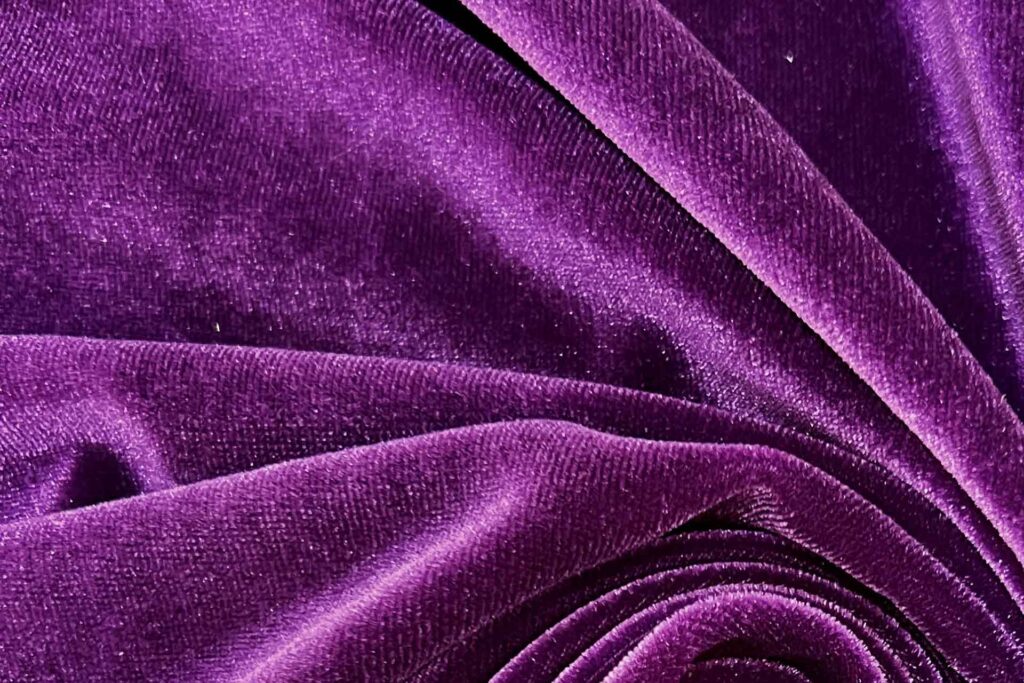
polyester velvet fabric
Polyester Velvet — The Commercial Standard
Polyester velvet is the dominant velvet composition in global commercial production — accounting for the majority of velvet fabric manufactured for garments, home textiles, curtains, and upholstery worldwide. Modern polyester velvet technology has advanced significantly, and quality polyester velvet at 270 GSM and above is visually indistinguishable from cotton velvet to most consumers, while offering performance advantages that natural fiber velvet cannot match.
Performance properties:
Dimensional stability and pile resilience. Polyester fiber has excellent elastic recovery — polyester velvet pile springs back from crushing more reliably than cotton velvet and significantly better than silk velvet. This dimensional stability makes polyester velvet the practical specification for upholstery, curtains, and soft furnishings where the fabric will experience sustained pressure and handling.
Color vibrancy and fastness. Polyester accepts disperse dye at high temperature, producing exceptionally vivid, saturated colors with excellent washing and light fastness. Polyester velvet maintains its color intensity through repeated washing and extended light exposure better than cotton or silk velvet — a critical advantage for fashion garments, curtains, and upholstery with long service life requirements.
Easy care and wash durability. Polyester velvet can be machine washed and dries quickly without significant shrinkage or pile damage — a major practical advantage over silk velvet (dry clean only) and most cotton velvet (gentle wash required). For garments and home textiles requiring frequent laundering, polyester velvet's easy-care performance is a significant specification advantage.
Lower cost. Polyester raw material is significantly less expensive than silk or cotton. Polyester velvet delivers velvet's aesthetic and tactile qualities at the most accessible price point — enabling velvet to be used across mass market fashion, home textile, and commercial upholstery applications where natural fiber cost would be prohibitive.
Production behavior: Polyester velvet is the easiest velvet type to work with in production — more dimensionally stable than silk, lighter than cotton, and more forgiving of pile direction inconsistencies than either natural fiber type. Standard industrial sewing equipment handles polyester velvet effectively. Pile direction must still be managed carefully — all panels cut in the same direction.
Cost: The lowest of the three main velvet types. Suitable for mass market, volume commercial, and cost-sensitive applications.
Best for: Mass market fashion garments, volume home textiles, commercial curtains and drapes, upholstery for commercial and residential furniture, decorative applications, children's clothing, and any application where cost efficiency alongside velvet aesthetics is the primary driver.
GSM range: 180–500 GSM — the widest available range of the three types.
Specialty Velvet Types — Ice Silk, Gold Thread & Non-Crush Velvet
Beyond the three main compositions, several specialty velvet types serve specific application requirements.
Ice Silk Velvet (冰丝绒) Produced from ice silk fiber — a modified polyester or nylon filament with a cooling, silky surface sensation. Ice silk velvet has a higher luster than standard polyester velvet and a distinctively cool, smooth hand feel against skin. The 'cooling' sensation comes from the fiber's rapid heat dissipation properties rather than any active cooling mechanism.
Best for: summer fashion garments, loungewear, sleepwear, lingerie, and any application where a cool, silky hand feel against skin is a key product feature. Increasingly popular in Asian markets for warm-climate premium casualwear. GSM range: 180–280 GSM.
Gold Thread Velvet (金丝绒) Velvet produced with metallic yarn — typically gold or silver — incorporated into the pile construction, creating a fabric with a characteristic shimmering metallic surface texture. The metallic yarn catches and reflects light differently from standard pile fiber, producing a distinctive visual effect used in festive, ceremonial, and decorative applications.
Best for: festive fashion, stage and performance costumes, decorative home textiles, ceremonial upholstery, and high-visual-impact fashion applications. GSM range: 270–420 GSM.
Non-Crush Velvet (不倒绒) A specialty velvet construction where the pile fibers are treated or constructed to resist flattening under pressure. Standard velvet pile crushes when sat upon or folded — non-crush velvet maintains its pile height and uniformity under sustained contact, making it practical for upholstery applications where conventional velvet would show permanent crushing at seat and armrest contact points.
Best for: upholstery fabric for chairs and sofas, automotive interior applications, commercial seating, and any velvet upholstery application where pile crushing under sustained contact is unacceptable. GSM range: 300–480 GSM.
Direct Comparison — Silk vs Cotton vs Polyester Velvet
| Factor | Silk Velvet | Cotton Velvet | Polyester Velvet |
|---|---|---|---|
| Drape | Exceptional — most fluid | Good — heavier drape | Good — varies by GSM |
| Luster | Highest — shimmering | Matte, rich | Medium — vivid colors |
| Breathability | Good | Excellent | Low-Medium |
| Pile recovery | Lower — crushes more easily | Good | Excellent |
| Wash durability | Dry clean only | Gentle wash | Machine washable |
| Color fastness | Good | Good | Excellent |
| Weight (same pile height) | Lightest | Heaviest | Medium |
| Production difficulty | Highest | Medium | Lowest |
| Cost | Highest | Medium | Lowest |
| MOQ flexibility | Limited | Medium | Most flexible |
| Best application fit | Luxury fashion, couture, occasion wear | Casual fashion, home textiles, natural fiber positioning | Mass market fashion, commercial upholstery, curtains, volume home textiles |
Velvet Fabric GSM Guide
| GSM Range | Fabric Character | Best Applications |
|---|---|---|
| 180–260 GSM | Lightweight, fluid drape | Lightweight fashion garments, summer dresses, blouses |
| 270–380 GSM | Standard weight, balanced pile density | Standard fashion garments, cushion covers, light curtains |
| 390–500 GSM | Heavyweight, dense pile, maximum plush | Upholstery, heavy curtains, decorative applications, premium home textiles |
For garment applications, 270–320 GSM is the most widely specified range — sufficient pile density for a full velvet appearance without excessive weight. For upholstery and curtains, 350–500 GSM provides the pile density and body required for furnishing applications.
Application-by-Application Specification Guide
Fashion Garments and Evening Wear
- Budget to mid-market: polyester velvet, 270–350 GSM
- Mid to premium: cotton velvet or ice silk velvet, 240–320 GSM
- Luxury and couture: silk velvet, 180–280 GSM
Children's Clothing
- Polyester velvet, 220–300 GSM — easy care, color fastness, cost efficiency
- OEKO-TEX Standard 100 certification required for European and North American markets
Home Textiles (Cushions, Throws, Bed Covers)
- Polyester velvet or cotton velvet, 270–420 GSM
- Polyester for color vibrancy and easy care; cotton for natural fiber positioning
Curtains and Drapes
- Polyester velvet, 350–500 GSM — color fastness under UV exposure, dimensional stability, easy care
- Non-crush construction recommended for curtains subject to frequent handling
Upholstery (Sofas, Chairs, Commercial Seating)
- Non-crush polyester velvet, 390–500 GSM
- Martindale abrasion rating: 25,000+ cycles for residential; 50,000+ for commercial
- Pile recovery confirmation essential before bulk order
>Decorative and Ceremonial Applications
- Gold thread velvet or polyester velvet, 300–450 GSM
- Color and metallic effect confirmed against physical sample before production
Key Specifications to Confirm When Sourcing Velvet Fabric
| Specification | What to Confirm | Standard |
|---|---|---|
| Fiber composition | Exact pile and base fiber, confirmed by lab test | Per agreed spec |
| Pile type | Cut pile, loop pile, embossed | Per design requirement |
| GSM | Physical sample weighing | ±5% tolerance |
| Pile height | mm measurement | Per design requirement |
| Pile direction | Confirm with directional sample | All panels cut same direction |
| Pile recovery | After sustained pressure test | Confirm for upholstery applications |
| Width | Usable width after selvage | Standard 57–59' or 144cm |
| Color fastness — washing | Grade rating | Minimum Grade 4 |
| Color fastness — rubbing | Dry and wet | Minimum Grade 3–4 |
| Color fastness — light | UV stability for curtains/upholstery | Minimum Grade 4 |
| Martindale abrasion | For upholstery applications | 25,000+ residential / 50,000+ commercial |
| Certifications | OEKO-TEX for children's garments | Per buyer requirement |
| MOQ | Per order type | See below |
| Lead time | Stock vs custom | Stock: 3–5 days / Custom: 7–20 days |
MOQ by Order Type:
| Order Type | MOQ |
|---|---|
| Stock velvet, standard colors | 500 meters per color |
| Custom dyeing | 1,500 meters per color |
| Jacquard or printed velvet | 2,500 meters minimum |
Frequently Asked Questions — Velvet Fabric
Is polyester velvet as good as silk velvet? For most commercial applications — fashion garments, home textiles, curtains, and upholstery — polyester velvet delivers equivalent or superior practical performance to silk velvet at a fraction of the cost. Polyester velvet has better pile recovery, color fastness, wash durability, and dimensional stability than silk velvet. The areas where silk velvet is genuinely superior — drape fluidity, luster depth, and the distinctive light-play of silk fiber — matter primarily in luxury fashion and couture applications where these properties are part of the product's value proposition. For volume commercial production, polyester velvet is the practical and cost-effective specification.
What is ice silk velvet and is it better than regular polyester velvet? Ice silk velvet is produced from a modified polyester or nylon filament engineered to dissipate heat quickly, creating a cool sensation against skin. It has a higher luster than standard polyester velvet and a distinctively smooth, almost silky surface feel. It is not objectively 'better' than standard polyester velvet — it is suited to different applications. For summer fashion garments, loungewear, and sleepwear where a cool, smooth hand feel is a key product feature, ice silk velvet is the more appropriate specification. For upholstery, curtains, and applications where pile recovery and durability are primary requirements, standard polyester velvet is more appropriate.
Does velvet fabric require special cutting and sewing? Yes. All velvet types require pile direction management during cutting — all pattern pieces must be cut with the pile running in the same direction to avoid color variation between panels in the finished product. Sewing velvet requires a walking foot or roller foot to prevent pile from shifting under the presser foot. Pressing must be done on a needle board or velvet board — conventional iron pressing will permanently crush the pile. These production requirements apply to silk, cotton, and polyester velvet alike, though polyester velvet is the most forgiving of the three.
How do I prevent velvet pile from crushing in upholstery applications? Specify non-crush velvet (不倒绒) construction for upholstery applications. Non-crush velvet uses pile fiber treatment or modified construction to resist flattening under sustained contact pressure. Standard velvet — even at high GSM — will show permanent pile crushing at seat and armrest contact points in upholstery applications over time. Confirm pile recovery performance with a physical sample test before bulk order commitment for any velvet upholstery specification.
What is the minimum order for wholesale velvet fabric? Standard MOQ for stock velvet in regular colors is 500 meters per color. Custom dyeing requires 1,500 meters minimum. Jacquard and printed velvet constructions start from 2,500 meters. Free swatches and color cards are available before bulk commitment — contact our team to request samples.
Source Wholesale Velvet Fabric from XINGYE TEXTILE
XINGYE TEXTILE supplies wholesale velvet fabric across all major compositions and constructions — polyester velvet, cotton velvet, ice silk velvet, gold thread velvet, non-crush velvet, and mixed fiber velvet — in weights from 180 to 500 GSM, serving fashion garment manufacturers, home textile brands, curtain and upholstery producers, and wholesale fabric buyers worldwide. Factory-direct pricing, MOQ from 500 meters for stock colors, free swatches available before bulk commitment.
Contact our sourcing team with your composition requirement, GSM, pile type, quantity, and destination for a formal quotation and physical sample within 24 hours.
→ Browse Our Full Fabric Range → Browse Upholstery Fabric → Browse Fabric for Bags → Read: Wholesale Waterproof Upholstery Fabric → Request a Free Swatch → Get a Wholesale Quote