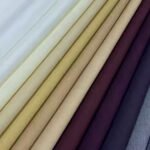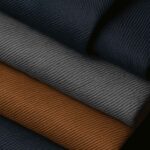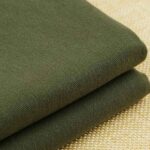
Polyester-Viscose vs Polyester-Cotton — Two Blends, Two Very Different Fabrics
If you're sourcing fabric for uniforms, workwear, or suiting, you've seen these two letters everywhere: TR and TC.
They look similar on paper — both are polyester blends, both are used for uniforms, both are cheaper than wool or pure cotton. But they perform very differently in the garment, and picking the wrong one is a mistake you won't catch until the uniforms have been through 10 wash cycles.
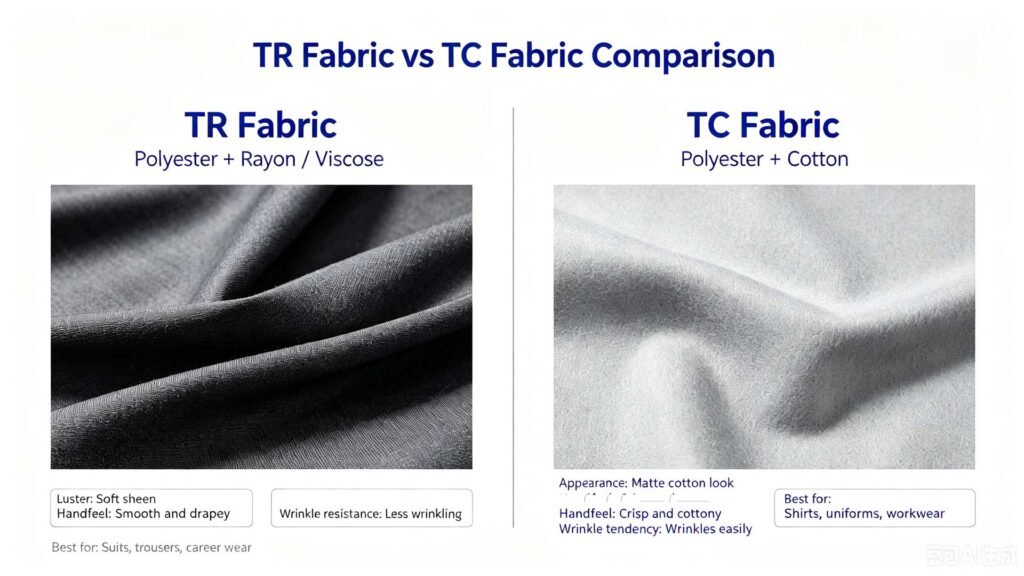
TR = Polyester + Viscose (Rayon). TC = Polyester + Cotton.
The difference between viscose and cotton changes everything — hand feel, breathability, drape, durability, shrinkage, and cost. This guide breaks down exactly where each fabric wins, where it loses, and which one you should specify for your program.
TR Fabric vs TC Fabric
What Do TR and TC Actually Stand For?
| TR | TC | |
|---|---|---|
| Full form | Terylene + Rayon | Terylene + Cotton |
| Fibers | Polyester + Viscose | Polyester + Cotton |
| Standard blend | 65% Polyester / 35% Viscose | 65% Polyester / 35% Cotton |
| Natural fiber content | Viscose (semi-synthetic, from wood pulp) | Cotton (natural plant fiber) |
| Also known as | Poly-viscose, Poly-rayon | Poly-cotton, Polycotton |
Both use 'T' for Terylene (polyester). The second letter tells you what natural or semi-natural fiber is blended with it.
Why the blend exists in both cases: Pure polyester is cheap and durable but uncomfortable against the skin. Blending with a second fiber improves breathability, hand feel, and moisture absorption. The question is which second fiber — viscose or cotton.
TR vs TC: Side-by-Side Comparison
| Property | TR (65/35 Poly-Viscose) | TC (65/35 Poly-Cotton) | Winner |
|---|---|---|---|
| Hand feel / softness | Smooth, slightly silky, closer to wool | Crisper, more like a classic cotton shirt | TR |
| Drape and body | Holds shape, structured drape, crease retention | Softer drape, less structure, casual rumple | TR |
| Breathability | Moderate — better than poly, not as good as TC | Good — cotton absorbs and releases moisture well | TC |
| Moisture absorption | Moderate — viscose absorbs more than poly but less than cotton | High — cotton absorbs sweat and releases it slowly | TC |
| Wrinkle resistance | Excellent — both fibers recover well | Very good — slightly less elastic recovery than viscose | TR (slight edge) |
| Durability (industrial wash) | 80-100+ cycles | 60-80 cycles | TR |
| Shrinkage | ≤2% (heat-set) | 2-4% (cotton shrinks more than viscose) | TR |
| Pilling resistance | 4.0+ with anti-pill treatment | 3.5-4.0 — cotton pills less than viscose, but cotton lint can surface | TC (slight edge) |
| Color retention | Excellent — both fibers take dye well | Very good — cotton can fade faster in hot wash | TR |
| Static cling | Moderate — viscose reduces static better than cotton | Moderate — cotton helps but less effective than viscose | TR |
| Cost | $$ (mid-range) | $$ (mid-range, slightly cheaper) | TC (slight edge) |
The Key Differences, Explained
1. Hand Feel — TR Feels Richer
TR fabric uses viscose, which is derived from wood pulp and processed into a smooth, uniform fiber. The result is a fabric that feels closer to wool or a premium rayon suiting than to cotton. It's smooth, slightly cool to the touch, and drapes with a clean, structured line.
TC fabric uses cotton, which is a shorter, more irregular natural fiber. The surface has a classic cotton hand feel — familiar, comfortable, but less refined. It wrinkles more readily and doesn't hold a crease as sharply as TR.
What this means for your uniform:
- If you want a sharp, professional look — TR
- If you want a classic cotton feel — TC
2. Breathability — TC Breathes Better
Cotton is one of the most breathable natural fibers. Air passes through cotton fabric easily, and cotton absorbs moisture (up to 25x its own weight) and releases it to the surface. TC fabric at 65/35 retains much of cotton's breathability.
Viscose is also breathable — significantly more than polyester — but not as much as cotton. Viscose fibers are denser and smoother than cotton fibers, which means less air space between threads.
What this means for your uniform:
- If your team works in hot, humid conditions for long hours — TC
- If your team works in air-conditioned environments with moderate activity — TR is comfortable enough
3. Drape and Appearance — TR Looks More Structured
TR fabric has body. It holds a crease, keeps a sharp collar, and maintains its shape through a full day of wear. That's why TR is the default for suit trousers, blazers, and formal uniforms — it looks tailored even off the rack.
TC fabric is softer and more relaxed. It drapes closer to the body and doesn't hold a crease as well. It's better for casual uniform shirts and lighter garments.
What this means for your uniform:
- If you need sharp creases and tailored structure — TR
- If you need soft, casual comfort — TC
4. Industrial Laundry — TR Lasts Longer
In industrial laundry conditions (75°C wash, high-speed extraction, hot tumble dry), TR outperforms TC by a significant margin.
| Factor | TR | TC |
|---|---|---|
| Wash cycles before visible wear | 80-100+ | 60-80 |
| Shrinkage after 50 washes | ≤2% | 3-4% |
| Color fade after 50 washes | Delta E < 3 | Delta E 3-5 |
| Collar/cuff fraying | Minimal at 80 cycles | Visible at 60 cycles |
| Fiber pilling | 4.0+ (with treatment) | 3.5-4.0 |
Why does TR last longer? Viscose is a manufactured fiber with uniform diameter and no natural impurities. Cotton is a natural fiber with variations, short fibers, and impurities that break down faster under high heat and aggressive washing.
What this means for your uniform:
- If you're running an industrial laundry program (hotels, hospitals, restaurants) — TR
- If uniforms are home-laundered or cold-washed — TC is fine
5. Shrinkage — TR Is More Stable
Cotton shrinks. It's not a defect — it's a property of natural cellulose fibers. Even pre-shrunk cotton can contract 3-5% over multiple hot washes. That means a size M uniform shirt can become a size S after 20 washes.
Viscose also shrinks in its untreated form, but when blended with polyester and properly heat-set, TR fabric achieves ≤2% residual shrinkage. The difference matters in uniform programs where consistent sizing is required for 6-12 months.
What this means for your uniform:
- If sizing consistency matters (rental programs, branded uniforms that must fit for a year) — TR
- If you allow for shrink in initial sizing (order 1 size up) — TC can work
When to Choose TR Fabric
Choose TR when you need:
- Sharp, structured appearance — suits, blazers, formal uniforms, executive wear
- Premium hand feel — suiting, thobes, customer-facing uniforms where fabric quality is visible
- Industrial laundry durability — hotel uniforms, restaurant uniforms, rental programs
- Consistent sizing over time — rental programs, multi-year uniform contracts
- Wrinkle-free performance — uniforms worn for 10+ hours straight without access to ironing
- Color consistency across production runs — large orders where shade matching matters
Best applications for TR:
- Hotel front-of-house uniforms (suits, blazers, trousers)
- Restaurant server and manager uniforms
- Executive and corporate uniforms
- School blazers
- Thobes and traditional wear
- Military and police service uniforms
- Formal event staff uniforms
When to Choose TC Fabric
Choose TC when you need:
- Maximum breathability — hot kitchens, outdoor work, high-activity roles
- Cotton hand feel — staff comfort preference, skin sensitivity
- Moisture absorption — environments where sweat management matters
- Lower cost — TC is slightly cheaper than TR at comparable specifications
- Home laundering — TC performs better in standard home wash conditions than TR does in home wash (TR benefits more from industrial laundry care)
Best applications for TC:
- Restaurant kitchen uniforms
- Hotel housekeeping uniforms
- Industrial work shirts
- School uniform shirts
- Healthcare uniform tunics and trousers
- Summer-weight uniform shirts
- Casual workwear programs
Quick Decision Matrix
| Factor | Choose TR | Choose TC |
|---|---|---|
| Appearance needs to look 'tailored' | ✓ | |
| Staff work outdoors or in unairconditioned spaces | ✓ | |
| Uniforms go through industrial laundry | ✓ | |
| Uniforms are home-washed | ✓ | |
| Uniforms need to last >80 wash cycles | ✓ | |
| Budget is the primary concern | ✓ | |
| Fabric hand feel must feel premium | ✓ | |
| Sizing must stay consistent for 12+ months | ✓ | |
| Staff work in moderate/AC environments | ✓ | |
| Staff work in hot/humid environments | ✓ | |
| Suiting and blazers | ✓ | |
| Shirts and casual tops | ✓ |
What Buyers Get Wrong About TR and TC
Mistake #1: 'TC is always better because cotton is natural.'
Cotton is natural. But natural doesn't always mean better for uniforms. Cotton shrinks, fades, wrinkles, and wears out faster than viscose in high-use uniform applications. TR often provides a better uniform experience despite being 'less natural.'
Mistake #2: 'TR and TC are basically the same thing.'
They are both polyester blends with a 65/35 ratio. That's where the similarity ends. TR = structured, durable, premium feel. TC = breathable, casual, softer drape. They serve different applications.
Mistake #3: 'TR fabric is not breathable.'
TR is significantly more breathable than pure polyester. The 35% viscose content provides real air circulation. It's not as breathable as TC or pure cotton, but it's comfortable for a full workday in air-conditioned environments.
Mistake #4: 'TC fabric doesn't need ironing.'
TC is wrinkle-resistant compared to pure cotton, but not wrinkle-free. A 65/35 TC shirt worn for a full shift will show creases. TR holds its shape better through the day.
How to Order: What to Specify
For TR fabric:
- Blend: 65% Polyester / 35% Viscose (standard)
- Weight: 240-320 GSM for suiting, 180-220 for lightweight
- Weave: Twill (standard), Gabardine (structured), Plain (lightweight)
- Finish: Anti-pilling treated, heat-set for ≤2% shrinkage
- Color: Custom dye or stock color
For TC fabric:
- Blend: 65% Polyester / 35% Cotton (standard)
- Weight: 180-260 GSM for shirts, 240-320 for trousers
- Weave: Twill (durable), Poplin (crisp shirt), Plain (lightweight)
- Finish: Pre-shrunk, wrinkle-resistant treatment recommended
- Color: Custom dye or stock color
Both are available from XINGYE TEXTILE with custom specifications, AQL quality inspection, and sample-first ordering.
Get a Quote
XINGYE TEXTILE manufactures both TR fabric (polyester-viscose) and TC fabric (polyester-cotton). Standard 65/35 blends, custom ratios, anti-pilling treated, ≤2% shrinkage guaranteed. Available in twill, plain, gabardine, poplin, and more. GSM range 180-350. Custom colors and functional finishes supported.
Minimum order: 300 meters per color. Sample-first ordering available.
Premium TR Fabric Manufacturer | Polyester-Viscose Blends for Suiting
Wholesale TC Fabric Manufacturer | Polyester-Cotton Blends for Uniforms