Elastane, spandex, and Lycra are three names for the same fiber — a polyurethane-based synthetic elastic fiber that provides stretch and recovery in fabric. The confusion between these terms is understandable: they appear interchangeably on fabric specifications, care labels, and supplier quotations, sometimes within the same document. But for garment manufacturers and fabric buyers, understanding the relationship between these terms — and more importantly, understanding how elastane performs in different base fiber blends and at different percentages — is the foundation of accurate stretch fabric specification. This guide clarifies the terminology, explains how elastane content affects fabric performance, and provides specification guidance for the most common stretch fabric applications.
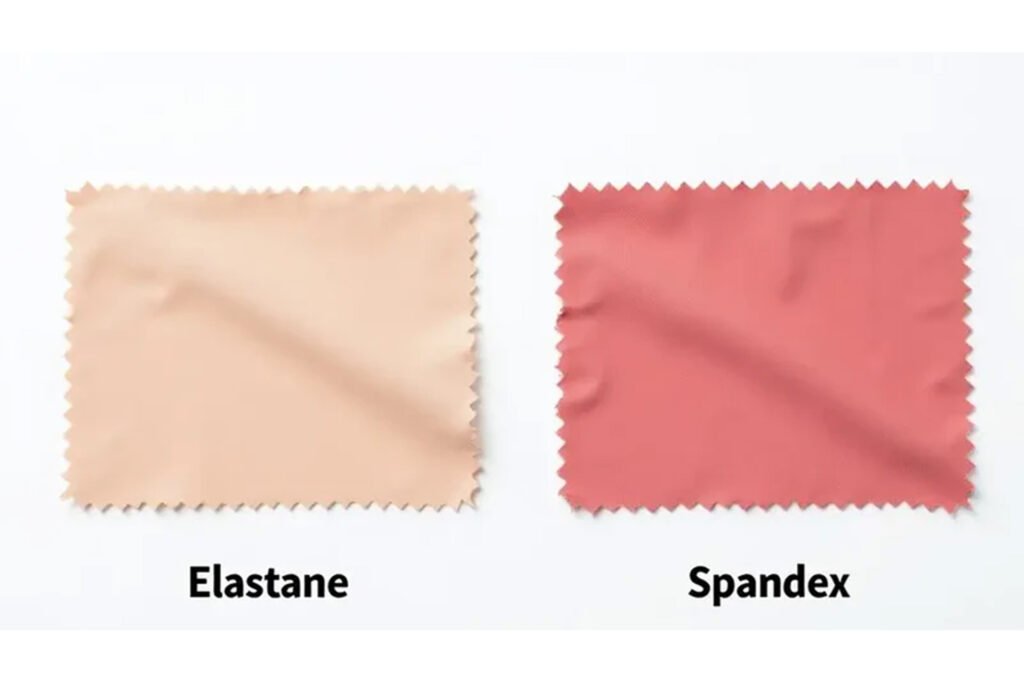
Elastane vs Spandex vs Lycra
Elastane vs Spandex vs Lycra — The Definitive Answer
All three terms refer to the same fiber: a segmented polyurethane fiber with extraordinary elastic properties — capable of stretching 500–800% of its original length and returning to its original dimensions without permanent deformation.
Elastane is the generic fiber name used in Europe, Asia, and international textile trade. It is the standard term in EU textile labeling regulations — garment care labels in European markets must use 'elastane' as the fiber designation.
Spandex is the generic fiber name used in North America — primarily the United States and Canada. 'Spandex' is an anagram of 'expands' and is the term required on care labels in North American markets. When a US or Canadian buyer specifies 'spandex content,' they mean exactly the same fiber as elastane.
Lycra is a registered brand name owned by The LYCRA Company (formerly a DuPont division). Lycra is one manufacturer's branded version of elastane/spandex fiber — similar to how 'Kleenex' is a brand name for facial tissue. Lycra-branded elastane is produced to specific quality standards and commands a price premium over generic elastane fiber. When a buyer specifies 'Lycra,' they are requesting branded elastane — not a different fiber type.
The practical implication for buyers:
- Specifying 'elastane' or 'spandex' in your fabric brief will be understood correctly by suppliers globally
- Specifying 'Lycra' requests branded fiber — confirm with your supplier whether Lycra-branded or generic elastane is being quoted, as the cost difference can be significant
- Care label terminology should match the destination market: 'elastane' for EU, 'spandex' for USA/Canada
How Elastane Works in Fabric — The Production Reality
Pure elastane fiber is never used alone in apparel fabric. It has no structural integrity on its own — a fabric made entirely of elastane would be unwearable. In practice, elastane is always blended with a base fiber at low percentages — typically 2–25% of the total fiber content — to add controlled stretch to the base fabric's construction.
The base fiber provides structure, appearance, weight, and most performance properties. The elastane component provides one specific function: elastic recovery — the ability to stretch and return to original dimensions.
How elastane is incorporated into fabric:
In woven fabrics, elastane yarn is woven into the warp, weft, or both directions alongside the base fiber. This produces stretch in one direction (2-way stretch — weft elastane only) or both directions (4-way stretch — warp and weft elastane). The fabric retains the appearance of a conventional woven textile while gaining elastic performance.
In knit fabrics, elastane filament is incorporated into the knit loop structure. Knit construction already has inherent stretch from the loop geometry — adding elastane significantly increases stretch percentage and improves recovery, preventing the fabric from growing or losing shape after repeated wearing and washing.
2-way vs 4-way stretch — critical specification:
| Stretch Type | Construction | Stretch Direction | Best Applications |
|---|---|---|---|
| 2-way stretch | Elastane in weft only | Width only | Formal trousers, fitted shirts, basic leggings |
| 4-way stretch | Elastane in warp and weft | Width and length | Activewear, swimwear, fitted uniforms, yoga wear |
Always specify stretch direction explicitly — 2-way and 4-way stretch fabrics at the same fiber composition and GSM will perform very differently in production and in wear.
Elastane Percentage — What the Numbers Mean
The percentage of elastane in a fabric blend is the most important stretch specification after stretch direction. Different percentages produce fundamentally different stretch levels and recovery characteristics.
| Elastane % | Stretch Level | Recovery | Typical Applications |
|---|---|---|---|
| 2–3% | Comfort stretch — barely perceptible | Excellent | Formal trousers, dress shirts, tailored uniforms |
| 4–5% | Moderate stretch — noticeable ease of movement | Excellent | Fitted casual trousers, stretch chinos, fitted uniforms |
| 5–8% | Significant stretch | Very good | Casualwear, polo shirts, fitted dresses |
| 8–15% | High stretch | Good | Light activewear, fitted sportswear, dance wear |
| 15–25% | Very high stretch | Good | Yoga wear, leggings, compression base layers |
| 20–30% | Maximum stretch | Moderate | Swimwear, competitive sportswear, compression garments |
Key principle: More elastane is not always better. Higher elastane percentages increase fabric cost, can create production difficulties in cutting and sewing, and may produce a fabric that feels too elastic for its intended application. Specify the minimum elastane percentage that achieves your required stretch performance.
Base Fiber Options — Nylon, Polyester, and Cotton Elastane
The base fiber blended with elastane determines the fabric's overall performance profile — breathability, hand feel, durability, cost, and application suitability. Elastane percentage alone does not define a stretch fabric's performance.
Nylon + Elastane (Polyamide Elastane)
The premium stretch fabric combination for activewear, swimwear, and performance sportswear. Nylon has the highest abrasion resistance of common apparel fibers, superior stretch recovery compared to polyester, and a softer, more luxurious hand feel. Nylon elastane fabric maintains its shape and surface appearance through intensive use and repeated washing better than polyester elastane at equivalent construction.
Common specifications:
- 90% Nylon / 10% Elastane — standard swimwear and activewear specification
- 80% Nylon / 20% Elastane — higher stretch for competitive swimwear and compression
Best for: swimwear, high-performance activewear, yoga wear, dance wear, premium leggings, and any application where maximum abrasion resistance and superior stretch recovery justify the cost premium over polyester.
GSM range: 80–280 GSM depending on application weight.
Polyester + Elastane
The most widely produced stretch fabric composition globally — offering reliable stretch performance at lower cost than nylon elastane. Polyester elastane has excellent color fastness, UV resistance, and dimensional stability. It is slightly less soft and has lower abrasion resistance than nylon elastane at equivalent construction, but delivers sufficient performance for the majority of activewear, casualwear, and uniform applications at more competitive pricing.
Common specifications:
- 92% Polyester / 8% Elastane — standard activewear and casual stretch specification
- 95% Polyester / 5% Elastane — moderate stretch for fitted casualwear and uniforms
- 87% Polyester / 13% Elastane — higher stretch for performance sportswear
Best for: everyday activewear, sportswear, fitted casualwear, stretch uniforms, leggings, and applications where cost efficiency alongside stretch performance is the primary driver.
GSM range: 80–300 GSM.
Cotton + Elastane
Cotton elastane fabric combines the natural breathability, softness, and moisture absorption of cotton with controlled stretch from the elastane component. Cotton elastane is less dimensionally stable than synthetic elastane blends — it may lose some stretch recovery after repeated washing — but the natural fiber comfort and breathability make it the preferred choice for garments worn directly against skin in non-performance applications.
Common specifications:
- 75% Cotton / 25% Elastane — significant stretch for fitted casualwear and denim-style stretch garments
- 95% Cotton / 5% Elastane — light comfort stretch for casualwear and fitted shirts
Best for: stretch jeans and casual trousers, fitted T-shirts, casual dresses, undergarments, and applications where natural fiber comfort and breathability are prioritized over maximum stretch recovery.
GSM range: 150–400 GSM.
Performance Comparison — Nylon vs Polyester vs Cotton Elastane
| Performance Factor | Nylon Elastane | Polyester Elastane | Cotton Elastane |
|---|---|---|---|
| Stretch recovery | Excellent | Very good | Good — decreases over time |
| Abrasion resistance | Highest | Good | Moderate |
| Breathability | Medium | Low-Medium | High |
| Moisture absorption | Low (~4%) | Very low (~0.4%) | High (~8%) |
| Hand feel | Soft, smooth, premium | Good — varies by construction | Soft, natural |
| Color fastness | Good | Excellent | Good |
| UV resistance | Lower — degrades under UV | Higher — better UV stability | Moderate |
| Chlorine resistance | Good — for swimwear | Moderate | Poor |
| Wash durability | Excellent | Excellent | Good |
| Cost per meter | Highest | Medium | Medium |
| Best application | Swimwear, premium activewear | Everyday activewear, sportswear | Casual stretch, denim, fitted shirts |
GSM Guide for Stretch Fabric
| GSM Range | Fabric Character | Applications |
|---|---|---|
| 80–150 GSM | Lightweight, high stretch, close fitting | Swimwear, competitive sportswear, lightweight base layers |
| 160–220 GSM | Mid-weight, balanced stretch and structure | Standard activewear, leggings, fitted casualwear, yoga wear |
| 230–280 GSM | Substantial, moderate stretch | Fitted uniforms, stretch trousers, structured sportswear |
| 290–400 GSM | Heavy, compression-grade | Compression garments, heavy performance wear, thick leggings |
Production Considerations for Elastane Fabric
Elastane-containing fabrics require specific production handling that differs from non-stretch fabrics. Manufacturers specifying stretch fabric for the first time need to account for these requirements.
Seam construction Standard lock-stitch seams break when stretched beyond the thread's elasticity. All seams in stretch garments must use stretch-capable stitching: overlock (serger) stitch, cover stitch, or zigzag stitch. Flatlock seaming is standard for activewear and swimwear. Test seam stretch performance on a sample before committing to bulk production construction methods.
Pattern grading for stretch Stretch fabric recovers after cutting — cut pieces will be slightly smaller than the pattern dimensions. Build stretch allowance into pattern grading based on the fabric's specific stretch percentage. Higher elastane content requires more stretch allowance compensation in the pattern.
Cutting behavior Elastane-blend fabrics — particularly knit constructions — can curl at cut edges and shift during cutting. Cut on a flat, non-slip surface. Allow fabric to relax flat before cutting — never cut under tension as the fabric will recover and pieces will be smaller than intended. Use rotary cutters for knit elastane fabrics rather than straight blades.
Heat sensitivity Elastane fiber degrades under excessive heat. Pressing temperature must be controlled — high-temperature pressing permanently damages elastane fibers and causes the fabric to lose stretch recovery. Confirm maximum pressing temperature with your supplier before production pressing begins. Steam pressing at moderate temperature is generally safe; direct high-heat contact is not.
Wash durability Quality elastane blend fabrics maintain stretch recovery through 50+ wash cycles. Stretch degradation accelerates with high-temperature washing, bleach, tumble drying on high heat, and chlorine exposure. For swimwear, confirm chlorine resistance performance — nylon elastane has significantly better chlorine resistance than polyester elastane or cotton elastane.
Key Specifications to Confirm When Sourcing Elastane Fabric
| Specification | What to Confirm | Standard |
|---|---|---|
| Base fiber and elastane % | Exact percentages, lab test confirmed | Per agreed spec |
| Fabric construction | Woven or knit, weave/knit type | Per garment application |
| Stretch direction | 2-way or 4-way | Confirmed by sample test |
| Stretch % | Extension at rated stretch | Per application requirement |
| Stretch recovery | % recovery after extension | Minimum 90% |
| GSM | Physical sample weighing | ±5% tolerance |
| Color fastness — washing | Grade rating | Minimum Grade 4 |
| Color fastness — rubbing | Dry and wet | Minimum Grade 3–4 |
| Chlorine resistance | For swimwear applications | Confirm test result |
| Shrinkage | After standard wash | ≤3% |
| Pressing temperature | Maximum safe temperature | Confirm before production |
| Certifications | OEKO-TEX Standard 100 | Per buyer requirement |
| MOQ | Per order type | See below |
| Lead time | Stock vs custom | Stock: 3–5 days / Custom: 7–20 days |
MOQ by Order Type:
| Order Type | MOQ |
|---|---|
| Stock elastane fabric, standard colors | 500 meters per color |
| Custom color or pattern | 1,200 meters per color |
Frequently Asked Questions
Are elastane, spandex, and Lycra the same thing? Yes — all three refer to the same polyurethane-based elastic fiber. Elastane is the generic term used in Europe and Asia; spandex is the generic term in North America. Lycra is a registered brand name owned by The LYCRA Company — it is one manufacturer's branded version of elastane, not a different fiber. When specifying stretch fabric, 'elastane' and 'spandex' are interchangeable; 'Lycra' requests branded fiber at a cost premium.
How much elastane do I need for activewear? For standard activewear and leggings, 8–15% elastane in a knit construction provides sufficient stretch and recovery for most fitness activities. For yoga wear and high-performance sportswear requiring maximum stretch, 15–25% elastane is appropriate. For competitive swimwear, 10–20% elastane in nylon base fabric is standard. More elastane increases cost and production complexity — specify only the percentage needed for your application's stretch requirement.
Is nylon elastane better than polyester elastane? For swimwear and premium activewear, yes — nylon elastane has superior abrasion resistance, better stretch recovery over time, softer hand feel, and significantly better chlorine resistance than polyester elastane. For everyday activewear and cost-sensitive applications, polyester elastane delivers adequate performance at lower cost. The choice depends on your application, performance requirements, and price point.
Does elastane fabric shrink? Elastane itself does not shrink — it is dimensionally stable. Shrinkage in elastane blend fabrics comes from the base fiber component. Cotton elastane fabrics can shrink 3–5% without pre-treatment; polyester and nylon elastane fabrics typically have ≤3% shrinkage. Confirm shrinkage specification on the fabric test report before bulk production.
What is the minimum order for wholesale elastane fabric? Standard MOQ for stock elastane fabric in regular colors is 500 meters per color. Custom color or pattern development requires 1,200 meters minimum. Free swatches and color cards are available — contact our team to request samples before bulk commitment.
Source Wholesale Elastane and Stretch Fabric from XINGYE TEXTILE
XINGYE TEXTILE supplies wholesale elastane fabric across all major base fiber compositions — nylon elastane, polyester elastane, and cotton elastane — in weights from 80 to 400 GSM, serving activewear brands, swimwear manufacturers, sportswear producers, and stretch fabric buyers worldwide. Factory-direct pricing, MOQ from 500 meters for stock colors, free swatches available before bulk commitment.
Contact our sourcing team with your base fiber preference, elastane percentage, stretch direction, GSM, quantity, and destination for a formal quotation within 24 hours.
→ Browse Our Full Fabric Range → Browse Fabric for Activewear → Browse Fabric for Swimwear → Read: Is Spandex Stretchable? → Read: Is Polyester Stretchy? → Request a Free Swatch → Get a Wholesale Quote