Choosing the right waterproof fabric for a bag or backpack is a multi-variable decision — base fiber, denier rating, coating type, waterproof performance level, weight, cost, and certification requirements all affect the final specification. The 'best' waterproof bag fabric does not exist as a universal answer: a 300D nylon TPU laminate is the correct choice for a premium ultralight daypack; a 600D PVC Oxford is the correct choice for a budget rolling luggage shell; a 420D polyester PU Oxford is the correct choice for a mid-market outdoor backpack. This guide maps the full range of waterproof bag fabric options to specific bag categories, price points, and performance requirements — so manufacturers and buyers can identify the right specification for their product without ambiguity.
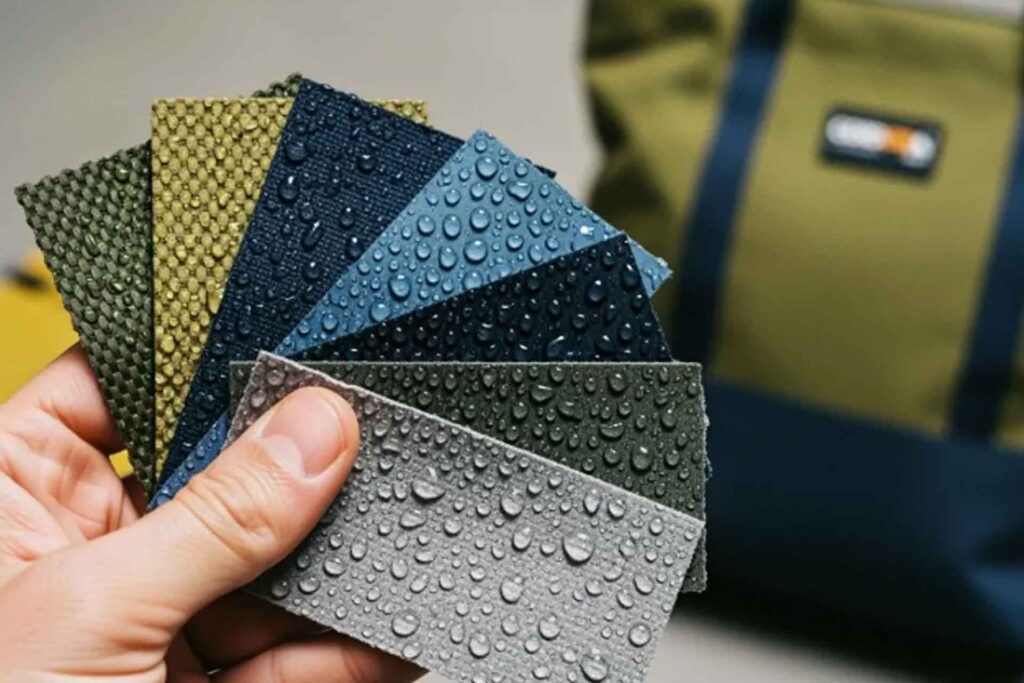
waterproof fabric for bags
The Four Variables That Determine Waterproof Bag Fabric Performance
Every waterproof bag fabric specification is defined by four independent variables. Understanding each variable — and how they interact — is the foundation of accurate bag fabric sourcing.
Variable 1: Base Fiber — Nylon or Polyester
The base fiber determines the fabric's weight, abrasion resistance, hand feel, and cost before any coating is applied.
Nylon base fabric is lighter, softer, and more abrasion-resistant than polyester at the same denier rating. A 420D nylon base weighs 160–180 GSM versus 150–170 GSM for 420D polyester — a modest difference that compounds across a finished bag's multiple panels. More significantly, nylon's superior abrasion resistance means nylon bags maintain their surface appearance longer under daily use than equivalent polyester constructions. The trade-off is cost — nylon base fabric runs 15–30% higher per meter than equivalent polyester.
Polyester base fabric is the dominant choice for commercial bag production globally — it delivers reliable performance at lower cost, accepts color well, and has excellent UV resistance for outdoor applications. For the majority of mid-market and commercial bag production, polyester base fabric is the correct specification.
Variable 2: Denier Rating — Fabric Weight and Durability
Denier determines how thick and heavy the yarns are — higher denier means heavier, denser, more durable fabric.
| Denier | Weight Range | Durability | Cost | Best Bag Application |
|---|---|---|---|---|
| 210D | 75–100 GSM | Light duty | Lowest | Pouches, inner liners, lightweight travel accessories |
| 300D | 110–130 GSM | Light-medium | Low | Lightweight backpacks, promotional bags, simple daypacks |
| 420D | 150–180 GSM | Medium-heavy | Medium | Everyday backpacks, travel bags, outdoor daypacks |
| 600D | 200–250 GSM | Heavy duty | Medium-high | Rolling luggage, hard-use backpacks, tool bags |
| 840D–1000D | 300–400 GSM | Very heavy duty | High | Military bags, heavy tool cases, extreme-duty outdoor gear |
Variable 3: Coating Type — DWR, PU, or TPU
The coating determines waterproof performance level, breathability, weight addition, and cost premium over the base fabric.
- DWR only: water repellent surface treatment, no continuous barrier, lightest weight, lowest cost
- PU coating: continuous waterproof barrier on fabric reverse, 2,000–4,000 mmH₂O, moderate cost
- TPU laminate: highest waterproof performance (5,000–10,000 mmH₂O), RF-weldable for seamless construction, highest cost
Variable 4: Waterproof Construction Method — Coated vs Welded
Standard bag construction uses stitched seams — needle holes through waterproof fabric create potential leak points at every seam line. For bags where seam waterproofing matters, two approaches are used:
- Seam sealing tape: waterproof tape applied over stitched seams on the inside of the bag — practical for most outdoor bag applications
- RF (radio frequency) welding: TPU laminate panels bonded together without stitching — produces fully seamless waterproof construction used in premium dry bags, waterproof laptop bags, and technical outdoor packs
Waterproof Bag Fabric by Category — Full Specification Guide
Everyday Backpacks and School Bags
The highest volume bag category globally. Buyers prioritize durability, color range, and cost efficiency alongside basic water resistance.
Recommended specification: 600D polyester Oxford with PU coating
- Base: 600D 100% polyester
- Coating: PU, single face
- Waterproof rating: 2,000–3,000 mmH₂O
- Weight: 240–280 GSM finished
- Why: 600D polyester PU Oxford is the industry standard for everyday backpacks and school bags — the combination of abrasion resistance, water repellency, color vibrancy, and low cost per meter matches the performance and price requirements of this category precisely
Alternative for premium school bag programs: 600D nylon PU Oxford at 15–20% cost premium for improved abrasion resistance and softer surface texture.
Outdoor and Hiking Backpacks
Outdoor backpacks require higher waterproof performance than everyday bags — sustained rain exposure, abrasion against rock and vegetation, and load-bearing under wet conditions are all real use scenarios.
Recommended specification: 420D nylon PU Oxford or 420D nylon TPU laminate
- Base: 420D 100% nylon
- Coating: PU coating (standard outdoor) or TPU laminate (premium outdoor)
- Waterproof rating: 3,000–5,000 mmH₂O (PU) / 5,000–10,000 mmH₂O (TPU)
- Weight: 200–230 GSM finished (PU) / 210–240 GSM finished (TPU)
- Why: nylon base delivers the abrasion resistance required for outdoor use against rough terrain; higher waterproof rating handles sustained rain exposure; TPU laminate enables seamless construction for premium models
For budget outdoor backpacks: 420D polyester PU Oxford at lower cost — adequate waterproof performance with acceptable durability for light-to-moderate outdoor use.
Travel Bags and Luggage
Rolling luggage and travel duffel bags prioritize abrasion resistance, structural rigidity under load, and reliable waterproof performance through airport handling conditions.
Recommended specification: 600D polyester PVC Oxford or 600D polyester PU Oxford
- Base: 600D 100% polyester
- Coating: PVC (standard/budget) or PU (mid-market)
- Waterproof rating: 5,000–10,000 mmH₂O (PVC) / 2,000–4,000 mmH₂O (PU)
- Weight: 300–450 GSM finished (PVC) / 240–270 GSM finished (PU)
- Why: 600D polyester provides the structural rigidity and abrasion resistance required for luggage shells; PVC coating delivers higher absolute waterproof performance at lower cost than TPU
For premium travel bags: 600D nylon TPU laminate for lighter weight, better hand feel, and RF-weldable seamless construction.
Waterproof Laptop Bags and Tech Accessories
Laptop bags require reliable waterproof performance to protect electronics, with emphasis on clean aesthetic, light weight, and professional appearance alongside water protection.
Recommended specification: 420D nylon TPU laminate
- Base: 420D 100% nylon
- Coating: TPU laminate, RF-weldable
- Waterproof rating: 5,000–10,000 mmH₂O
- Weight: 200–230 GSM finished
- Why: TPU laminate enables RF-welded seamless construction — eliminating seam leak points critical for electronics protection; nylon base delivers lighter weight and better appearance than polyester; professional matte surface finish compatible with laptop bag aesthetic
Dry Bags and Waterproof Stuff Sacks
Dry bags are designed for submersion-level waterproof performance — kayaking, rafting, beach and marine use. Maximum waterproof performance is the primary specification requirement.
Recommended specification: 210D–420D nylon TPU laminate, RF-welded construction
- Base: 210D or 420D 100% nylon
- Coating: TPU laminate, high-grade
- Waterproof rating: 10,000+ mmH₂O
- Construction: fully RF-welded, no stitched seams
- Why: TPU laminate is the only coating type compatible with RF-welded seamless construction required for submersion-level waterproofing; nylon base for minimum weight and maximum abrasion resistance
Promotional and Budget Tote Bags
Promotional bags prioritize low cost per unit and high color vibrancy for branding applications. Basic water repellency rather than full waterproofing is typically sufficient.
Recommended specification: 210D–300D polyester Oxford with DWR or light PU coating
- Base: 210D or 300D 100% polyester
- Coating: DWR surface treatment or light PU coating
- Waterproof rating: 500–2,000 mmH₂O
- Weight: 100–150 GSM finished
- Why: lowest cost per meter at sufficient water repellency for promotional applications; polyester's high color fastness ensures vibrant print results for branded bags
Tool Bags and Workwear Accessories
Tool bags require maximum abrasion resistance and structural durability alongside waterproof protection for tools and equipment.
Recommended specification: 600D–1000D polyester or nylon PVC Oxford
- Base: 600D–1000D polyester (budget) or nylon (premium)
- Coating: PVC double-face coating
- Waterproof rating: 10,000+ mmH₂O
- Weight: 400–600 GSM finished
- Why: PVC double-face coating delivers maximum waterproof performance and abrasion resistance for tool bag applications; heavy denier provides structural rigidity under tool weight
Nylon vs Polyester Base — Decision Summary for Bag Buyers
| Factor | Choose Nylon When... | Choose Polyester When... |
|---|---|---|
| Abrasion resistance | High-wear outdoor, hiking, daily carry | Light-to-moderate use, promotional, school bags |
| Weight | Minimizing finished bag weight is a priority | Weight is not a primary specification |
| Hand feel | Premium soft surface texture required | Standard surface acceptable |
| Cost | Budget allows 15–30% premium over polyester | Cost efficiency is primary driver |
| UV resistance | Short outdoor exposure | Extended outdoor exposure (polyester better) |
| Application | Technical outdoor, premium travel, laptop bags | Everyday backpacks, luggage, promotional bags |
PU vs PVC vs TPU Coating — Decision Summary for Bag Buyers
| Factor | PU Coating | PVC Coating | TPU Laminate |
|---|---|---|---|
| Waterproof rating | 2,000–4,000 mmH₂O | 5,000–20,000 mmH₂O | 5,000–10,000 mmH₂O |
| Weight addition | Moderate — 30–50 GSM | Heavy — 100–300 GSM | Light — 20–40 GSM |
| Flexibility | Good | Stiffens in cold | Excellent — flexible to -30°C |
| RF weldable | No | Yes (heavy PVC) | Yes — seamless construction |
| Environmental | Better than PVC | REACH compliance required | Best — no chlorine/phthalates |
| Cost | Medium | Low-Medium | Highest |
| Best for | Mid-market backpacks, outdoor bags | Luggage, tool bags, budget waterproof | Premium dry bags, laptop bags, technical outdoor |
Waterproof Bag Fabric GSM and Weight Guide
Finished fabric weight (after coating) directly affects the finished bag weight — a critical specification for backpacks and travel bags where total carry weight is a product selling point.
| Fabric Specification | Finished GSM | Bag Panel Weight (per m²) | Best Weight Application |
|---|---|---|---|
| 210D polyester DWR | 100–130 GSM | 100–130g | Ultralight pouches, stuff sacks |
| 300D polyester PU | 150–170 GSM | 150–170g | Lightweight promotional bags |
| 420D polyester PU | 200–230 GSM | 200–230g | Standard everyday backpacks |
| 420D nylon TPU | 210–240 GSM | 210–240g | Premium outdoor daypacks |
| 600D polyester PU | 250–280 GSM | 250–280g | Mid-market backpacks, travel bags |
| 600D polyester PVC | 350–450 GSM | 350–450g | Luggage shells, tool bags |
| 600D nylon TPU | 260–290 GSM | 260–290g | Premium travel bags, laptop bags |
| 840D nylon PU | 360–400 GSM | 360–400g | Heavy-duty outdoor, tactical bags |
Bag manufacturers should calculate total fabric consumption per bag (all panels combined in m²) and multiply by finished fabric GSM to estimate total fabric weight contribution to the finished bag. For backpacks with weight-sensitive buyers, this calculation is essential before confirming fabric specification.
Key Specifications to Confirm When Sourcing Waterproof Bag Fabric
| Specification | What to Confirm | Standard |
|---|---|---|
| Base fiber | Nylon or polyester, confirmed by lab test | Per agreed spec |
| Denier | 210D–1000D | Per application requirement |
| Coating type | DWR, PU, PVC, or TPU laminate | Per performance requirement |
| Finished GSM | Physical sample weighing after coating | ±5% tolerance |
| Waterproof rating | mmH₂O, ISO 811 or AATCC 127 test | Per application minimum |
| RF weldability | Required for seamless dry bag construction | Confirm for TPU laminate |
| Width | Usable width after selvage | 144cm standard |
| Color fastness — washing | Grade rating | Minimum Grade 4 |
| Color fastness — rubbing | Dry and wet | Minimum Grade 3–4 |
| UV resistance | For outdoor bag applications | Minimum Grade 4 |
| REACH compliance | For PVC coating, EU market products | Phthalate-free confirmation |
| Certifications | OEKO-TEX Standard 100 | Per buyer requirement |
| MOQ | Per coating type and order | 500–2,000 meters depending on spec |
| Lead time | Stock vs custom | Stock: 3–7 days / Custom: 20–30 days |
Frequently Asked Questions — Waterproof Bag Fabric
What is the most durable waterproof fabric for backpacks? For everyday backpacks, 600D polyester PU Oxford offers the best balance of durability and cost. For premium outdoor and technical backpacks, 420D–600D nylon with PU coating or TPU laminate provides superior abrasion resistance and longer surface life under demanding use. For extreme-duty applications — military, heavy tool bags — 840D–1000D nylon or polyester with PVC or heavy PU coating is the correct specification.
Is 600D Oxford fabric waterproof? Standard 600D Oxford fabric without coating has minimal waterproof performance — the tight weave resists light moisture but will not withstand sustained rain. 600D PU Oxford — with polyurethane coating applied to the reverse face — is waterproof to 2,000–4,000 mmH₂O and is the industry standard for everyday backpacks and travel bags. Always confirm whether the 600D Oxford you are quoting includes PU coating or is uncoated base fabric.
What is the difference between TPU and PU coating for bags? PU (polyurethane) coating is a liquid compound applied directly to the fabric reverse — a simpler, lower-cost process that produces reliable waterproof performance at 2,000–4,000 mmH₂O. TPU (thermoplastic polyurethane) laminate bonds a pre-formed film to the fabric — a more controlled process that produces higher breathability, better cold-weather flexibility, and RF-weldability for seamless construction. For standard bag production, PU coating is sufficient. For premium dry bags, laptop bags, and technical outdoor packs requiring seamless construction, TPU laminate is the correct specification.
Can waterproof bag fabric be custom printed? Yes. 100% polyester Oxford fabric — with or without PU coating — is compatible with screen printing and digital printing. Confirm print method compatibility with the coating specification before production — some heavy PVC-coated fabrics have limited print adhesion. For premium branded bags requiring vibrant color-accurate printing, 300D–420D polyester PU Oxford is the most widely used printable waterproof bag fabric.
What is the minimum order for wholesale waterproof bag fabric? Standard MOQ for stock waterproof Oxford fabric (polyester or nylon, PU coated) is 500 meters per color. Custom coating specifications and TPU laminate require 1,500–2,000 meters minimum. Special constructions start from 3,000 meters. Free swatches available before bulk commitment — contact our team to confirm availability for your specific denier and coating requirement.
Source Wholesale Waterproof Bag Fabric from XINGYE TEXTILE
XINGYE TEXTILE supplies wholesale waterproof fabric for bags and backpacks — polyester and nylon base, 210D to 1000D, with DWR, PU coating, PVC coating, and TPU laminate options — direct from our production facility in China. We serve bag manufacturers, luggage brands, outdoor equipment producers, and promotional product buyers worldwide with factory-direct pricing, flexible MOQ, and full technical documentation.
Free swatches and SGS test reports available before bulk commitment. Contact our sourcing team with your bag category, denier requirement, coating type, waterproof rating, quantity, and destination for a formal quotation within 24 hours.
→ Browse Fabric for Bags → Browse Oxford Fabric → Read: TPU vs PVC Waterproof Fabric → Read: Nylon vs Polyester in Waterproof Laminates → Read: Waterproof Fabric Technical Specs Explained → Request a Free Swatch → Get a Wholesale Quote