Poly-Cotton vs Pure Cotton — The Comparison Every Uniform Buyer Needs to Read
If you're sourcing fabric for uniforms, workwear, shirts, or any garment that will be washed more than a few times, you will eventually face this choice: TC fabric or 100% cotton.
TC fabric (polyester-cotton blend, typically 65% polyester / 35% cotton) and 100% cotton look similar at a glance. Both are breathable. Both can be woven into the same weaves. Both are used for shirts, trousers, and uniforms. But they perform very differently over time — and the difference gets bigger with every wash cycle.
Cotton is natural, familiar, and comfortable. TC is engineered, durable, and practical. The right choice depends on what you're making, who will wear it, how it will be washed, and what your budget per wear looks like.
This comparison covers everything: hand feel, breathability, durability, shrinkage, wrinkle resistance, cost, care, and which application each fabric suits best.
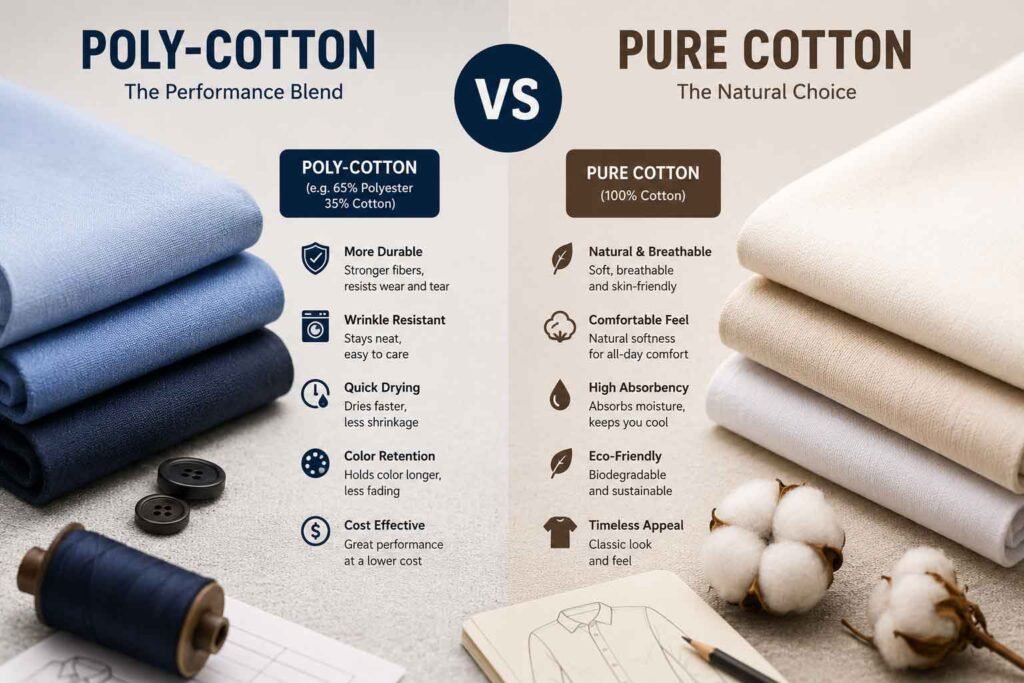
Poly-Cotton vs Pure Cotton
What Is TC Fabric?
TC stands for Terylene-Cotton — a blend of polyester and cotton. The 'T' comes from Terylene, the original UK brand name for polyester, which is still used as the generic term for polyester in many markets. The standard blend is 65% polyester / 35% cotton.
| Component | Share | What It Contributes |
|---|---|---|
| Polyester | 65% | Strength, wrinkle resistance, durability, color retention, quick drying |
| Cotton | 35% | Breathability, moisture absorption, comfort against the skin |
The 65/35 ratio is the industry standard because it hits the optimal balance: enough polyester to make the fabric durable and wrinkle-resistant, enough cotton to keep it breathable and comfortable.
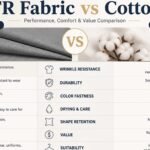
Quick Comparison Table
| Factor | TC (65/35 Poly-Cotton) | 100% Cotton |
|---|---|---|
| Hand feel | Crisp, smooth, consistent | Soft, natural, familiar |
| Breathability | Good — cotton content provides airflow | Excellent — naturally breathable |
| Wrinkle resistance | Excellent — polyester content prevents wrinkles | Poor — wrinkles within hours |
| Durability (industrial wash) | 60-80+ cycles | 20-30 cycles |
| Shrinkage | 2-4% (pre-shrunk) | 3-8% (even pre-shrunk) |
| Color fastness | Excellent — polyester holds dye | Good — fades in hot wash |
| Moisture absorption | Good — cotton absorbs, poly repels | Excellent — absorbs up to 25x own weight |
| Pilling resistance | Good — 4.0+ with anti-pill treatment | Moderate |
| Drying speed | Fast | Slow |
| Cost | $$ (mid-range) | $$ (varies widely by quality) |
| Care | Easy — machine wash, low iron | Moderate — ironing required |
| Applications | Uniforms, workwear, school wear, shirts | Casual shirts, home textiles, underwear |
Detailed Comparison
1. Hand Feel
100% cotton feels like cotton. Soft, natural, slightly irregular texture from the natural fibers. High-quality long-staple cotton (Egyptian, Supima) is exceptionally smooth. Standard cotton is comfortable and familiar.
TC fabric feels crisper and smoother. The polyester content gives it a cleaner, more uniform surface. It feels like a quality shirt fabric — not as soft as premium cotton, but smoother and more consistent. After a few washes, TC actually softens while still holding its structure.
| Scenario | Cotton | TC |
|---|---|---|
| First wear | Very soft | Crisp, structured |
| After 20 washes | Soft, slightly worn | Softened, still structured |
| After 50 washes | Thinned, fuzzy | Still smooth, minimal change |
Winner: Cotton for pure softness. TC for structure and consistency.
2. Breathability
This is cotton's natural advantage. Cotton fibers are hollow and allow air to pass through freely, and they absorb moisture (sweat) efficiently. A 100% cotton shirt keeps you cool in warm weather.
TC fabric is less breathable than pure cotton because the polyester component (65%) does not absorb moisture. The 35% cotton content provides meaningful breathability, but not cotton's full performance.
| Condition | Cotton | TC |
|---|---|---|
| Hot, humid weather | Excellent — breathes, absorbs sweat | Good — wearable, but warmer than cotton |
| Air-conditioned environment | Good — comfortable | Excellent — breathable enough, plus wrinkle-free |
| High physical activity | Good — absorbs sweat | Fair — polyester content retains less moisture |
| Summer uniforms | Cotton preferred | TC lightweight (poplin) is workable |
Winner: Cotton for hot weather and high activity. TC for moderate and AC environments.
3. Wrinkle Resistance
This is where TC dominates cotton — and it's the reason most uniform programs choose TC.
Cotton wrinkles. It's a property of the natural cellulose fiber. A cotton shirt worn for 8 hours looks noticeably wrinkled by the end of the day. Industrial laundry makes cotton wrinkle even more.
TC resists wrinkles because the polyester component has elastic memory. When the fabric bends, the polyester fibers return to position. A TC shirt can be worn all day, hung overnight, and worn again without ironing.
| Scenario | Cotton | TC |
|---|---|---|
| After 8 hours wear | Visible wrinkling — needs ironing | Minimal creasing — hang and wear |
| After industrial laundry | Heavily wrinkled — needs pressing | Wrinkle-free — ready to wear |
| After packing | Wrinkled — needs steam or iron | Few wrinkles — release when hung |
Winner: TC — by a wide margin.
4. Durability and Wash Life
For uniform buyers, this is the most important number.
Cotton fibers break down under industrial laundry — 75°C heat, aggressive detergents, mechanical agitation. A cotton shirt needs replacement after 20-30 wash cycles. Collar and cuffs fray, fabric thins at stress points, color fades.
TC survives 60-80+ industrial wash cycles. The polyester content resists heat, chemicals, and mechanical stress. The cotton content provides comfort. TC uniforms last 2-3x longer than cotton equivalents.
| Property | Cotton | TC |
|---|---|---|
| Color fade (20 industrial washes) | Visible — Delta E 4-6 | Minimal — Delta E 1-3 |
| Shrinkage (5 washes) | 3-8% | 2-4% |
| Seam fraying | Starts 10-15 washes | Starts 30-40 washes |
| Collar delamination | 10-15 washes | 30-40 washes |
| Overall life (industrial laundry) | 20-30 cycles | 60-80+ cycles |
Winner: TC — lasts 2-3x longer in industrial laundry.
5. Shrinkage
Cotton shrinks. It's not a defect — it's a property of natural cellulose fibers. Even sanforized (pre-shrunk) cotton shrinks 2-4% over multiple washes. Unsanforized cotton can shrink 8-10%.
TC shrinks less because the polyester component provides dimensional stability — polyester does not absorb water and does not swell. Pre-shrunk TC fabric shrinks 2-4% total, mostly in the first wash.
| Fabric | Shrinkage (5 washes, 60°C) | Shrinkage (50 washes, industrial) |
|---|---|---|
| Cotton (pre-shrunk) | 2-4% | 4-8% |
| Cotton (unsanforized) | 5-10% | 8-12% |
| TC (heat-set, pre-shrunk) | 1-2% | 2-4% |
Winner: TC — more dimensionally stable.
6. Moisture Absorption
Cotton absorbs up to 25x its own weight in water. That's excellent for sweat absorption — and terrible for drying time. A sweat-soaked cotton shirt takes hours to dry.
TC absorbs less moisture. The polyester content (65%) repels water. The cotton content (35%) absorbs. TC dries faster than cotton but doesn't absorb sweat as effectively.
| Scenario | Cotton | TC |
|---|---|---|
| Sweat absorption | Excellent — absorbs and holds | Moderate |
| Drying time | 2-4 hours at room temperature | 30-60 minutes |
| Feeling when wet | Heavy, cold, clammy | Lightweight, dries quickly |
| Stain absorbency | High — stains soak in | Lower — with stain-resistant finish, liquids bead |
Winner: Cotton for absorption. TC for quick drying.
7. Cost
Cotton pricing varies wildly with quality. Budget cotton can be cheaper than TC. Premium cotton (Egyptian, Supima) is far more expensive.
TC is mid-range and highly consistent in price. But the real comparison is cost per wear — and TC wins that easily because it lasts 2-3x longer.
| Fabric | Typical Price (per meter, FOB China) | Cost Per Wear (50 washes) |
|---|---|---|
| Budget cotton (40s poplin) | ¥15-20/m | ~¥1.50 (replaced at 30 washes) |
| Standard cotton (60s poplin) | ¥22-30/m | ~¥2.00 |
| TC 65/35 (240 GSM twill) | ¥16-24/m | ~¥0.40 (lasts 60-80 washes) |
| Premium cotton (80s two-ply) | ¥30-45/m | ~¥2.50 |
Winner: TC — significantly lower cost per wear.
When to Choose TC Fabric
| Application | Choose TC | Why |
|---|---|---|
| Uniforms (hotel, restaurant, corporate) | ✓ | Wrinkle-free, lasts 60-80 washes, professional appearance |
| School uniforms | ✓ | Survives rough wear, consistent sizing, industrial laundry durable |
| Work shirts | ✓ | Durable, wrinkle-resistant, low maintenance |
| Hospitality shirts | ✓ | Professional, stain-resistant option available |
| Summer shirts (lightweight TC) | ✓ | 180-220 GSM TC poplin works in warm weather |
| Home laundry garments | ✓ | Easy care — machine wash, no ironing |
When to Choose 100% Cotton
| Application | Choose Cotton | Why |
|---|---|---|
| Premium casual shirts | ✓ | Natural softness, breathability, classic look |
| Hot climate wear | ✓ | Superior breathability and moisture absorption |
| Children's clothing | ✓ | Soft, natural, non-irritating |
| Underwear / base layers | ✓ | Gentle against sensitive skin |
| Home textiles | ✓ | Sheets, towels — cotton absorbs moisture, feels soft |
| Fashion garments | ✓ | Natural drape and authenticity |
Can They Be Used Together?
Yes — many uniform programs use both fabrics in different garments:
| Garment | Recommended Fabric | Why |
|---|---|---|
| Uniform shirt (worn all day) | TC poplin or twill | Wrinkle-free, professional all shift |
| Suit / blazer | TR (poly-viscose) | Better drape than TC for formal wear |
| Summer polo | Cotton or CVC (60/40 cotton-rich) | Breathable, comfortable in heat |
| Work trousers | TC twill | Holds crease, durable, wrinkle-free |
| T-shirts | 100% cotton | Soft, comfortable, absorbent |
CVC (Chief Value Cotton) option: If you want cotton's softness with TC's durability, CVC 60/40 (60% cotton, 40% polyester) is a middle ground. More cotton feel, still durable, slightly more expensive than standard TC.
Quick Decision Guide
| Your Priority | Choose |
|---|---|
| I need wrinkle-free uniforms that look sharp all day | TC |
| I need fabric that breathes in hot weather | Cotton |
| I need uniforms to survive industrial laundry | TC |
| I need natural fiber, no synthetics | Cotton |
| I need consistent sizing after repeated washing | TC |
| I need the lowest cost per wear | TC |
| I need softness against the skin | Cotton |
| I'm making premium fashion shirts | Cotton |
| I'm making school or work uniforms | TC |
| I'm making casual tees | Cotton |
Get a Quote — TC Fabric and 100% Cotton
XINGYE TEXTILE manufactures both TC fabric (65/35 polyester-cotton) and 100% cotton fabric in a range of weights, weaves, and finishes. TC in twill, poplin, gabardine, and oxford — 180-350 GSM. Cotton in poplin, twill, sateen, canvas, and jersey — 120-400 GSM. Custom colors, custom finishes, OEKO-TEX and GOTS certified options.
We don't recommend one over the other. We recommend the right fabric for your application. Tell us what you're making, and we'll help you choose.
About the Author
By Andy Tian, Export Sales Manager, XINGYE TEXTILE
Andy Tian has 10 years of experience in textile export at XINGYE TEXTILE, covering fabric sourcing, pricing, sampling, and order execution for uniform fabric buyers worldwide.