Imagine investing in a beautiful fabric only to find that your finished garment shrinks, stretches, or distorts after the first wash. This frustrating scenario is all too common in the textile and apparel industries, where fabric dimensional stability plays a crucial role in ensuring the quality, fit, and longevity of clothing. But what exactly is fabric dimensional stability? Why does it matter, and how can manufacturers and buyers ensure fabrics maintain their original size and shape through wear and care?
In this comprehensive guide, we will explore the concept of fabric dimensional stability, delve into the causes of shrinkage and stretch, discuss testing standards, and highlight effective methods to control these changes. Whether you are a textile professional, fashion designer, or curious consumer, understanding this key fabric property can save you time, money, and disappointment.
What Is Fabric Dimensional Stability
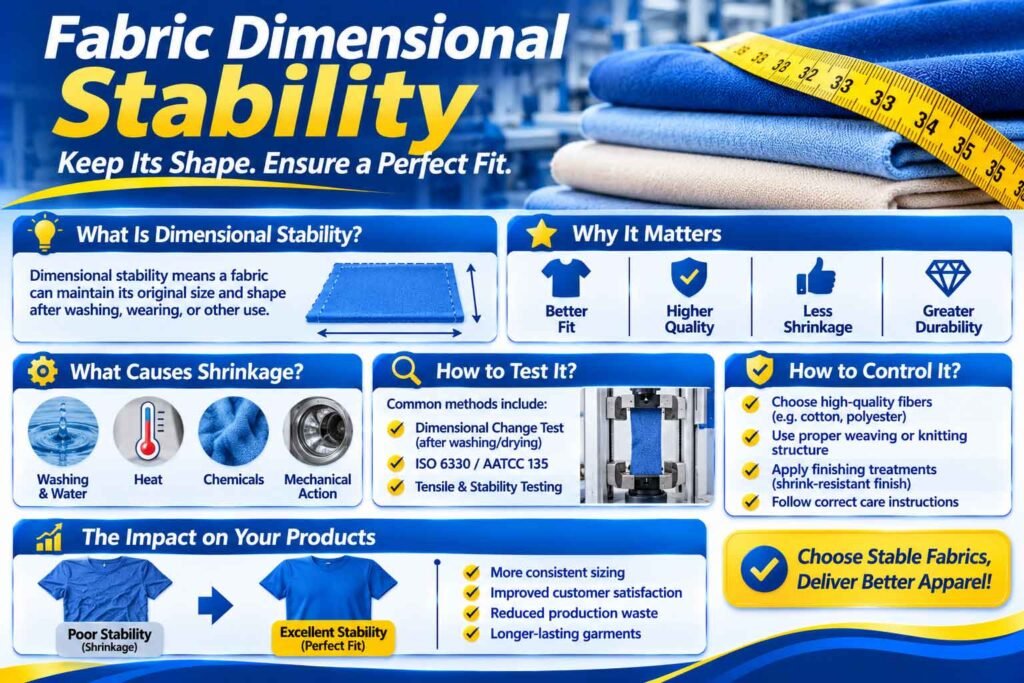
What Is Fabric Dimensional Stability?
Fabric dimensional stability refers to a fabric's ability to retain its original dimensions — length, width, and overall shape — after being subjected to various stresses such as washing, drying, steaming, or environmental changes like humidity and temperature fluctuations.
In simpler terms, it measures how well a fabric resists shrinking, stretching, or distorting during and after use. High dimensional stability means the fabric maintains its size and shape, ensuring garments fit as intended over time.
Why Dimensional Stability Matters
- Garment Fit and Appearance: Poor dimensional stability leads to ill-fitting clothes, puckering seams, distorted hems, and overall unsatisfactory appearance.
- Consumer Satisfaction: Shrinking or stretching garments cause returns, complaints, and loss of brand reputation.
- Manufacturing Efficiency: Unstable fabrics complicate cutting, sewing, and finishing processes, increasing waste and costs.
- Sustainability: Stable fabrics extend garment lifespan, reducing textile waste and environmental impact.
Causes of Dimensional Instability: Shrinkage and Stretch
Dimensional changes in fabrics primarily manifest as shrinkage (reduction in size) or stretch/growth (increase in size or bagging). Understanding the underlying causes helps in selecting and treating fabrics appropriately.
1. Relaxation of Internal Stresses
During spinning, weaving, knitting, dyeing, and finishing, fibers and yarns are subjected to tension and mechanical forces. These create internal stresses that remain 'locked' in the fabric structure.
- When exposed to moisture, heat, or mechanical agitation (e.g., washing), these stresses relax.
- Fibers revert toward their natural, relaxed state, causing the fabric to shrink or stretch.
2. Fiber Composition and Properties
- Natural fibers like cotton, wool, linen, and viscose generally show higher shrinkage due to their hygroscopic nature — they absorb water, swell, and then contract.
- Synthetic fibers such as polyester and nylon are more dimensionally stable because of their crystalline, thermoplastic structures. However, improper heat setting can still cause shrinkage.
- Blended fabrics exhibit intermediate behavior, influenced by the proportion and interaction of fibers.
3. Fabric Construction
- Knitted fabrics have looped structures that are more flexible and prone to dimensional changes, often shrinking more than woven fabrics.
- Woven fabrics with tighter weaves tend to be more stable, while loose weaves shrink or stretch more due to greater yarn mobility.
4. Finishing and Processing
- Mechanical finishing processes like sanforizing (compressive shrinkage) and heat setting stabilize dimensions by relaxing stresses before fabric reaches garment production.
- Chemical treatments such as resin finishes cross-link fibers to reduce shrinkage.
- Poor or inconsistent finishing leads to residual stresses, causing unpredictable dimensional changes.
Types of Dimensional Changes
| Dimensional Change Type | Description | Typical Cause |
|---|---|---|
| Relaxation Shrinkage | Permanent reduction in fabric size due to release of mechanical tension | Spinning/weaving tension, drying under tension |
| Felting Shrinkage | Irreversible shrinkage in wool due to scale interlocking | Moisture, heat, agitation in wool fibers |
| Thermal Shrinkage | Shrinkage caused by heat exposure, especially in synthetics | Incomplete heat setting or overheating |
| Hygral Expansion | Reversible dimensional change due to moisture absorption | Changes in humidity, especially in natural fibers |
| Stretch or Growth | Fabric expansion or bagging after use | Loop relaxation in knits, elastane recovery |
How Is Fabric Dimensional Stability Tested?
Testing fabric dimensional stability is essential for quality control and compliance with industry standards. Commonly used test methods simulate real-world laundering and drying conditions to measure dimensional changes.
Standard Test Methods
- AATCC Test Method 135: Measures dimensional changes after home laundering cycles (washing and tumble drying).
- ISO 6330 & ISO 5077: International standards for domestic washing and drying procedures.
- AATCC Test Method 150: Measures dimensional changes after dry cleaning.
- ASTM D6207: Evaluates stability under humidity and temperature cycling.
Testing Procedure Overview
- Sample Preparation: Cut fabric specimens (usually 380mm x 380mm), mark length and width, and condition under standard atmosphere.
- Initial Measurement: Record precise dimensions before testing.
- Washing and Drying: Launder samples using specified temperature, cycle, and drying methods.
- Reconditioning: Condition samples again to standard atmosphere.
- Final Measurement: Measure dimensions and calculate percentage changes in length and width.
Calculating Dimensional Change
Percentage Change=(Initial DimensionFinal Dimension−Initial Dimension)×100
- Negative values indicate shrinkage.
- Positive values indicate growth/stretch.
Industry Benchmarks and Acceptable Limits
- Woven fabrics: Typically acceptable shrinkage is less than 3-5% after multiple wash cycles.
- Knitted fabrics: Shrinkage up to 8% may be tolerated depending on end-use.
- Premium apparel: Often requires shrinkage below 2-3% for consistent fit.
Manufacturers may reject fabric batches exceeding these limits to avoid production losses and customer dissatisfaction.
Methods to Improve and Control Fabric Dimensional Stability
Mechanical Techniques
- Sanforizing: Compressively shrinks fabric before cutting to minimize post-production shrinkage.
- Heat Setting: Stabilizes synthetic fibers by controlled heating to lock molecular structure.
- Compacting and Relaxation Drying: Used for knits to relax loops and reduce shrinkage.
Chemical and Finishing Treatments
- Resin Finishes: Cross-link cellulose fibers to reduce shrinkage (e.g., DMDHEU-based treatments).
- Anti-felting Treatments: For wool, reduce felting shrinkage through chlorination or enzyme finishes.
- Softening and Enzymatic Finishes: Improve fabric handle and reduce internal stresses.
Best Practices in Production
- Selecting appropriate yarn twist and fabric construction.
- Controlling tension during spinning, weaving, and knitting.
- Consistent and calibrated finishing processes.
- Pre-shrinking fabric before cutting and sewing.
- Conducting rigorous shrinkage testing and grading fabrics accordingly.
Real-World Insights: Lessons from the Industry
- Shrinkage can vary even within the same fabric type due to changes in humidity, yarn tension, dyeing temperature, and finishing quality.
- For example, cotton woven fabrics typically shrink 3-5%, while cotton knits can shrink 5-8%.
- Polyester blends generally show better dimensional stability but require proper heat setting to avoid thermal shrinkage.
- Pre-shrinking fabrics or garments before production significantly reduces returns and improves customer satisfaction.
- Testing labs use advanced equipment such as calibrated washing machines, tumble dryers, and conditioning chambers to ensure reproducible results.
Conclusion
Understanding what is fabric dimensional stability and its critical role in textile manufacturing is essential for producing high-quality garments that retain their fit and appearance after washing and wear. Shrinkage and stretch arise from fiber properties, fabric construction, and processing stresses, but with proper testing and control methods—such as sanforizing, heat setting, and resin finishing—manufacturers can minimize these dimensional changes.
For brands, designers, and buyers, insisting on fabrics with verified dimensional stability saves costs, protects brand reputation, and ensures customer satisfaction. Whether you are sourcing fabrics or managing production, make dimensional stability a top priority in your quality control checklist.
Take Action
- Textile professionals: Implement standardized dimensional stability testing to ensure fabric quality.
- Apparel manufacturers: Choose fabrics with proven stability and apply appropriate finishing techniques.
- Consumers: Always follow garment care labels to maintain fabric dimensions and prolong garment life.
For more insights on fabric properties and textile quality, explore our related articles on fabric handle, shrinkage testing, and garment performance.