The Two Most Common Weaves in Textiles — and the Choice That Shapes Your Fabric
Every woven fabric starts with the same two elements: warp threads (running lengthwise) and weft threads (running crosswise). How those threads cross each other determines the weave — and the weave determines almost everything about how the fabric looks, feels, drapes, and performs.
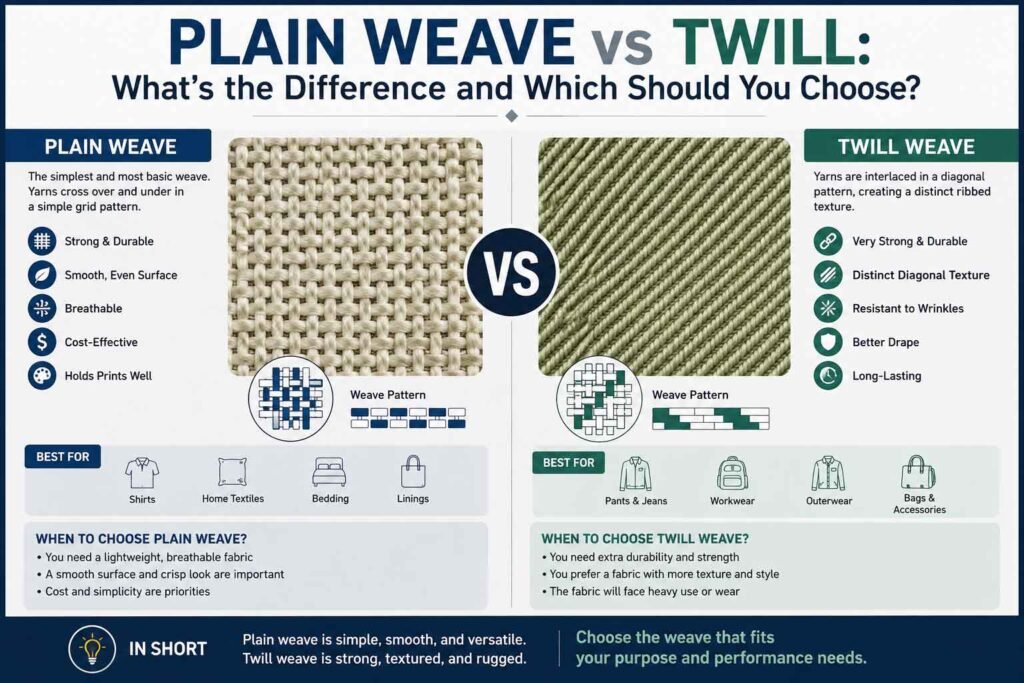
Plain weave and twill weave are the two most common weaves in the world. Together they account for the vast majority of apparel fabrics, home textiles, and uniform fabrics. But they produce very different fabrics:
- Plain weave — the simplest, tightest weave. Crisp, flat, and strong.
- Twill weave — a diagonal, stepped weave. Softer, drapier, and more forgiving.
If you're sourcing fabric for shirts, uniforms, trousers, or suits, this is one of the most important decisions you'll make — after fiber choice. This guide breaks down the differences and helps you choose the right weave for your application.
Plain Weave vs Twill
What Is Plain Weave?
Plain weave is the simplest and oldest weave structure. Each weft thread passes over one warp thread and under the next, alternating with each row. The result is a flat, tightly interlocked fabric with a checkerboard structure.
| Fact | Plain Weave |
|---|---|
| Structure | 1-over, 1-under (each thread alternates) |
| Complexity | Simplest weave — no machinery sophistication needed |
| Surface | Flat, smooth, uniform |
| Pattern | No visible pattern (or subtle checkerboard under magnification) |
| Names you know | Poplin, broadcloth, voile, organdy, canvas, muslin, taffeta |
What Is Twill Weave?
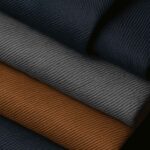
Twill weave passes each weft thread over two or more warp threads and under one, with each row staggered by one thread. This creates the characteristic diagonal rib or step pattern.
| Fact | Twill Weave |
|---|---|
| Structure | 2-over-1 (or 3-over-1), staggered each row |
| Complexity | Slightly more complex than plain weave |
| Surface | Diagonal rib pattern — visible on the face of the fabric |
| Pattern | Characteristic diagonal lines (the 'twill line') |
| Names you know | Denim, gabardine, chino, serge, drill, flannel, herringbone |
The Key Difference: Structure
| Plain Weave | Twill Weave | |
|---|---|---|
| Thread crossover | Every thread crosses every other thread | Weft floats over 2+ warps before going under |
| Interlacement frequency | Maximum — tightest possible weave | Lower — threads have longer floats |
| Thread density | Can be very dense | Typically fewer threads per inch for same weight |
| Diagonal line | None | Visible diagonal (45° typically) |
| Front vs back | Same on both sides | Face shows the diagonal; back is smoother |
Quick Comparison Table
| Property | Plain Weave | Twill Weave | Winner |
|---|---|---|---|
| Strength | ★★★★☆ — strong, tight structure | ★★★★☆ — floats allow more stretch/movement | Tie (different types of strength) |
| Abrasion resistance | ★★★★☆ — tight surface resists wear | ★★★★☆ — floating threads can snag slightly more | Plain (slight edge) |
| Softness / drape | ★★★☆☆ — crisp, stiff, holds shape | ★★★★★ — softer, drapes better, more flexible | Twill |
| Wrinkle resistance | ★★★☆☆ — wrinkles show more | ★★★★☆ — diagonal structure hides wrinkles | Twill |
| Crease retention | ★★★☆☆ | ★★★★★ — holds a sharp crease | Twill |
| Breathability | ★★★★☆ — open structure allows air | ★★★☆☆ — denser surface | Plain (slight edge) |
| Durability | ★★★★☆ | ★★★★★ — less thread-to-thread friction | Twill |
| Surface texture | Flat, smooth, crisp | Diagonal rib, softer, more visual interest | Depends on use |
| Cost to produce | Slightly lower | Slightly higher | Plain |
| Stain visibility | Shows stains evenly | Diagonal lines can mask stains | Twill |
| Pilling | ★★★☆☆ — tight structure resists pilling | ★★★☆☆ — similar | Tie |
Detailed Comparison
1. Strength and Durability
Both weaves are strong, but they handle stress differently.
Plain weave is the tightest interlacement — every thread is locked by its neighbor. This makes it dimensionally stable and resistant to distortion. It's why plain weave is used for high-stress applications like filter fabric and industrial textiles.
Twill weave has floating threads that move slightly under stress, which gives it a different kind of durability — it resists tearing and snagging better in some applications. The longer floats distribute stress more evenly, which is why twill fabrics (like denim) are famous for toughness.
| Test | Plain | Twill |
|---|---|---|
| Tear strength | Good | Better — floats distribute stress |
| Abrasion (surface) | Better — tight surface | Good — floats can snag |
| Dimensional stability | Better — locks threads | Good |
Winner: Twill for tear strength. Plain for dimensional stability.
2. Softness and Drape
This is the biggest practical difference.
Plain weave is crisp and flat. It holds its shape, feels slightly stiff, and shows wrinkles. This is why poplin (plain weave) shirts have a sharp, formal look.
Twill weave is softer and drapier. The floating threads allow the fabric to flex and follow the body. It feels more supple against the skin and falls with a natural drape. Denim, gabardine, and chino are all twill — and they all feel softer than plain weave equivalents.
| Application | Plain | Twill |
|---|---|---|
| Shirt (dress) | Crisp, formal | Softer, casual |
| Trousers | Stiff, holds shape | Drapes, comfortable |
| Jacket | Structured | Soft, flexible |
| Upholstery | Firm | Supple |
Winner: Twill for softness and drape. Plain for structure and crispness.
3. Wrinkle Resistance
Twill hides wrinkles better because the diagonal structure breaks up the visual line of a crease. A twill shirt worn for 8 hours looks less wrinkled than a plain weave shirt.
Plain weave shows wrinkles because the flat surface reflects light evenly — any crease or wrinkle is clearly visible.
This is one reason uniform trousers are almost always twill (they look pressed longer), while dress shirts are often plain weave poplin (they're ironed daily anyway).
Winner: Twill.
4. Crease Retention
Twill holds a sharp crease exceptionally well. The diagonal structure locks the crease into the weave. This is why gabardine (twill) trousers keep their knife-edge crease through a full day of wear.
Plain weave does not hold creases as well. The crease has no structural 'groove' to settle into.
For uniform trousers, suits, and anything requiring a pressed look — twill is the clear choice.
Winner: Twill.
5. Breathability
Plain weave is generally more breathable because the maximum interlacement creates a structure with more air channels... actually, the opposite is true in practice. Let's look at the real data:
| Weave | Thread density | Breathability |
|---|---|---|
| Plain (poplin) | High thread count | Good — fine threads, open structure |
| Twill (gabardine) | Very high density | Lower — dense, wind-resistant |
The density matters more than the weave structure itself. A lightweight plain weave is more breathable than a heavy twill. At the same weight and fiber, plain weave is slightly more breathable than twill because the threads interlace more frequently, creating tiny air gaps.
Winner: Plain (at equivalent weight and density).
6. Appearance and Aesthetics
Plain weave has a flat, uniform, formal appearance. It reflects light evenly and shows color clearly. Poplin shirts and broadcloth are the standard for formal and business dress.
Twill weave has a distinctive diagonal texture that adds visual depth. The diagonal lines catch light differently, making colors appear richer and more dimensional. Denim's famous look is the twill line.
| Look | Plain | Twill |
|---|---|---|
| Formality | Formal, crisp | Casual to formal (gabardine) |
| Texture | Smooth, flat | Diagonal, textured |
| Color depth | Flat, even | Rich, dimensional |
| Stain hiding | Poor — shows everything | Better — texture breaks up stains |
When to Choose Plain Weave
| Application | Why Plain Weave |
|---|---|
| Dress shirts | Crisp, formal, sharp collar and cuffs |
| Blouses | Smooth, clean surface for prints |
| Summer shirts | More breathable, lighter feel |
| Print base fabric | Flat surface takes prints cleanly |
| Lightweight apparel | Voile, organdy, chiffon-style weaves |
| Technical/industrial fabric | Dimensional stability, filter fabric |
| Lining | Smooth, slippery surface |
| Table linens | Crisp, formal look |
When to Choose Twill Weave
| Application | Why Twill Weave |
|---|---|
| Trousers | Holds crease, durable, comfortable drape |
| Uniforms (trousers, jackets) | Professional look, crease retention, wrinkle resistance |
| Denim | The classic twill — durability and character |
| Suiting | Gabardine twill — structured drape |
| Workwear | Durability, abrasion resistance |
| Chino / khaki pants | Classic twill casual trousers |
| Blazers and jackets | Soft drape, rich texture |
| Outerwear | Wind-resistant, durable |
Quick Decision Guide
| Your Priority | Choose |
|---|---|
| I need a crisp, formal shirt | Plain (poplin) |
| I need trousers that hold a crease | Twill (gabardine) |
| I need maximum breathability | Plain |
| I need softness and drape | Twill |
| I need wrinkle resistance | Twill |
| I need a flat surface for printing | Plain |
| I need durability for workwear | Twill |
| I need dimensional stability | Plain |
| I want a rich, textured look | Twill |
Frequently Asked Questions
Q: Is twill stronger than plain weave? A: They're strong in different ways. Twill has better tear strength (floating threads distribute stress). Plain weave has better dimensional stability and surface abrasion resistance. For most apparel, twill is considered more durable overall.
Q: Is poplin a plain weave? A: Yes — poplin is a plain weave with a fine rib (the weft is heavier than the warp), creating a subtle texture. It's the most common plain weave for shirts.
Q: Is denim a twill? A: Yes — denim is a twill weave, almost always a 3/1 twill (weft passes over 3 warps and under 1). The diagonal line is the signature denim look.
Q: Which weave is more expensive? A: Plain weave is slightly cheaper to produce (simpler loom setup). The price difference is small and usually outweighed by fiber choice and quality.
Q: Which weave is better for uniforms? A: Twill — for trousers, jackets, and blazers (crease retention, drape, durability). Plain weave (poplin) for dress shirts (crisp formality). Most uniform programs use both: poplin shirts + twill trousers.
Q: Can the same fiber be made in both weaves? A: Yes — fiber and weave are independent. A 65/35 poly-cotton can be woven as plain (poplin) or twill. The weave changes the hand feel, drape, and performance even with the same fiber.
By Andy Tian, Export Sales Manager, XINGYE TEXTILE
Andy Tian has 10 years of experience in textile export at XINGYE TEXTILE, covering fabric sourcing, pricing, sampling, and order execution for uniform fabric buyers worldwide.
Get a Quote — Plain Weave and Twill Fabric
XINGYE TEXTILE manufactures both plain weave and twill weave fabric in TR, TC, cotton, polyester, and nylon compositions. Plain: poplin, broadcloth, voile, canvas. Twill: gabardine, drill, chino, herringbone. GSM range 80-400. Custom colors, custom development. OEKO-TEX certified.
We'll help you choose the right weave for your application — tell us what you're making.
Minimum order: 300 meters per color. Sample-first ordering.