If you've ever tried to estimate shipping costs, calculate material for a sewing project, or figure out why one 'cotton fabric' feels so much heavier than another, you've run into the same confusing truth: a yard of cotton doesn't have one fixed weight. It can range anywhere from under 100 grams to well over 500 grams, depending entirely on how the fabric is woven and finished. Here's how to actually calculate it — and why the answer changes so much.
How Much Does a Yard of Cotton Fabric Weigh
Why There's No Single Answer
A 'yard' measures length, not weight. Since fabric weight depends on both the width of the bolt and the density of the weave, two fabrics labeled 'cotton' and sold 'by the yard' can weigh completely different amounts depending on their construction.
This is why the textile industry doesn't rely on 'yard weight' as a real measurement — instead, it uses GSM (grams per square meter) or ounces per square yard (oz/yd²) to describe fabric density. Yard weight is really just GSM or oz/yd² multiplied out once you know the width of the bolt.
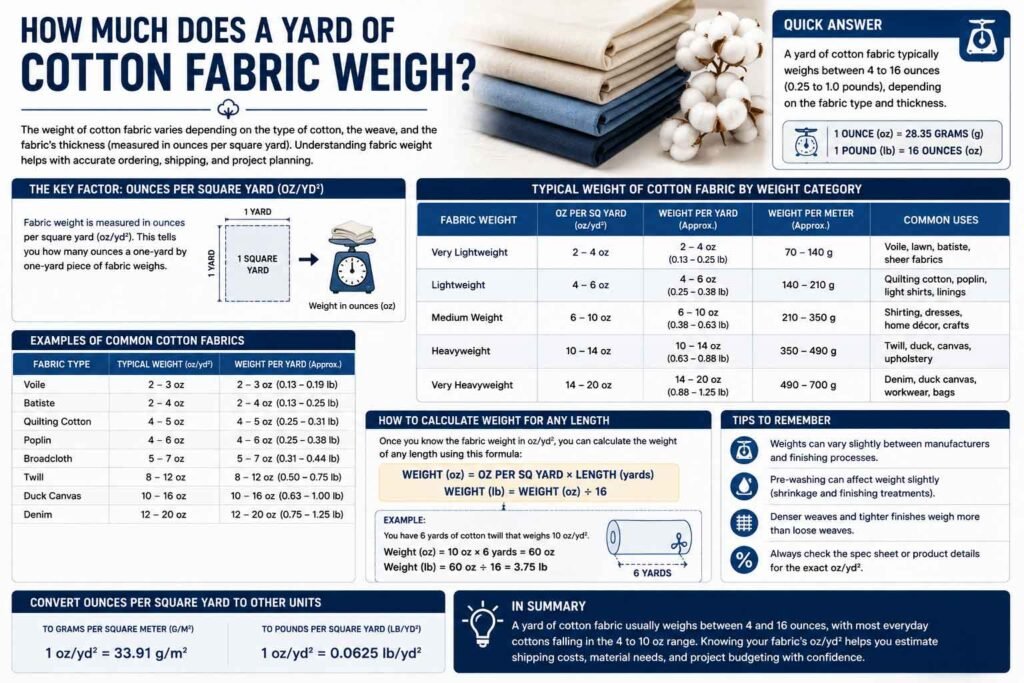
Typical Cotton Fabric Weights by Type
Here's a general breakdown of common cotton fabrics and their approximate weight per yard, assuming a standard 44–45 inch width:
| Fabric Type | Weight (oz/yd²) | Approx. Weight per Yard |
|---|---|---|
| Cotton voile / lawn (lightweight) | 2–3 oz | ~60–85 g |
| Quilting cotton (typical) | 4–5 oz | ~115–140 g |
| Cotton shirting | 3.5–5 oz | ~100–140 g |
| Cotton canvas (mid-weight) | 7–10 oz | ~200–285 g |
| Denim (mid-weight) | 10–14 oz | ~285–400 g |
| Heavy canvas / duck cloth | 12–18 oz | ~340–510 g |
These numbers assume the standard 44–45' width used in most quilting and apparel cotton. Fabric sold at wider widths (like 60' home décor cotton) will weigh more per yard simply because there's more material in each cut, even at the same density.
How to Calculate It Yourself
If you know the fabric's GSM (often listed on fabric specs or supplier tags), you can calculate the weight of a yard using this formula:
Weight per yard = GSM × width (in meters) × 0.9144
Example:
A cotton fabric rated at 150 GSM, sold at 44 inches wide (about 1.12 meters):
150 × 1.12 × 0.9144 = ~153 grams per yard
If you only know oz/yd², the conversion is simpler:
Weight per yard = oz/yd² × width (in yards) × 28.35
What Actually Determines Fabric Weight
1. Thread Count and Weave Density
A tightly woven fabric with more threads per square inch weighs more than a loosely woven one of the same fiber type, even at the same width.
2. Yarn Thickness
Thicker cotton yarns (measured in a system called 'yarn count,' where lower numbers mean thicker yarn) produce heavier fabric than fine, high-count yarns used in lightweight shirting.
3. Finishing Treatments
Some finishes — like brushing for flannel or heavy sizing for canvas — add measurable weight to the finished fabric compared to the raw woven cloth.
4. Fabric Width
Wider bolts naturally contain more fabric per linear yard, so a 60-inch-wide cotton will weigh noticeably more per yard than the same fabric cut at 44 inches, even if the density (GSM) is identical.
Why This Matters in Practice
- Sewing and quilting: Knowing fabric weight helps predict drape, structure, and how a garment or quilt will feel and behave.
- Shipping and freight: Businesses selling fabric by the yard need accurate weight estimates to calculate shipping costs, especially for bulk orders.
- Manufacturing and costing: Apparel manufacturers use GSM to estimate material cost per garment and compare suppliers on a like-for-like basis.
Conclusion
There's no single answer to 'how much does a yard of cotton weigh' because cotton fabric spans an enormous range of weights depending on weave density, yarn thickness, and bolt width. The most reliable approach is to check the fabric's GSM or oz/yd² rating and calculate the actual yard weight using the formulas above — rather than relying on rough averages that may be off by a factor of five or more.