Nylon Was the Fabric That Changed the World — And It's Still One of the Strongest
In 1938, DuPont introduced the world's first fully synthetic fiber. It was called nylon. It was stronger than silk, cheaper to produce, and it launched a revolution that would eventually make synthetic fibers — led by polyester — the most-produced textiles on earth.
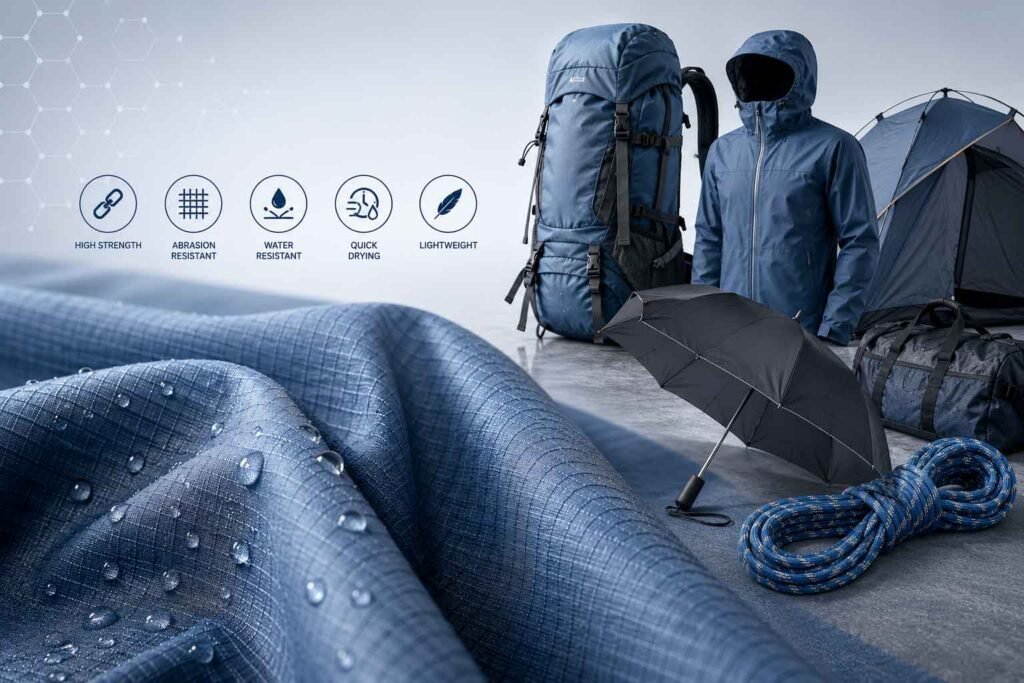
Eighty-plus years later, nylon remains one of the most important technical fibers in existence. It's not the most common fabric in your closet (polyester holds that title), but it IS the fiber inside your umbrella, your backpack, your rain jacket, your car's airbags, your climbing rope, your fishing line, and your parachute. Wherever the requirement is strength, abrasion resistance, or elasticity — nylon is the answer.
This guide covers what nylon fabric is, how it's made, the different types of nylon, its properties and applications, nylon vs polyester, and how to source quality nylon fabric.
What Is Nylon Fabric
What Is Nylon Fabric?
Nylon is a fully synthetic polymer fiber — the first ever created. It's made from petroleum-derived chemicals through a process of polymerization and extrusion. Unlike rayon or modal (which are regenerated from natural cellulose), nylon has no natural component. It's 100% manufactured.
| Fact | Nylon |
|---|---|
| Fiber source | Petroleum-derived polyamide |
| Fiber type | Fully synthetic (polyamide) |
| Invented | 1938 by Wallace Carothers (DuPont, USA) |
| Original use | Replacing silk in women's stockings |
| Chemical family | Polyamides (PA6, PA66 are the most common) |
| Global production | ~7 million tons annually |
| Biodegradability | No — takes decades to decompose |
How Is Nylon Fabric Made?
| Stage | Process | What Happens |
|---|---|---|
| 1. Polymerization | Adipic acid and hexamethylene diamine (for nylon 66) are combined under heat and pressure | Forms long-chain polyamide polymer molecules |
| 2. Melting | The polymer is melted into a viscous liquid | |
| 3. Extrusion | The molten polymer is forced through spinnerets (plates with tiny holes) | Forms continuous filaments. The hole size and shape determine the filament thickness and cross-section |
| 4. Cooling and solidifying | The filaments are cooled in air | The liquid filaments solidify into continuous fibers |
| 5. Drawing (stretching) | The filaments are stretched to 4-5x their original length | Aligns the polymer molecules — dramatically increases strength. This is what gives nylon its famous toughness |
| 6. Texturing (optional) | Filaments are crimped, twisted, or air-textured | Adds bulk, softness, or stretch |
| 7. Cutting (for staple) | Filaments are cut into short lengths | Allows blending with cotton, wool, and other fibers |
| 8. Spinning into yarn | Staple fibers are spun into yarn | For woven and knitted fabrics |
The key to nylon's strength — drawing: When nylon filaments are stretched, the long polymer chains align parallel to each other. This molecular alignment creates a fiber that is stronger than steel wire of the same diameter.
Types of Nylon
| Type | Characteristics | Best For |
|---|---|---|
| Nylon 6 (PA6) | Slightly softer, better dyeability, lower melting point (220°C) | Apparel, hosiery, sportswear |
| Nylon 6,6 (PA66) | Stronger, higher melting point (265°C), better abrasion resistance | Technical fabrics, airbags, industrial, military |
| Nylon 6,10 / 6,12 | Low moisture absorption, better dimensional stability | Specialty applications, high-performance gear |
| Nylon filament | Continuous fiber — smooth, strong, slippery | Hosiery, linings, umbrellas, parachutes |
| Nylon staple | Cut short, spun like cotton — softer, more cotton-like | Blended with cotton/wool for comfort fabrics |
| Textured nylon | Crimped or air-textured — bulky, soft, stretchy | Activewear, tights, fleece-like knits |
| High-tenacity nylon | Extra-strength filament for extreme loads | Ropes, webbing, seat belts, parachutes |
| Microfiber nylon | Ultra-fine filaments | Performance apparel, cleaning cloths |
Nylon Fabric Properties
| Property | Rating | Explanation |
|---|---|---|
| Strength | ★★★★★ | Stronger than polyester, cotton, and most natural fibers. High-tenacity nylon exceeds steel wire strength per weight |
| Abrasion resistance | ★★★★★ | The most abrasion-resistant common textile fiber. Nylon outlasts cotton 10:1 and polyester 2:1 in abrasion tests |
| Elasticity | ★★★★★ | Nylon is elastic and recovers shape — a nylon jacket bounces back after being crushed in a bag |
| Water resistance | ★★★★☆ | Nylon absorbs little water and dries fast. Coated nylon is waterproof |
| Wrinkle resistance | ★★★★★ | Does not wrinkle. Hang and wear |
| Quick drying | ★★★★★ | Dries rapidly — nylon activewear is dry in under an hour |
| Lightweight | ★★★★☆ | Strong at low weight — nylon fabrics achieve strength that requires 2x the cotton weight |
| Breathability | ★★☆☆☆ | Poor breathability — nylon does not absorb moisture. Blended or textured constructions improve this |
| UV resistance | ★★☆☆☆ | Nylon degrades in prolonged sunlight. Polyester resists UV better. UV-resistant treatments available |
| Static buildup | ★★☆☆☆ | Nylon generates static, similar to polyester |
| Biodegradability | ★☆☆☆☆ | Non-biodegradable — takes 30-40 years to decompose in landfill |
| Mold / mildew resistance | ★★★★★ | Does not support mold, mildew, or insect damage |
Nylon vs Polyester — The Eternal Comparison
| Factor | Nylon | Polyester |
|---|---|---|
| Strength | ★★★★★ — stronger | ★★★★☆ — strong, but less than nylon |
| Abrasion resistance | ★★★★★ — best in class | ★★★★☆ — good |
| Elasticity | ★★★★★ — recovers shape | ★★★★☆ — good |
| UV resistance | ★★☆☆☆ — poor | ★★★★☆ — good |
| Breathability | ★★☆☆☆ | ★★☆☆☆ |
| Moisture absorption | Slightly more than polyester | Very low |
| Softness | Smooth, can feel slick | Crisper |
| Dyeability | Excellent — vibrant colors | Good |
| Cost | $$ - $$$ (more expensive) | $ - $$ (cheaper) |
| Melting point | 220-265°C | 250-290°C |
| Typical use | Technical gear, hosiery, outerwear | Apparel, uniforms, home textiles |
Simple rule:
- Choose nylon when strength, abrasion resistance, and elasticity matter — backpacks, outerwear, hosiery, sportswear, technical gear
- Choose polyester when UV resistance, cost, and wrinkle resistance matter — uniforms, everyday apparel, outdoor furniture
Nylon vs Cotton
| Factor | Nylon | Cotton |
|---|---|---|
| Strength | ★★★★★ | ★★★☆☆ |
| Abrasion resistance | ★★★★★ | ★★☆☆☆ |
| Breathability | ★★☆☆☆ | ★★★★★ |
| Moisture absorption | Very low | Very high |
| Drying speed | Very fast | Slow |
| Comfort | Less comfortable next to skin | Very comfortable |
| Durability | 5-10x cotton | Baseline |
| Cost | $$ - $$$ | $ - $$$ |
| Biodegradable | No | Yes |
Why nylon-cotton blends are the military standard: 50/50 nylon-cotton ripstop combines nylon's strength and durability with cotton's breathability and comfort. It's why BDU (Battle Dress Uniform) fabric is almost always nylon-cotton.
Common Uses of Nylon Fabric
| Application | Why Nylon | Typical Spec |
|---|---|---|
| Outerwear / rain jackets | Water-resistant, lightweight, abrasion-resistant | 30-70D nylon with PU coating or DWR |
| Backpacks and luggage | Strength, abrasion resistance | 210-1000D nylon |
| Parachutes and kites | Extreme strength at minimal weight | 30-50D high-tenacity nylon |
| Umbrellas | Water-resistant, quick-drying, durable | 190-210D nylon |
| Tactical and military gear | Abrasion resistance, tear resistance | 500-1000D nylon or nylon-cotton ripstop |
| Hosiery and tights | Elasticity, strength, sheerness | 20-70 denier nylon |
| Sportswear / activewear | Stretch, quick-dry, durable | Textured nylon knits |
| Swimwear | Water-resistant, quick-drying, elastic | Nylon-spandex blends (80/20) |
| Sleeping bags | Lightweight, strong, compressible | 20-40D ripstop nylon |
| Tents | Waterproof when coated, strong, lightweight | 40-70D coated nylon |
| Ropes and webbing | High-tenacity strength | 1000D+ |
| Airbags and seatbelts | High-tenacity, controlled stretch | High-tenacity PA66 |
| Upholstery | Abrasion resistance | 500-1000D nylon |
Nylon Blends
| Blend | Ratio | Why | Best For |
|---|---|---|---|
| Nylon-Cotton | 50/50 | Combines strength + breathability. Military standard | BDU uniforms, workwear, outdoor pants |
| Nylon-Spandex | 80/20, 85/15 | Adds stretch and recovery | Swimwear, leggings, compression wear |
| Nylon-Wool | Various | Adds strength to wool's warmth and feel | Socks, hiking gear |
| Nylon-Polyester | Various | Balances cost and performance | Budget outdoor gear |
Nylon Fabric Care
| Care Instruction | Why |
|---|---|
| Machine wash cold or warm (30-40°C) | Hot water can damage nylon's molecular structure over time |
| Gentle cycle | Nylon is strong, but high-spin agitation can cause pilling on textured nylon |
| Mild detergent | No bleach — chlorine damages nylon |
| Tumble dry low or hang dry | High heat can shrink or melt nylon. Nylon dries quickly anyway |
| Iron on low heat with a pressing cloth | Nylon melts at high heat (220°C+). Use synthetic setting |
| Do not use fabric softener | Coats the fibers, reduces performance, can reduce water resistance |
How to Buy Nylon Fabric — What to Specify
| Spec Element | What to Ask |
|---|---|
| Nylon type | Nylon 6 (softer, apparel) or Nylon 6,6 (stronger, technical) |
| Filament or staple | Filament (strong, smooth) or staple (soft, cotton-like) |
| Denier | 20-70D (hosiery/linings), 30-100D (apparel), 200-500D (bags/outerwear), 500-1000D (tactical/heavy) |
| GSM | 80-150 (light), 150-250 (mid), 250-400 (heavy) |
| Weave | Plain, twill, ripstop, oxford |
| Coating / finish | PU coating (waterproof), DWR (water repellent), UV treatment |
| Color | Custom dye or stock colors |
| Certification | OEKO-TEX for chemical safety |
The Environmental Impact of Nylon
| Factor | Nylon |
|---|---|
| Raw material | Petroleum-based — non-renewable |
| Production energy | Moderate to high |
| Water usage | Low compared to cotton |
| Biodegradability | No — decades to decompose |
| Microplastics | Sheds microfibers during washing, same as polyester |
| Recyclability | Yes — nylon can be mechanically and chemically recycled (Econyl® is recycled nylon from fishing nets and carpets) |
| Durability benefit | Lasts 5-10x longer than cotton — fewer replacements, lower per-wear impact |
Recycled nylon (Econyl): Made from reclaimed fishing nets, carpet fluff, and industrial waste. Chemically identical to virgin nylon. Reduces carbon footprint by up to 90% compared to virgin nylon production.
Frequently Asked Questions
Q: Is nylon fabric breathable? A: No — nylon has poor breathability because the fibers do not absorb or transport moisture. For breathable nylon apparel, look for textured nylon, mesh constructions, or nylon blends with cotton or spandex.
Q: Is nylon fabric waterproof? A: Nylon fibers themselves are water-resistant, but the fabric weave allows water through. Coated nylon (PU, PVC, silicone) or laminated nylon is waterproof. Nylon with a DWR finish is water-repellent.
Q: Does nylon shrink? A: Properly heat-set nylon shrinks less than 1-2%. Low-quality nylon or nylon washed in very hot water can shrink more.
Q: Is nylon stronger than polyester? A: Yes. Nylon is approximately 30-50% stronger than polyester of the same denier, with significantly better abrasion resistance.
Q: Is nylon safe to wear? A: Yes — nylon is non-toxic, hypoallergenic for most people, and used in clothing, medical textiles, and food contact applications. OEKO-TEX certified nylon is tested for harmful substances.
Q: What is the difference between nylon 6 and nylon 6,6? A: Nylon 6,6 has a higher melting point (265°C vs 220°C), higher strength, and better abrasion resistance. Nylon 6 is softer, more dyeable, and less expensive. For technical applications, nylon 6,6 is preferred. For apparel, nylon 6 is common.
Q: Does nylon melt? A: Yes — nylon melts at 220-265°C. It should never be ironed on high heat or exposed to open flames. This is why nylon is not used for FR (flame-resistant) workwear.
Get a Quote — Nylon Fabric
XINGYE TEXTILE manufactures nylon and nylon-blend fabric for apparel, outerwear, technical gear, and industrial applications. Available in nylon 6 and nylon 6,6. Filament and staple. Denier range 20-1000D. Plain, twill, ripstop, and oxford weaves. PU-coated and DWR options. Recycled nylon (Econyl-type) available. Custom colors, custom development. OEKO-TEX certified.
Applications: Outerwear, sportswear, tactical gear, bags, tents, hosiery, industrial textiles.
Minimum order: 300 meters per color. Sample-first ordering.