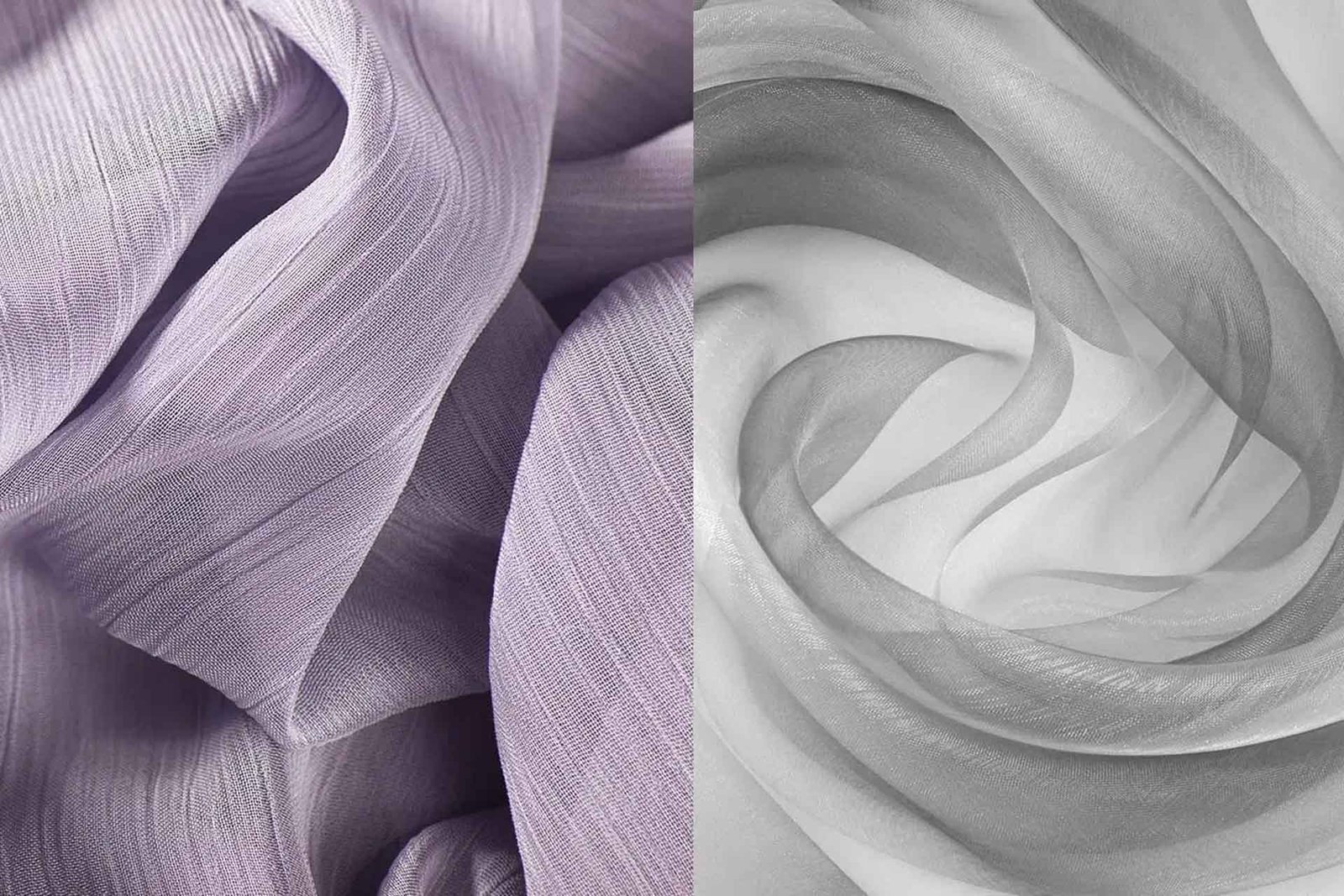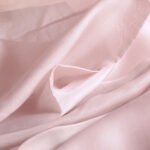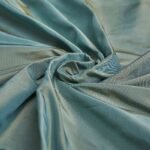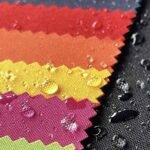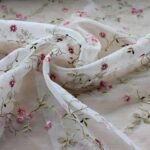
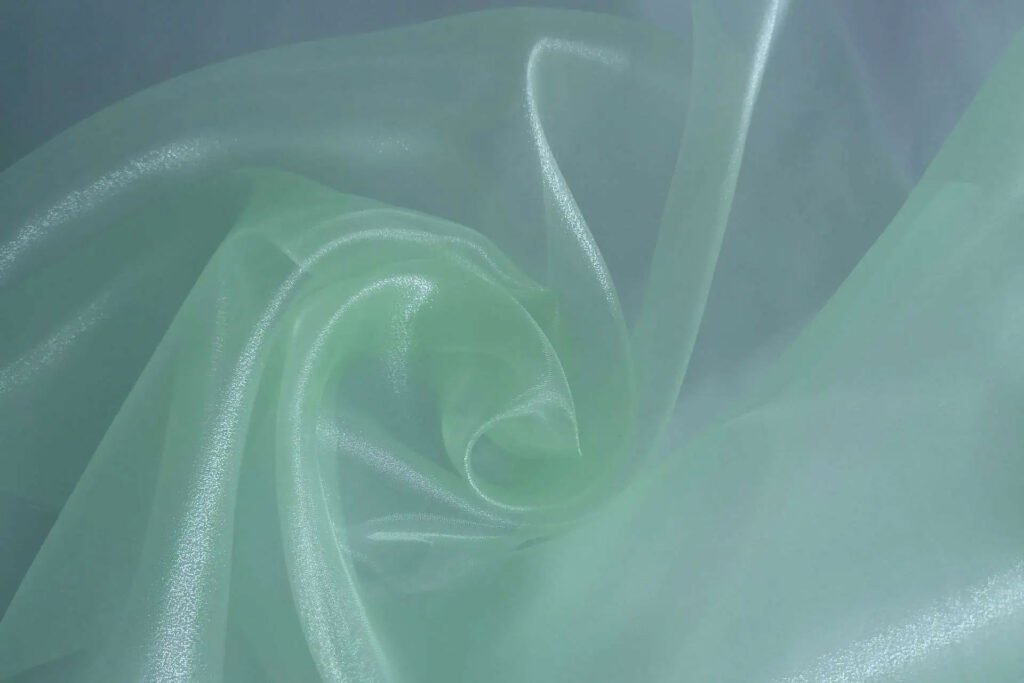
Organza is a sheer, crisp plain weave fabric produced from highly twisted yarn — silk, polyester, or nylon — that holds its shape and creates volume without lining or interfacing. It is the only sheer fabric that combines transparency with structural rigidity: where silk chiffon floats and collapses under gravity, organza stands away from the body and maintains precise silhouette lines. Where tulle creates soft, cloudlike volume, organza creates clean architectural shapes with defined edges. This combination of sheerness and structure makes organza the defining fabric for ball gown skirts, structured bridal overlays, puff sleeves, and any garment design where volume, shape, and transparency must coexist. This guide covers every major organza fabric type, how silk and polyester organza compare, and wholesale sourcing specifications for manufacturers buying at production scale.
What Is Organza Fabric
What Makes Organza Unique — The Construction
Organza is produced from highly twisted yarn woven in a plain weave at high thread count. The high yarn twist is the key — it creates a springy, resilient yarn structure that produces organza's characteristic stiffness when woven at sufficient thread density.
Two construction elements work together to produce organza's defining properties:
High yarn twist. Organza yarn is twisted significantly more than standard weaving yarn — the tight twist creates a yarn with internal spring tension that resists compression and wants to return to its original shape. This springiness is what gives woven organza its stiffness and ability to hold volume.
Dense plain weave. The highly twisted yarn is woven in a balanced plain weave at high thread count — producing a fabric that is simultaneously sheer (light passes through the open structure) and stiff (the twisted yarn resists deformation). Standard plain weave fabric at equivalent thread count would be much softer — it is the high twist of the yarn that creates organza's unique combination of sheerness and rigidity.
Three properties define organza across all fiber compositions:
Structural sheerness. Organza transmits light and is visually transparent — but unlike chiffon or georgette, it does not drape under its own weight. A piece of organza held horizontally maintains its shape; chiffon immediately drapes. This structural sheerness allows organza to create volume and silhouette definition simultaneously — a combination impossible in any other sheer fabric construction.
Crisp, papery hand feel. The high-twist yarn produces a fabric that is firm and resilient against pressure — it springs back when compressed. This crispness is the physical mechanism behind organza's ability to hold pleats, maintain structured ruffles, and create precise silhouette lines without internal support.
Characteristic scroop. Silk organza produces a distinctive soft rustling sound — called scroop — when the fabric moves. This is caused by friction between the highly twisted silk filaments and is considered a quality indicator of genuine silk organza. Polyester organza produces a different, less refined sound quality.
Types of Organza Fabric
Silk Organza The premium construction — produced from mulberry silk yarn woven in organza construction. Silk organza has a softer, warmer luster than polyester, produces genuine scroop, and has better drape control in layered construction. Available from lightweight 12mm through standard 16–18mm to heavier 20mm+ constructions in 5A and 6A mulberry silk grade.
GSM range: 52–87 GSM. Best for: luxury bridal gowns, couture evening wear, high-end fashion garments where genuine silk quality is part of the product positioning.
→ Full Guide: Silk Organza Fabric
Polyester Organza The dominant commercial construction globally — polyester yarn woven in organza structure. Polyester organza is significantly less expensive than silk, machine washable, and available in a wider color range including vivid fashion colors that silk organza cannot achieve. The structure, sheerness, and volume-creating properties are equivalent to silk organza — the differences are in hand feel, luster character, and breathability.
GSM range: 45–80 GSM. Best for: commercial bridal, fashion garments, theatrical costumes, home textiles, decorative applications, and any application where the organza aesthetic is required at accessible pricing.
Iridescent Organza (Shot Organza) Produced using warp and weft threads in different colors — the smooth, sheer organza surface amplifies the iridescent color-change effect dramatically. Iridescent organza appears to shift between two colors depending on viewing angle and light direction — one of the most visually spectacular effects available in sheer fabric production. Available in both silk and polyester base constructions.
GSM range: 50–80 GSM. Best for: statement evening wear, fashion garments where color-play is the primary design intent, theatrical costumes, luxury accessories, decorative applications.
→ Full Guide: Iridescent Organza Fabric
Embroidered Organza Organza base fabric with embroidery — typically floral, geometric, or abstract patterns — applied by machine or hand embroidery. The sheer organza ground allows embroidery thread to appear as floating pattern elements when layered over other fabrics. Available in silk and polyester base with various embroidery thread types.
GSM range: 80–150 GSM including embroidery weight. Best for: luxury bridal overlays, occasion wear, high-end fashion garments where embroidery detail alongside structural sheerness is the design requirement.
→ Full Guide: Embroidered Organza Fabric
Nylon Organza Produced from nylon yarn in organza construction — softer hand feel than polyester organza with slightly better drape. Less common than silk or polyester but used in some fashion and intimate apparel applications where a softer organza character is preferred.
GSM range: 45–75 GSM. Best for: fashion garments, intimate apparel overlays, and applications where softer hand feel than polyester alongside organza structure is required.
Silk Organza vs Polyester Organza — Key Differences
| Factor | Silk Organza | Polyester Organza |
|---|---|---|
| Luster | Soft, warm, multi-directional | Brighter, cooler, more uniform |
| Hand feel | Crisp but slightly warmer and natural | Crisp, slightly cooler, more plastic-like |
| Scroop | Yes — characteristic rustling | No — or minimal synthetic sound |
| Breathability | Good — natural fiber | Low — synthetic traps heat |
| Drape in layers | Slightly more fluid | Slightly stiffer per layer |
| Color range | Standard colors — vivid whites and pastels | Full range including deep fashion colors |
| Care | Dry clean or gentle hand wash | Machine washable |
| Static | Low | Higher — generates static |
| Cost | Significantly higher | Much lower |
| Best for | Luxury bridal, couture, premium garments | Commercial bridal, costume, fashion, home textiles |
Burn test for identification: Silk organza: burns slowly, self-extinguishes, crushable ash, hair smell. Polyester organza: melts and burns, hard plastic bead, chemical smell.
Organza vs Chiffon vs Tulle — Choosing the Right Sheer Fabric
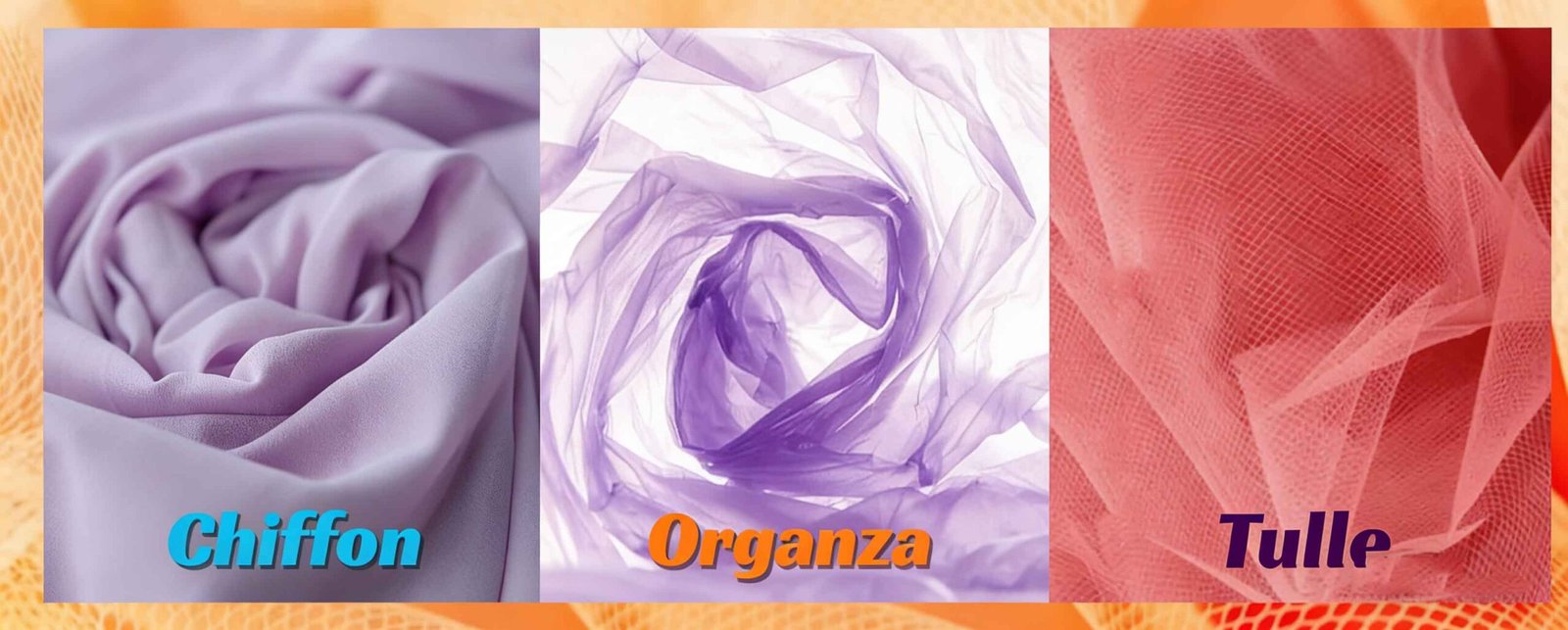
Organza, chiffon, and tulle are the three dominant sheer fabrics in bridal and evening wear production — frequently specified for similar applications but with fundamentally different structural characters.
| Factor | Organza | Chiffon | Tulle |
|---|---|---|---|
| Construction | Plain weave, high twist | Plain weave, high twist, open | Hexagonal net structure |
| Structure | Crisp, stiff — holds shape | Soft, floating — no structure | Soft, mesh-like — minimal structure |
| Volume creation | Through structural rigidity | Through multiple layers floating | Through netting that springs back |
| Edge character | Clean, crisp edges | Soft, flowing edges | Soft, net-like edges |
| Surface texture | Smooth, sheer | Slightly grainy, sheer | Net pattern visible |
| Scroop | Yes (silk) | Slight (silk) | None |
| Layering behavior | Each layer adds stiffness and volume | Each layer adds opacity and floating weight | Each layer adds soft volume |
| Best for | Structured volume, clean silhouette lines | Floating, fluid, transparent layers | Soft, cloudlike volume, tutu silhouettes |
Decision guide:
- Structured ball gown with clean silhouette lines → organza
- Floating, ethereal overlay layers → chiffon
- Soft, full, cloudlike volume → tulle
- Maximum structured volume → multiple organza layers
- Sheer flowing sleeves → chiffon
- Ballet or dance skirts → tulle
→ Full Comparison: Organza vs Chiffon → Full Comparison: Organza vs Tulle vs Chiffon
Organza Applications in Garment and Home Textile Production
Bridal Gowns Organza is one of the most widely specified fabrics in bridal production — used for structured skirt layers, overlay bodices, sleeves, and decorative elements. Multiple layers of organza build volume progressively through the fabric's own structural rigidity, allowing full ball gown silhouettes without heavy crinoline support. Silk organza for luxury bridal; polyester organza for commercial and budget bridal production.
Evening Wear Structured evening wear — puff sleeves, structured bodices, voluminous skirts — specifies organza for its ability to create precise silhouette shapes that soft fabrics cannot maintain. Iridescent organza is increasingly specified for statement evening wear where color-play adds visual drama alongside the organza structure.
Theatrical and Performance Costumes Polyester organza is the standard fabric for theatrical costume production where visual impact, durability through repeated performance, and cost efficiency are the primary requirements. The structural properties of organza create dramatic silhouettes under stage lighting; the polyester composition withstands the handling demands of performance use.
Home Textiles — Curtains and Drapes Polyester organza is widely used for sheer curtains and window treatments — the stiff structure allows curtains to hang in clean, precise folds without requiring elaborate heading construction. The sheer quality allows light to pass through while providing visual privacy. Available in wide widths (280cm) for curtain applications without seaming.
Embroidered Organza Applications Embroidered organza — silk or polyester base with machine or hand embroidery — is used as overlay fabric in luxury bridal gowns, occasion wear, and high-end fashion garments where the combination of embroidery detail and sheer organza ground creates visual depth and complexity.
Key Specifications to Confirm When Sourcing Organza
| Specification | What to Confirm | Standard |
|---|---|---|
| Fiber content | Silk, polyester, or nylon — lab test confirmed | Per agreed spec |
| Silk grade (if silk) | 5A or 6A minimum | Per application requirement |
| GSM | Physical sample weighing | ±5% tolerance |
| Width | 114cm silk / 150cm polyester standard | Confirm before pattern grading |
| Stiffness character | Confirm against physical sample | Varies by momme and finish |
| Color range | Confirm availability for specific colors | Per design requirement |
| Color fastness — washing | Grade rating | Minimum Grade 3–4 |
| Color fastness — light | UV stability for curtain applications | Minimum Grade 4 |
| Certifications | OEKO-TEX Standard 100 | Per buyer requirement |
| MOQ | Per fiber and order type | See below |
| Lead time | Stock vs custom | Stock: 3–5 days / Custom: 7 days |
MOQ by Fiber Type:
| Fiber | Stock MOQ | Custom MOQ |
|---|---|---|
| Silk organza | 50–100m per color | 150–300m per color |
| Polyester organza | 500m per color | 1,200–2,000m per color |
| Iridescent organza | 500m per color | 1,200m+ per color |
| Embroidered organza | 300–500m per pattern | 1,000m+ per pattern |
Frequently Asked Questions — Organza Fabric
Is organza the same as chiffon? No — organza and chiffon are both sheer fabrics but with opposite structural characters. Organza is stiff and crisp — it holds its shape and creates volume through structural rigidity. Chiffon is soft and floating — it drapes under gravity and moves freely. Both are sheer and both are used in bridal and evening wear, but they serve completely different design functions. Organza creates structure and volume; chiffon creates fluidity and floating movement. They are not interchangeable.
What is iridescent organza? Iridescent organza — also called shot organza — is produced using warp and weft threads in two different colors. The smooth, sheer organza surface amplifies the color-change effect: the fabric appears to shift between two colors depending on viewing angle and light direction. The iridescent effect is more dramatic on organza than on heavier fabrics because the sheer structure allows light to interact with both warp and weft colors simultaneously.
Can organza be used for curtains? Yes — polyester organza is widely used for sheer curtains and window treatments. The stiff structure allows organza curtains to hang in clean, precise folds; the sheer quality allows light through while providing visual privacy. For curtain applications, specify polyester organza in 150–280cm width to minimize vertical seaming. UV-resistant finishing is recommended for organza curtains in sun-exposed windows.
What is the difference between silk organza and polyester organza? The structural organza properties — stiffness, sheerness, volume creation — are equivalent in both constructions. The differences are in fiber performance: silk organza has a softer, warmer luster, produces the characteristic scroop sound, is breathable, and requires dry cleaning. Polyester organza has a brighter, cooler luster, is machine washable, available in more vivid colors, and significantly less expensive. For luxury bridal and couture — silk organza. For commercial bridal, fashion, costume, and home textiles — polyester organza.
What is the minimum order for wholesale organza fabric? Silk organza: 50–100 meters per color for stock. Polyester organza: 500 meters per color for stock. Custom dyeing and special constructions require higher MOQ — contact our team to confirm for your specific requirement. Free swatches available before bulk commitment.
Source Wholesale Organza Fabric from XINGYE TEXTILE
XINGYE TEXTILE supplies wholesale organza fabric — silk organza in 5A and 6A mulberry silk, polyester organza, iridescent organza, and embroidered organza — serving bridal manufacturers, evening wear brands, theatrical costume producers, home textile buyers, and wholesale fabric buyers worldwide. Factory-direct pricing, flexible MOQ from 50 meters for silk and 500 meters for polyester, free swatches available before bulk commitment.
→ Browse Our Full Fabric Range → Read: Silk Organza Fabric → Read: Iridescent Organza Fabric → Read: Embroidered Organza Fabric → Read: Organza vs Chiffon → Read: Organza vs Tulle vs Chiffon → Read: Types of Silk Fabric → Request a Free Swatch → Get a Wholesale Quote