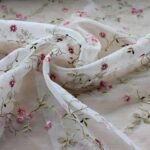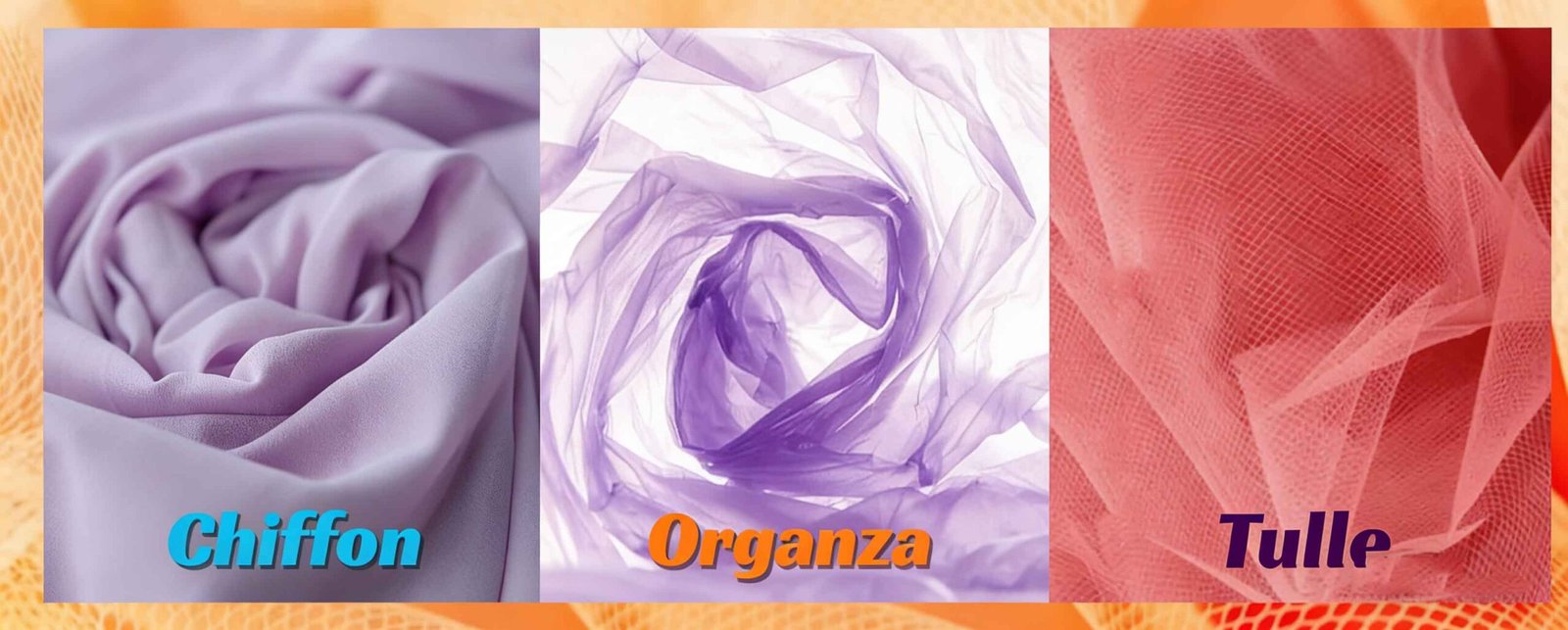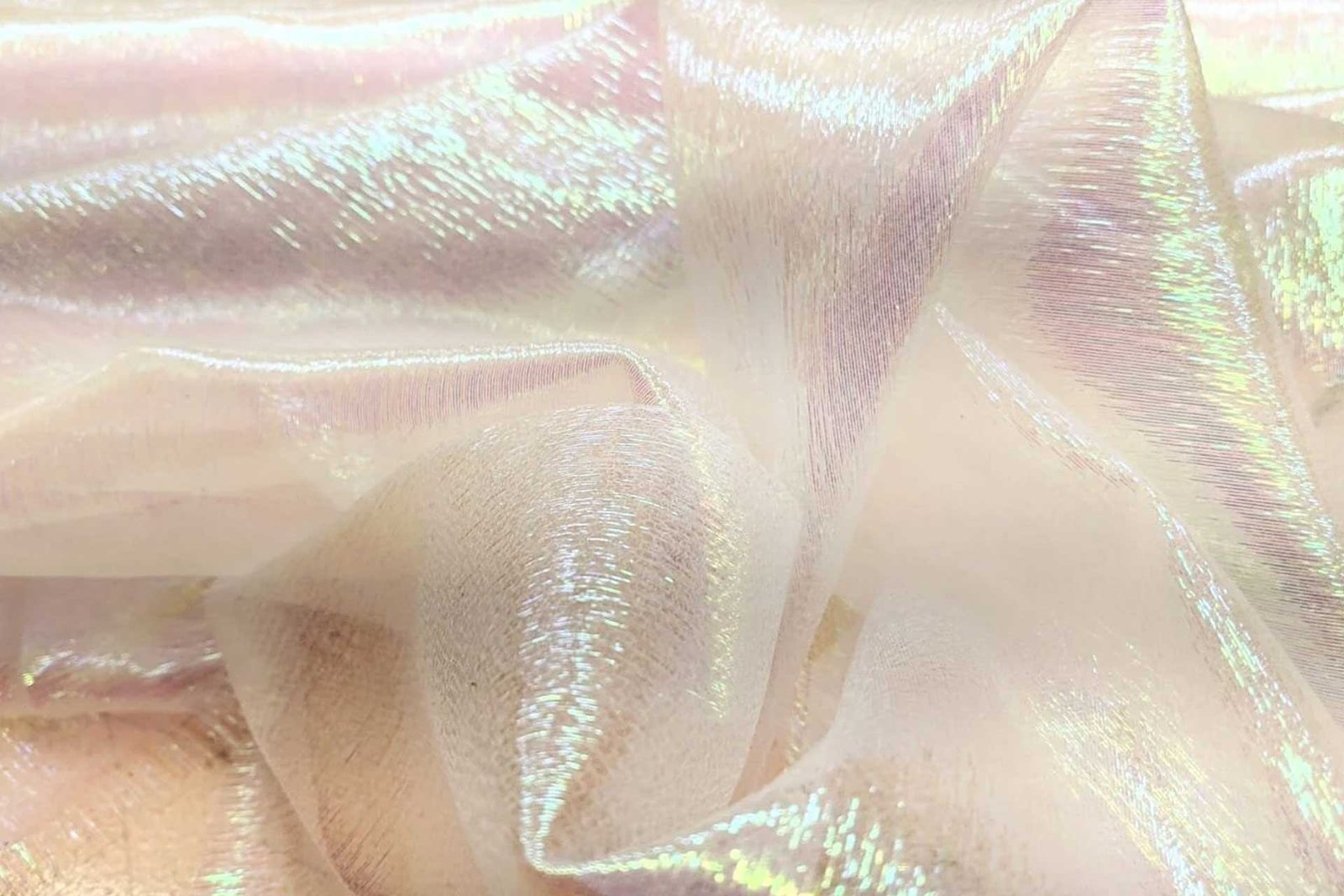
Organza and chiffon are both sheer fabrics — both are lightweight, both are used in bridal and evening wear, and both are available in silk and polyester compositions. But they are not interchangeable, and specifying the wrong one for a garment design is a production mistake that cannot be corrected after cutting. Organza is stiff and structural — it holds its shape, creates volume, and maintains precise silhouette lines. Chiffon is soft and fluid — it drapes under gravity, floats with movement, and creates flowing, ethereal garment effects. The choice between them is determined entirely by what the garment design requires: structure or fluidity, volume or movement, precise edges or soft transitions. This guide provides the complete comparison — construction mechanics, drape behavior, production considerations, and application mapping — so manufacturers and buyers can specify confidently.
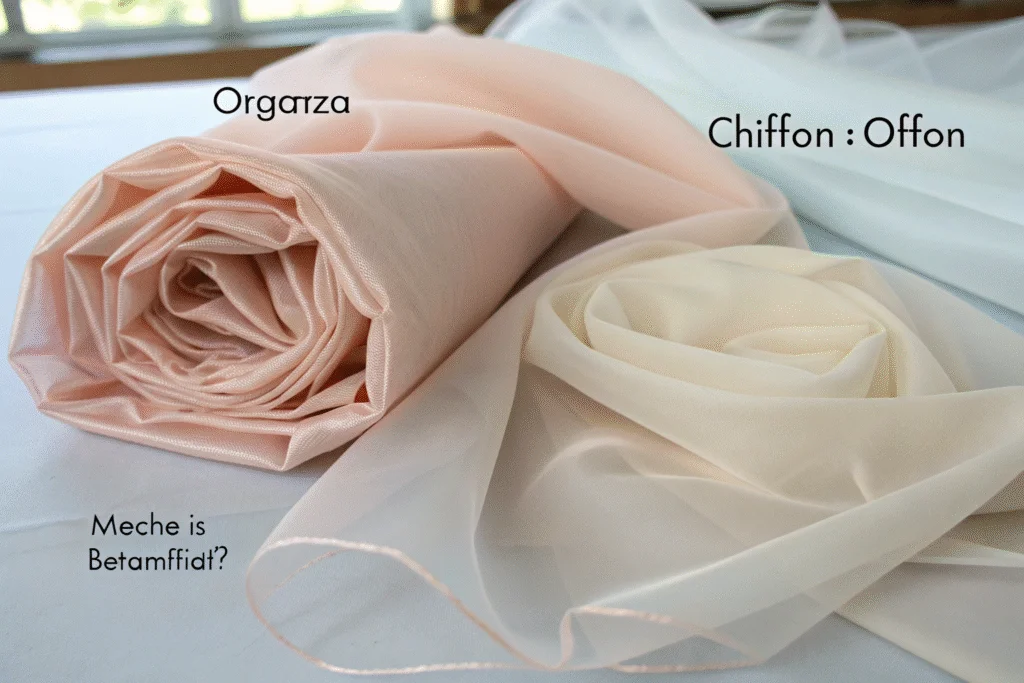
organza vs chiffon
The Fundamental Difference — Structure vs Fluidity
Organza and chiffon are produced from similar yarn — highly twisted filament yarn in plain weave construction — but the differences in twist level, thread count, and fiber weight produce fabrics with opposite structural characters.
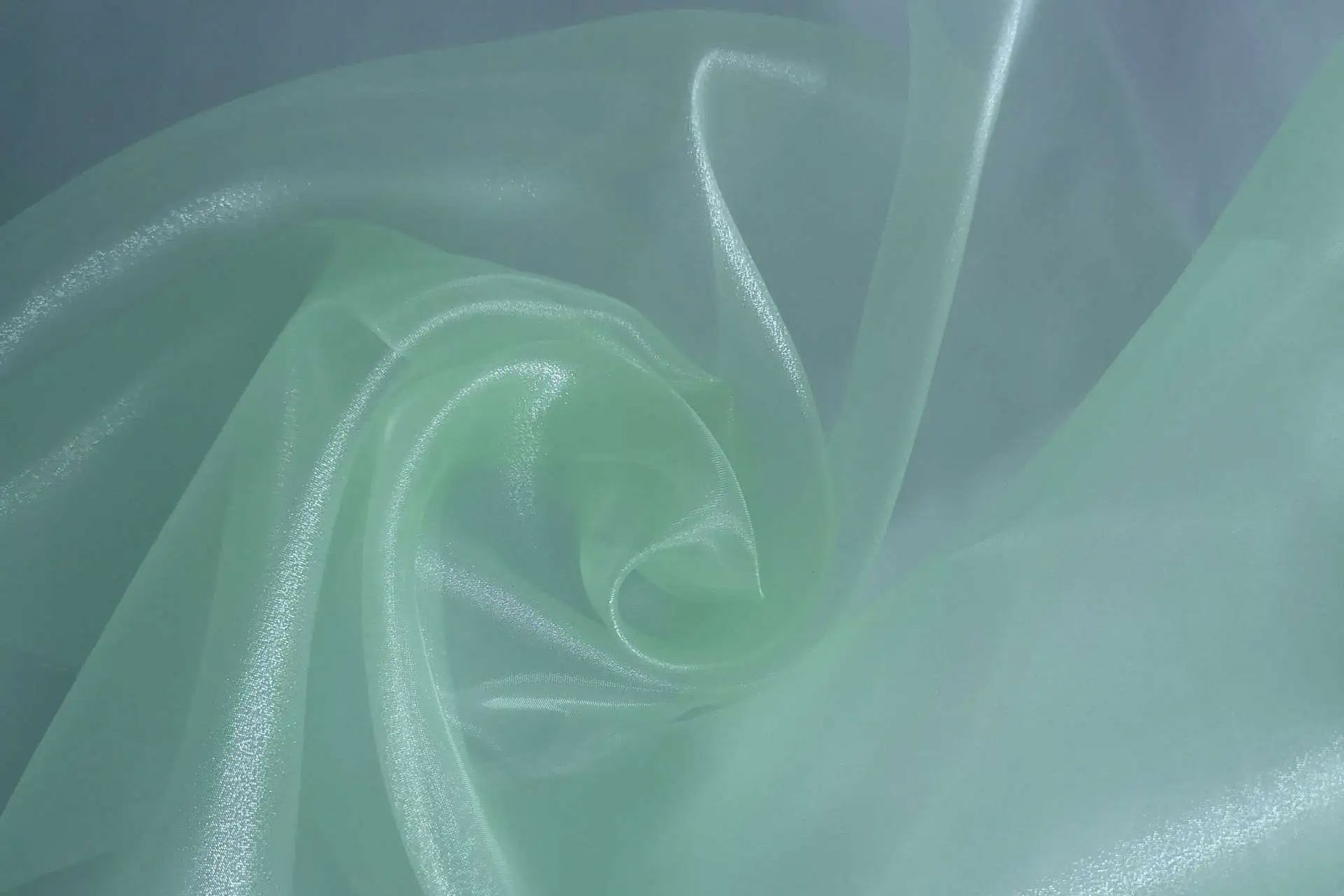
Organza uses high-twist yarn woven at high thread count — the twisted yarn's internal spring tension, combined with dense interlacing, produces a fabric with structural rigidity. Organza resists gravity — hold a piece horizontally and it maintains its position. Press it and it springs back. Fold it and the fold holds a clean edge. This rigidity is what creates organza's ability to stand away from the body, hold precise pleats, and create architectural volume.
Chiffon uses high-twist yarn woven at lower thread count and lighter weight — the twist creates the characteristic slightly grainy, matte surface but the lower thread density and lighter weight allow gravity to act freely on the fabric. Chiffon flows under its own weight, responds to air movement, and drapes in continuous soft curves. Press chiffon and it yields; fold it and the fold disappears. This yielding quality is what creates chiffon's floating, fluid garment effects.
The practical consequence:
- A garment designed for organza that is made in chiffon will collapse — losing all volume and structural lines
- A garment designed for chiffon that is made in organza will stand stiffly away from the body — losing all fluid movement
These are not aesthetic preferences — they are structural requirements. The fabric must match the design intent.
Direct Performance Comparison
| Factor | Organza | Chiffon |
|---|---|---|
| Structure | Crisp, stiff, holds shape | Soft, fluid, drapes freely |
| Drape behavior | Stands away from body | Falls against body with gravity |
| Transparency | Sheer — light passes through | Sheer — light passes through |
| Volume creation | Through structural rigidity — per layer | Through floating layers — cumulative weight |
| Edge character | Clean, precise, holds fold | Soft, flowing, no defined edge |
| Layer behavior | Each layer adds stiffness | Each layer adds soft opacity |
| Scroop (silk) | Pronounced rustling | Slight |
| Hand feel | Crisp, papery | Soft, slightly grainy |
| Weight range | 12–20mm / 52–87 GSM | 6–12mm / 26–52 GSM |
| Breathability | Good (silk) / Low (polyester) | Good (silk) / Low (polyester) |
| Wrinkle behavior | Holds pressed folds cleanly | Wrinkles fall out naturally |
| Production difficulty | Moderate — shifts during cutting | High — slips, shifts, difficult to handle |
When to Specify Organza
Organza is the correct specification when the garment design requires any of the following:
Structural volume that holds its shape Ball gown skirts, puff sleeves, structured ruffles, and architectural silhouettes all require a fabric that creates and maintains volume through its own structural rigidity. Organza creates volume per layer through stiffness — three to five layers of organza over an underlining creates a full, structured skirt that holds its shape throughout extended wearing. Chiffon cannot replicate this — multiple chiffon layers create floating weight but not structural rigidity.
Precise silhouette lines and clean edges Organza holds pressed creases, maintains structured seam lines, and creates clean edges on ruffles, flounces, and decorative elements. When a garment design requires precise architectural lines — a structured bodice, a sharply defined peplum, a precisely pleated overlay — organza is the correct specification. Chiffon's soft edges make precise structural lines impossible.
Overlay with visual transparency and body When a garment layer needs to be visible (sheer) but also structured — providing visual depth over an underlayer while maintaining its own shape — organza is the only sheer fabric that achieves both simultaneously. A single organza overlay over a contrasting underlayer creates a distinct layered effect with the organza holding away from the underlayer; chiffon would collapse against the underlayer.
Specific applications: Bridal ball gown skirts, structured evening wear bodices, architectural puff sleeves, theatrical costume construction, formal accessories requiring shape retention, structured ruffles and cascading layers with clean edges.
When to Specify Chiffon
Chiffon is the correct specification when the garment design requires any of the following:
Floating, fluid movement Garments where the fabric's movement is central to the design — flowing evening gowns, draped formal dresses, floating sleeves — require a fabric that responds freely to body movement and air. Chiffon's light weight and soft drape create the characteristic floating movement that defines the flowing gown aesthetic. Organza's rigidity would prevent this movement entirely.
Layered transparency with gradual opacity Multiple layers of chiffon build opacity progressively while maintaining the floating drape of each layer — two layers are semi-transparent, three to four approach opacity, five or more are essentially opaque while retaining chiffon's movement. This layered transparency is used in evening wear where the opacity of the garment changes subtly with movement and light. Organza layers add stiffness, not gradual opacity.
Soft, flowing overlays When an overlay layer needs to float softly over a base fabric — blending with the underlayer rather than standing away from it — chiffon is the correct specification. Chiffon overlays move with the underlayer, creating a unified flowing surface; organza overlays stand away from the underlayer, creating a distinct visual separation.
Draping and bias construction Draped garment construction and bias-cut designs require a fabric that flows freely and conforms to body contours without resistance. Chiffon's soft drape makes it appropriate for these techniques; organza's stiffness would resist draping and produce an unflattering silhouette in draped designs.
Specific applications: Flowing evening gowns, bridal veils, layered chiffon skirts, draped formal dresses, floating sleeves and cape overlays, scarves, soft ruffles with gentle edges.
Combining Organza and Chiffon in the Same Garment
Many bridal and evening wear designs deliberately combine organza and chiffon to achieve both structural volume and fluid movement within a single garment. Understanding how they work together helps manufacturers specify and produce combination designs correctly.
Common combination approaches:
Organza underlayer with chiffon overlay Organza provides structural volume and silhouette definition in the body of the garment; chiffon overlay floats softly over the top, creating visual depth and fluid surface movement. This combination is used in layered bridal skirts where the structured organza layers create the ball gown silhouette and the chiffon overlay creates a soft, floating surface finish.
Organza bodice with chiffon skirt Structured organza bodice provides precise shaping and volume in the upper garment; flowing chiffon skirt creates fluid movement below. This contrast — structured top, fluid bottom — is a signature formal garment design approach that requires precise fabric specification for each section.
Chiffon overlay on organza underlining Organza underlining provides body and structure; chiffon overlay creates a soft surface and adds floating movement to a garment that would otherwise be too stiff. The organza provides structural support without being visible; the chiffon provides the visual and tactile surface.
Production note for combination garments: When both fabrics are used in the same garment, confirm that seam allowances, pressing temperatures, and handling procedures are compatible with both fabric types. Silk organza and silk chiffon can typically be pressed at the same temperature; mixing silk organza with polyester chiffon requires separate pressing protocols for each section.
Production Comparison — Handling Organza vs Chiffon
| Production Factor | Organza | Chiffon |
|---|---|---|
| Cutting difficulty | Moderate — stiff surface shifts less | High — slips constantly, requires stabilizer |
| Cutting method | Rotary blade, single or low ply | Single ply only, tissue paper stabilizer |
| Sewing speed | Standard — fabric feeds consistently | Reduced — fabric shifts under presser foot |
| Needle size | 9–11 fine | 9–11 fine |
| Presser foot | Standard or roller foot | Roller foot or Teflon foot |
| Seam finishing | French seams, narrow rolled hem | French seams, narrow rolled hem |
| Pressing | Reverse face, max 140°C, minimal steam | Reverse face, max 140°C, minimal steam |
| Needle marks | Permanent — pin in seam allowances only | Permanent — pin in seam allowances only |
| Hemming | Narrow rolled hem or hand-rolled | Narrow rolled hem or hand-rolled |
| Pattern matching | Not required — no pattern | Not required — no pattern |
| Layer behavior in construction | Layers add stiffness | Layers add floating weight |
Key production difference: Chiffon is significantly more difficult to handle in production than organza — its combination of slipperiness, light weight, and tendency to shift under cutting and sewing equipment requires more production time and skill. Organza's stiffness makes it more stable under cutting and sewing, though its smooth surface still requires careful handling to prevent shifting.
Silk vs Polyester — Does It Matter for Organza and Chiffon?
For both organza and chiffon, the choice between silk and polyester affects performance in similar ways — the structural character of each fabric type (organza's stiffness, chiffon's fluidity) is maintained in both fiber compositions, but the fiber properties produce different results in wear and care.
Choose silk for both when: Natural breathability and temperature regulation are functional requirements for the finished garment — silk organza and silk chiffon breathe significantly better than polyester equivalents. Genuine scroop character is part of the product quality. Premium or luxury market positioning requires natural fiber credentials. Dry-cleaning care is acceptable for the end product.
Choose polyester for both when: Cost efficiency is the primary driver. Machine washability is a specification requirement or end-customer expectation. Vivid fashion colors beyond standard silk color range are required. Volume production where consistent batch-to-batch color matching is critical — polyester dyes more consistently than silk across large production runs.
Frequently Asked Questions — Organza vs Chiffon
Can I substitute chiffon for organza in a pattern? Only if the design is fundamentally changed. If the pattern was designed for organza — with structured volume, stiff layers, and precise silhouette lines — substituting chiffon will produce a garment that collapses and loses all volume and structural character. If the pattern has floating, draped elements that do not rely on fabric stiffness, a softer fabric substitution may work. In general, organza and chiffon are not interchangeable — the fabric is a structural component of the garment design, not a decorative choice.
Which is harder to sew — organza or chiffon? Chiffon is generally harder to sew than organza. Chiffon's combination of slipperiness, light weight, and tendency to shift under the presser foot makes it one of the most technically demanding common fabrics in garment production. Organza's stiffness makes it more stable under the needle — it feeds more consistently and shifts less during sewing. Both require fine needles, slow sewing speed, and careful seam finishing, but chiffon requires more production skill and time to handle accurately.
How many layers of organza do I need for a ball gown skirt? Three to five layers of standard 14–16mm organza creates a full, structured ball gown silhouette. Each additional layer increases both volume and stiffness. For maximum volume in theatrical or competition gowns, five to eight layers may be used. The weight of multiple organza layers should be factored into garment construction — a full five-layer organza skirt is substantially heavier than equivalent chiffon construction and may require reinforced waistband attachment.
Is polyester organza as good as silk organza for bridal? For commercial bridal production where cost efficiency is the primary driver — polyester organza delivers equivalent structural volume and visual sheerness to silk organza at significantly lower cost. The differences — hand feel, luster character, breathability, scroop — matter primarily in luxury bridal where the genuine silk quality is part of the product's value proposition and price positioning. For mid-market and commercial bridal, polyester organza is the standard practical specification.
What is the minimum order for wholesale organza and chiffon? Silk organza and silk chiffon: 50–100 meters per color for stock. Polyester organza and polyester chiffon: 500 meters per color for stock. Custom dyeing for both: 150–300 meters (silk) or 1,200–2,000 meters (polyester) per color. Free swatches available before bulk commitment.
Source Wholesale Organza and Chiffon from XINGYE TEXTILE
XINGYE TEXTILE supplies wholesale organza and chiffon fabric — silk and polyester constructions across the full range of weights, colors, and specialty types including iridescent and embroidered — serving bridal manufacturers, evening wear brands, theatrical costume producers, and wholesale fabric buyers worldwide. Factory-direct pricing, flexible MOQ, free swatches available before bulk commitment.
→ Browse Our Full Fabric Range → Read: What Is Organza Fabric? → Read: Silk Organza Fabric → Read: Silk Chiffon Fabric → Read: Organza vs Tulle vs Chiffon → Read: Types of Silk Fabric → Request a Free Swatch → Get a Wholesale Quote