Every procurement manager who asks 'which fabric is best' is asking the wrong question. There is no best. There is only:
- What climate is the garment worn in?
- How many times will it be washed?
- What's the budget per meter?
- What's the acceptable replacement cycle?
Answer those four questions first. Then the fiber choice becomes obvious.
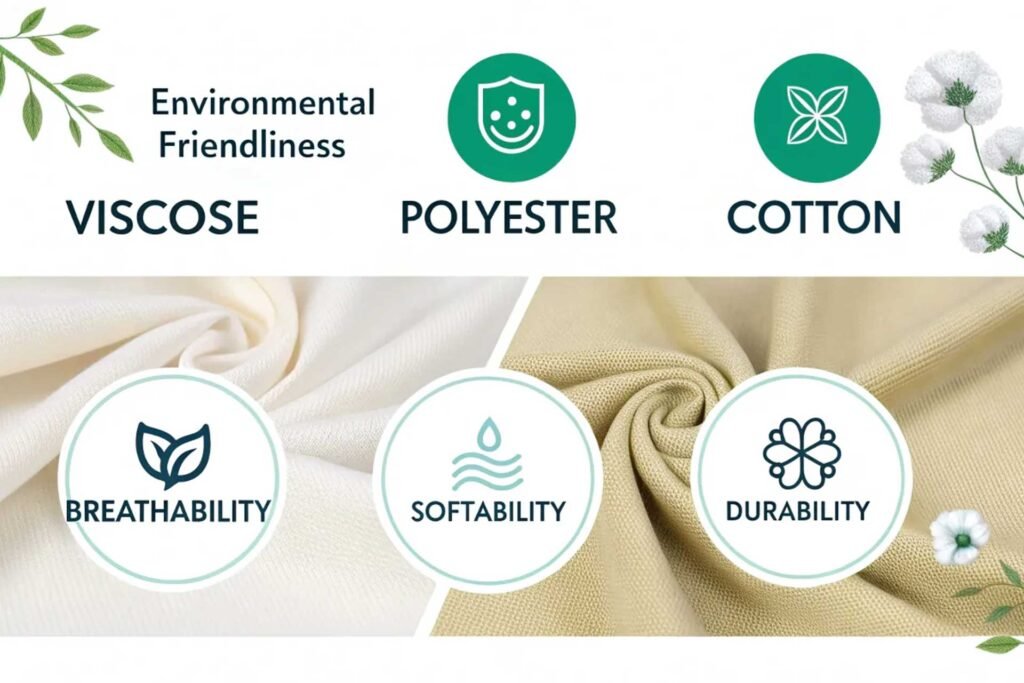
胶粘纤维 vs 涤纶 vs 棉
1. The Three Tools in Your Spec Kit
| Viscose | Polyester | Cotton | |
|---|---|---|---|
| Origin | Semi-synthetic (wood pulp) | Fully synthetic (PET) | Natural (cotton boll) |
| Why spec it | Drape, hand feel, breathability | Durability, cost, color retention | Natural comfort, brand perception |
| Price vs TR baseline | +15-20% for pure | -10-15% for pure | +5-15% depending on grade |
| Wet strength | 50-60% retained | 95%+ retained | 90%+ retained |
| Best served in... | TR blend (35-50%) | TC or TR blend (50-80%) | TC or CVC blend (35-50%) |
Pure any of these fibers is rarely the right answer for a uniform contract over 5,000 meters. Blends exist because the weaknesses of each fiber get cancelled by the strengths of another.
2. Viscose — Spec It for Drape, Not Durability
Pure viscose has the best hand feel and drape of the three. It breathes. It moves. It looks like a premium fabric.
What the manufacturer knows that the article doesn't tell you:
Viscose loses 40-50% of its strength when wet. A viscose garment that feels sturdy in your hand gets alarmingly fragile in a commercial washing machine.
In practical terms:
- A pure viscose uniform blazer will feel luxurious for the first 10 wears
- By wash 15-20, the collar starts softening unevenly
- By wash 30-35, seam areas show visible wear
- By wash 45-50, the garment is replacement-ready
When to spec viscose anyway:
- Front-of-house hospitality (low sweat exposure, dry clean protocol, drape matters)
- Airline cabin crew (strict dry cleaning schedule, premium appearance required)
- Corporate uniforms with garment-care contracts (not home-laundered)
When to avoid:
- Any garment that hits industrial laundry
- Kitchen, healthcare, or maintenance uniforms
- Budget below $3.50/meter FOB — at that price point the viscose quality is too low to survive
3. Polyester — Spec It for Cost Control, Accept the Trade-Off
Polyester dominates uniform textiles for one reason: it's cheap, strong, and holds color through 100+ washes.
But spec 100% polyester and you'll get four complaints in the first month:
- 'It doesn't breathe' (correct — moisture vapor transmission is 40-50% lower than cotton)
- 'It feels cheap' (correct — the hand feel is unmistakably synthetic)
- 'It smells after a shift' (correct — polyester traps bacteria more than cellulose fibers)
- 'Static cling' (correct — polyester generates 2-3x more static than cotton in dry conditions)
When pure polyester works:
- Budget-driven contracts where cost-per-garment is the only metric
- Industrial workwear that must survive 100+ heavy wash cycles (warehouse, logistics)
- Outer shells and protective gear where durability trumps comfort
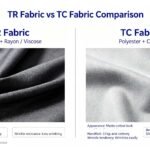
The better option for most contracts: TC 65/35 (65% polyester, 35% cotton). You get 90% of the cost advantage and 80% of the comfort. The 35% cotton content fixes the breathability and odor complaints.
4. Cotton — Spec It When the Client Demands Natural
Cotton carries a perception advantage that no amount of lab data can override. '100% cotton' on a spec sheet signals quality to procurement managers who don't work with textiles daily.
What the data actually says:
| Metric | 100% Cotton | TC 65/35 | TR 65/35 |
|---|---|---|---|
| Cost per meter FOB | $3.80-4.50 | $2.80-3.20 | $3.20-3.80 |
| Shrinkage (1st wash) | 3-5% | 1-2% | 1-3% |
| Wrinkle recovery | Poor | Excellent | Excellent |
| 50-wash appearance | Faded, softened | 90% original | 85% original |
| Color fastness | Grade 3-4 | Grade 4-5 | Grade 4 |
Pure cotton wins on perception. It loses on cost, shrinkage, wrinkle recovery, and color retention.
When to spec pure cotton:
- The client's brand positioning requires 'natural' (organic food companies, eco-hotels)
- Application is low-wash or hand-wash protocol
- Budget allows for 40-50% higher replacement rate vs polyester blends
The better option: CVC (Chief Value Cotton) 60/40 or 50/50 cotton-polyester. Keeps the 'cotton' label on the spec sheet with much better performance.
5. The Real-World Decision Matrix
| Scenario | Spec | Why |
|---|---|---|
| Hotel front-of-house uniform | TR 65/35 | Drape, wrinkle recovery, survives dry cleaning |
| Hospital scrubs or patient gowns | TC 65/35 or CVC | Frequent hot wash, budget-sensitive |
| Restaurant kitchen uniform | TC 65/35 | Grease resistance, 80°C wash tolerance |
| Corporate office uniform (temperate) | TR or CVC 50/50 | Professional appearance, moderate wash |
| Warehouse/logistics workwear | TC 80/20 or 100% polyester | Abrasion resistance, 100+ wash cycles |
| Summer outdoor uniform (hot climate) | CVC 50/50 open weave | Breathability + structural stability |
| Airline cabin crew | TR 65/35 with anti-static finish | Drape, dry-clean-ready, color retention |
| Promotional one-time wear | TC or pure polyester | Lowest cost, single use |
6. What the Comparison Table Actually Means
You've seen the standard comparison table — breathability, softness, durability, cost. Here's the version that matters for a uniform spec:
| Decision Factor | Viscose Rating | Polyester Rating | Cotton Rating |
|---|---|---|---|
| Comfort (subjective) | 9/10 | 5/10 | 8/10 |
| Wash survival (50 cycles) | 4/10 | 10/10 | 6/10 |
| Color retention | 7/10 | 9/10 | 5/10 |
| Cost efficiency | 6/10 | 9/10 | 5/10 |
| Perceived quality | 8/10 | 4/10 | 8/10 |
No fiber scores above 6 across all five factors. That's why you don't pick a fiber. You pick a blend that optimizes for your specific combination of wash protocol, climate, budget, and brand positioning.
Bottom Line
Viscose gives you drape and breathes. Polyester gives you cost and survival. Cotton gives you perception and comfort. Each one is wrong if used alone for a standard uniform contract.
The correct answer is almost always a blend. TR 65/35 for front-of-house. TC 65/35 for back-of-house. CVC 50/50 for the jobs in between.
Spec the blend. Not the fiber.