Viscose is not a natural fiber — but it is not a synthetic fiber either. It occupies a middle ground that has genuine implications for how buyers classify it in sustainability reporting, how it is treated under certification schemes like GOTS and OEKO-TEX, and how it should be described in brand communications to end consumers. This guide explains what viscose actually is, why the natural vs synthetic classification matters for sourcing decisions, and what garment manufacturers and apparel brands need to know when specifying viscose and rayon fabrics for production.
Is Viscose a Natural Fiber
What Is Viscose — Natural, Synthetic, or Neither?
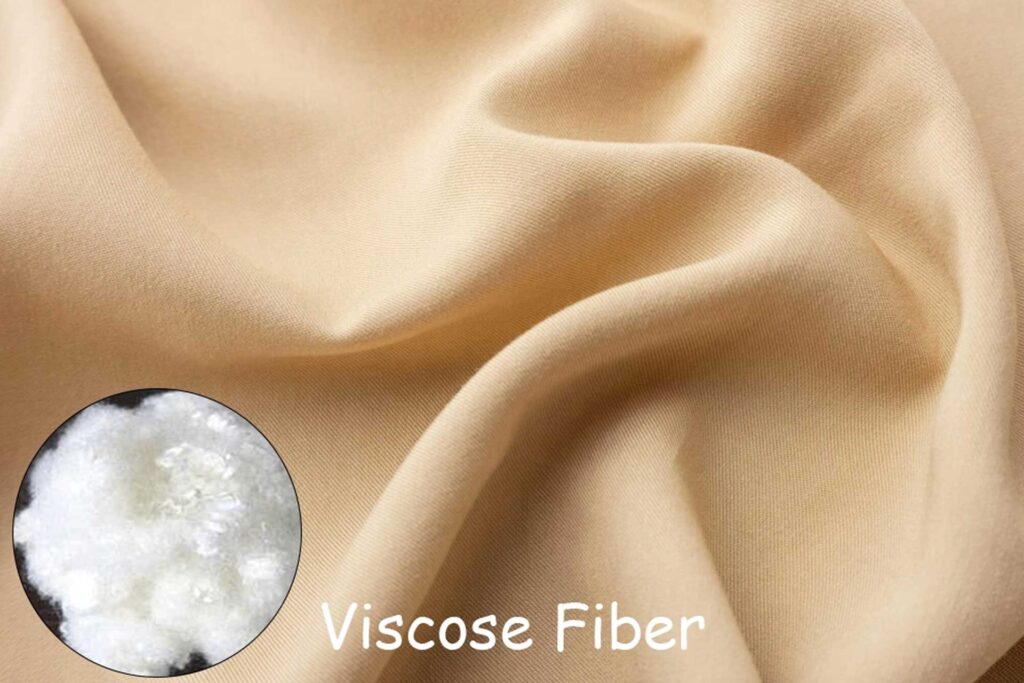
Viscose — also known as rayon — is classified as a semi-synthetic or regenerated cellulose fiber. Understanding what this means in practice requires a brief look at how it is made.
The raw material for viscose is cellulose, typically extracted from wood pulp sourced from trees such as eucalyptus, beech, pine, or bamboo. Cellulose is a natural polymer — the same basic material found in cotton fiber. In this sense, viscose starts from a natural origin.
However, converting raw cellulose into a spinnable fiber requires significant chemical processing. The cellulose is dissolved in a sodium hydroxide and carbon disulfide solution, forced through spinnerets to form filaments, and then regenerated into fiber through a chemical bath. The resulting fiber — viscose — has a molecular structure similar to natural cellulose but has been fundamentally transformed through industrial chemistry.
This is why viscose is classified as semi-synthetic or regenerated, not natural:
- Natural fibers (cotton, wool, silk, linen) are used in fiber form as they occur in nature, with minimal processing
- Synthetic fibers (polyester, nylon, acrylic) are made entirely from petrochemical raw materials through chemical synthesis
- Regenerated fibers (viscose, modal, lyocell) start from natural cellulose but are fundamentally transformed through chemical processing before becoming a usable fiber
For sourcing managers, the practical implication is that viscose cannot be described as a natural fiber in product labeling or sustainability claims without qualification — but it can legitimately claim plant-based origin and biodegradability under appropriate conditions.
Why the Classification Matters for Sourcing and Brand Claims
The natural vs semi-synthetic distinction has direct consequences for how brands can communicate about viscose in their products and sustainability reports.
Product labeling In most markets, including the EU and USA, viscose must be labeled as 'viscose' or 'rayon' on garment care labels — not as 'natural fiber.' Mislabeling viscose as natural is a compliance risk. Buyers sourcing fabric for brands selling into regulated markets should confirm that their fabric supplier's fiber content declarations are accurate and supported by lab test reports.
Sustainability claims Viscose is biodegradable under appropriate conditions and is derived from plant-based cellulose — both of which are legitimate sustainability credentials. However, the chemical-intensive production process has significant environmental impacts if not properly managed: carbon disulfide used in conventional viscose production is toxic, and uncontrolled chemical discharge causes water pollution.
Brands making sustainability claims about viscose need to either reference certified responsible sourcing (see Section 3 below) or be careful not to overstate the environmental benefits of the fiber relative to conventional synthetics.
GRS and recycled content claims Viscose produced from recycled cellulose sources — post-consumer textile waste or pre-consumer production waste — can be certified under the Global Recycled Standard (GRS). GRS-certified recycled viscose allows brands to make verified recycled content claims in their sustainability communications, which is increasingly required by European retail buyers and institutional procurement specifications.
Certification Options for Viscose and Rayon Fabric
For buyers sourcing viscose fabric with sustainability requirements, the relevant certification landscape covers three main schemes:
OEKO-TEX Standard 100 Tests the finished fabric for harmful substances — residual chemicals from the dyeing and finishing process, heavy metals, formaldehyde, pesticides, and pH levels. OEKO-TEX Standard 100 certification confirms that the fabric is safe for human skin contact but does not make any claim about environmental impact or production process sustainability. This is the minimum certification required by most European retail buyers for apparel fabric.
XINGYE TEXTILE holds OEKO-TEX certification on applicable product lines. Certification scope is confirmed per order on request.
GOTS — Global Organic Textile Standard GOTS certification covers the entire supply chain from fiber to finished fabric and requires that the input fiber is certified organic. For viscose to qualify under GOTS, it must be produced from certified organic cellulose sources using an approved production process. Conventional viscose produced from non-organic wood pulp does not qualify for GOTS certification.
GOTS-certified viscose fabric is available but commands a significant price premium over conventional viscose. It is primarily specified by premium organic apparel brands and buyers selling into markets with strict organic textile standards.
GRS — Global Recycled Standard GRS applies to viscose produced from recycled cellulose content. It verifies the recycled input material, chain of custody through production, and social and environmental practices at the production facility. GRS-certified recycled viscose allows verified 'recycled content' claims in brand communications and sustainability reports.
For buyers whose end customers or retail partners require verified sustainability credentials on viscose fabric, GRS certification is increasingly the minimum standard in European and North American markets.
Viscose vs Modal vs Lyocell — Sustainability Comparison
Buyers evaluating viscose for sustainability-sensitive applications should understand how it compares to its cellulose-based alternatives.
| Fiber | Production Process | Environmental Profile | Certification Options | Price vs Viscose |
|---|---|---|---|---|
| Conventional Viscose | Chemical-intensive, open-loop | High chemical use, water risk if unmanaged | OEKO-TEX, GRS (if recycled) | Base price |
| Modal | Modified viscose process, more efficient | Lower chemical use than conventional viscose | OEKO-TEX, GRS | +15–25% |
| Lyocell (Tencel) | Closed-loop solvent process, ~99% solvent recovery | Significantly lower environmental impact | OEKO-TEX, GRS, FSC | +30–50% |
| GOTS Viscose | Conventional process, organic input | Organic fiber source, certified supply chain | GOTS, OEKO-TEX | +40–80% |
Practical guidance for buyers:
For standard uniform and workwear production where sustainability certification is not a buyer requirement, conventional viscose and TR fabric remain the most cost-effective specification.
For brands selling into European retail with sustainability reporting requirements, OEKO-TEX Standard 100 certified viscose or TR fabric covers most buyer compliance requirements at minimal cost premium.
For brands making active sustainability claims — 'eco-friendly', 'sustainable', 'responsible sourcing' — GRS certified recycled viscose or lyocell is the appropriate specification, with pricing discussed per order based on certification scope required.
Viscose in Garment Production — Performance Properties That Matter
Regardless of fiber classification, viscose's performance properties are what drive its continued dominance in global apparel production. For sourcing managers evaluating viscose for a specific garment category, these are the properties that matter in production:
Drape Viscose produces the most fluid, natural drape of any man-made fiber. This is why it is the viscose component in TR fabric that gives formal trousers and suits their characteristic fall and movement — polyester alone cannot replicate this.
Moisture absorption Viscose absorbs moisture at approximately 11–13% of its weight — significantly higher than polyester (0.4%) and nylon (4%). This makes viscose-containing fabrics substantially more comfortable in warm conditions and explains why TR fabric outperforms 100% polyester in wearer comfort for formal and uniform applications.
Dyeability Viscose accepts dye readily and produces vivid, saturated colors with good uniformity across batch production. This makes it well suited to institutional uniform applications where consistent color matching across large orders and multiple production runs is a procurement requirement.
Biodegradability Viscose fiber is biodegradable under industrial composting conditions. This is a legitimate end-of-life sustainability credential for brands communicating about garment disposal, though the practical significance depends on the garment reaching an appropriate composting facility rather than landfill.
Limitations in production Viscose loses 40–50% tensile strength when wet, which affects seam performance in high-wash-frequency garments. Shrinkage of 3–8% is possible in pure viscose without pre-treatment. These limitations are managed in production by blending viscose with polyester — the standard TR fabric approach — which provides the dimensional stability and wash durability that pure viscose lacks.
Frequently Asked Questions — Viscose and Natural Fiber Classification
Can I call viscose a natural fiber on my product label? No. Viscose must be labeled as 'viscose' or 'rayon' under EU and US textile labeling regulations. Describing viscose as a natural fiber on a product label or in marketing communications without qualification is a compliance risk and potentially misleading to consumers. You can accurately describe viscose as 'plant-based' or 'derived from wood cellulose' as a supplementary description alongside the correct fiber name.
Is viscose better for the environment than polyester? It depends on the production process and end-of-life scenario. Conventional viscose production uses significant chemical inputs and has a higher water impact than polyester production. However, viscose is biodegradable and derived from renewable plant sources, while polyester is petroleum-based and does not biodegrade. Neither fiber has a clearly superior environmental profile across all impact categories — the comparison depends on which environmental metric is prioritized and which production standard is applied.
Does viscose qualify for GOTS certification? Standard commercial viscose does not qualify for GOTS, which requires certified organic fiber input. GOTS-certified viscose is available but requires a certified organic supply chain from forest to fiber, which significantly increases cost. For most commercial uniform and apparel production, OEKO-TEX Standard 100 certification is the more practical and cost-effective sustainability credential for viscose fabric.
Is TR fabric (polyester-viscose blend) eligible for any sustainability certification? Yes. TR fabric can be certified under OEKO-TEX Standard 100 for chemical safety. If the polyester component is produced from recycled PET and the viscose component meets GRS requirements, the blended fabric can potentially qualify for GRS certification for recycled content. Certification scope and eligibility should be confirmed with the fabric supplier per order.
What is the minimum order quantity for OEKO-TEX certified viscose and TR fabric? At XINGYE TEXTILE, standard MOQ for OEKO-TEX certified rayon and TR fabric is 500 meters per color for stock constructions. Certification documentation is provided with the order. Contact our team to confirm certification scope and availability for your specific requirement.
Wholesale Viscose, Rayon & Certified TR Fabric — Factory Direct from XINGYE TEXTILE
XINGYE TEXTILE manufactures and supplies wholesale viscose fabric, 100% rayon fabric, modal fabric, and TR fabric — including OEKO-TEX certified and GRS-certified product lines — direct from our production facility in Shijiazhuang, China.
We hold GOTS, GRS, and OEKO-TEX certifications on applicable product lines, supplying garment manufacturers, uniform contractors, apparel brands, and wholesale fabric buyers in 50+ countries with consistent quality, factory-direct pricing, and flexible MOQ from 500 meters per color.
Physical samples and certification documentation are available before bulk commitment. Our technical team can advise on the right viscose or TR fabric specification for your garment category, sustainability requirements, and buyer compliance needs.
→ Browse 100% Rayon Fabric → Browse TR Fabric (Polyester-Viscose) → Browse Modal Fabric → Read: Is Viscose Fabric Breathable? → Read: Is Rayon Stretchy? → Request a Sample or Quote