Gabardine Is Not a Fiber It's a Weave — And It's the Most Important Uniform Weave in History
Most people think of gabardine as a fabric. Technically, it's a weave structure — a steep, tightly woven twill with a distinctive diagonal rib pattern. But it's such a specific, recognizable weave with such specific properties that the textile industry treats it as its own category.
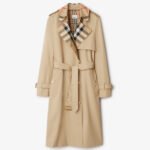
Gabardine was invented in 1879 by Thomas Burberry, founder of the Burberry fashion house. He designed it as a waterproof, breathable fabric for outdoor wear — and it became the fabric of the trenches in World War I (that's where the 'trench coat' got its name). Since then, gabardine has become the default weave for uniforms, suits, trousers, and outerwear worldwide.
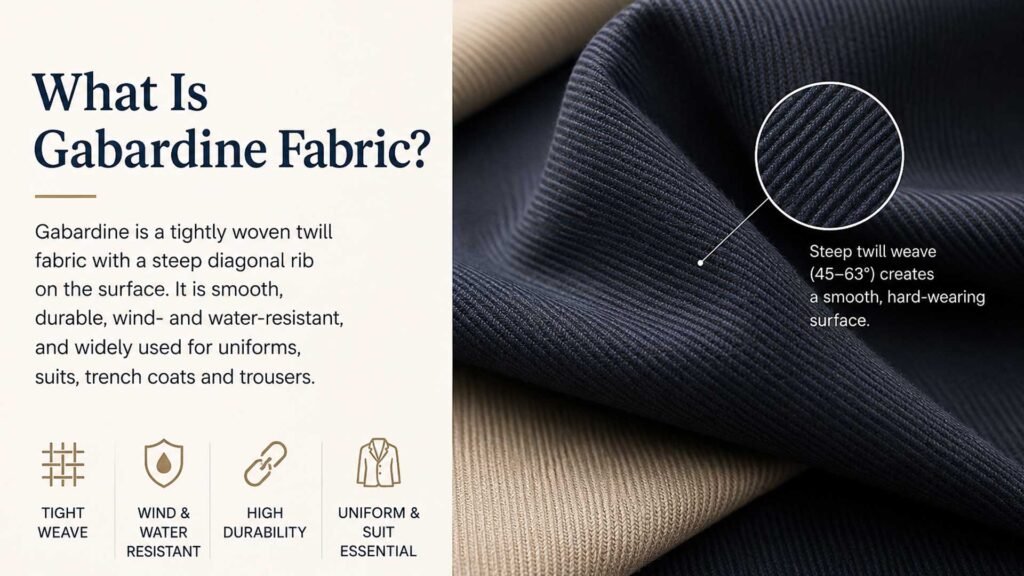
The magic of gabardine is in its construction: the steep twill angle (typically 45-63°) and high warp density create a fabric that is smooth on the surface, tightly packed against wind and water, and strong enough to survive years of wear — while still looking crisp and professional.
This guide covers what gabardine fabric is, how it's made, why it dominates the uniform industry, its properties, and how to source quality gabardine.
What Is Gabardine Fabric
What Is Gabardine Fabric?
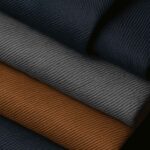
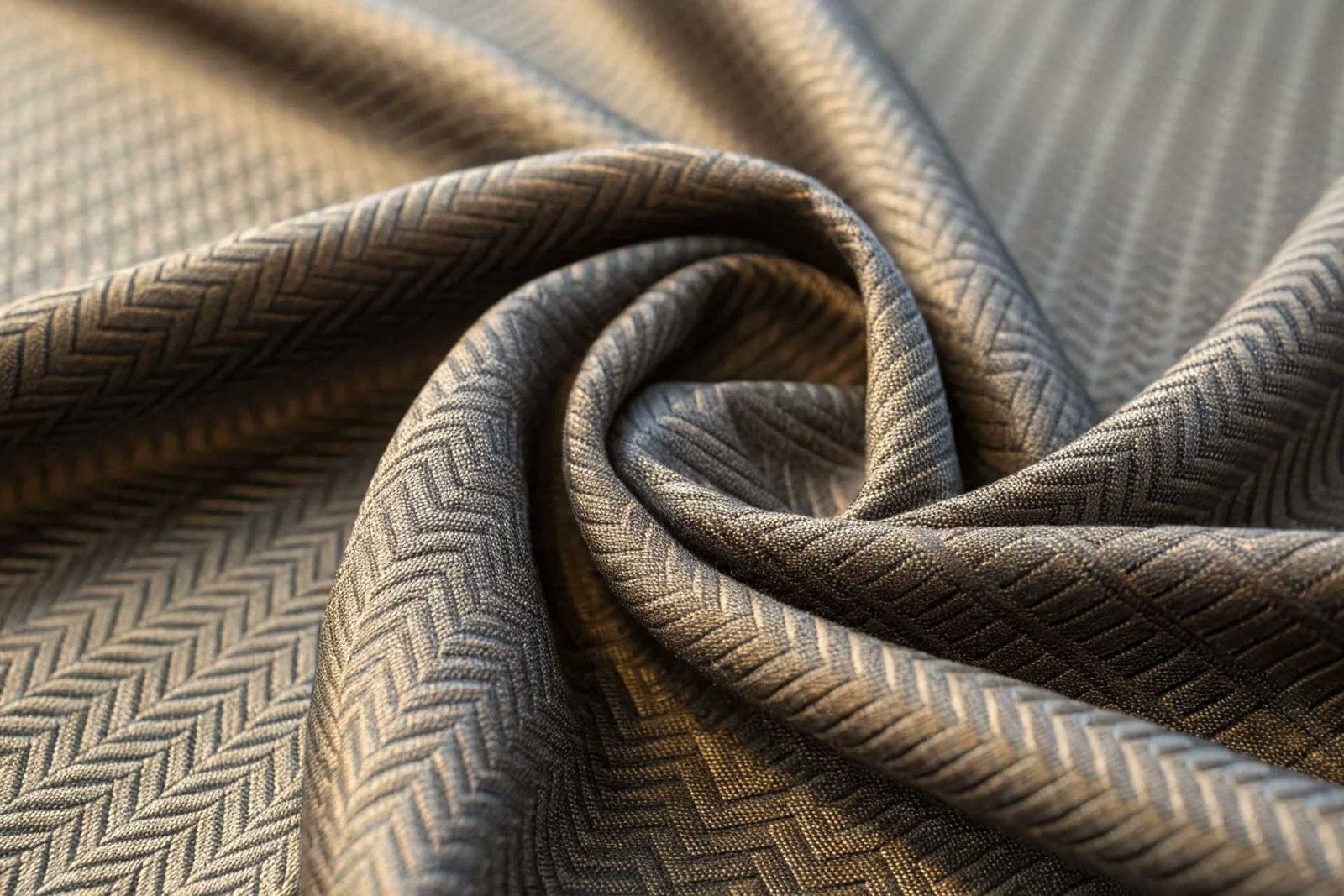
Gabardine is a tightly woven twill fabric with a steep diagonal rib on the surface. The weave is so dense that the diagonal lines are barely visible — creating a smooth, hard-wearing surface that resists wind, water, and abrasion.
| Fact | Gabardine |
|---|---|
| Fabric type | Weave structure (twill family) |
| Invented | 1879 by Thomas Burberry |
| Twill angle | 45-63° (steep twill) |
| Warp density | 2x the weft density (tight weave) |
| Surface | Smooth, fine diagonal rib, almost flat |
| Fibers used | Wool, cotton, polyester, TR, TC, nylon — any fiber can be woven as gabardine |
| Signature application | Uniforms, suits, trench coats, trousers |
How Is Gabardine Different from Regular Twill?
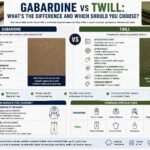
Both gabardine and twill have diagonal lines. The difference is in the angle and density.
| Factor | Standard Twill | Gabardine |
|---|---|---|
| Twill angle | 30-45° | 45-63° (steeper) |
| Warp density | Moderate | 2x weft density — very tight |
| Diagonal rib | Visible, pronounced | Fine, subtle, almost invisible |
| Surface | Textured, soft | Smooth, hard, compact |
| Weight | Varies | Typically heavier (220-350 GSM) |
| Durability | Good | Excellent — one of the most durable weaves |
| Appearance | Casual to mid-formal | Formal, sharp, professional |
How Is Gabardine Fabric Made?
Gabardine can be woven from any fiber — wool, cotton, polyester, TR, TC — but the weave structure is always the same:
| Stage | Process | What Happens |
|---|---|---|
| 1. Yarn preparation | Warp and weft yarns are prepared with high twist | High-twist yarns make the fabric stronger and more resistant to snagging |
| 2. Weaving | The warp is threaded so that the weft floats over 2-3 warp threads in a staggered diagonal pattern | Creates the steep diagonal rib. The warp is set at roughly 2x the density of the weft |
| 3. Finishing | Fabric is heat-set, singed (to remove surface fuzz), and calendered (to smooth the surface) | Produces the characteristic smooth, compact surface |
| 4. Optional treatments | Water-repellent, stain-resistant, or wrinkle-resistant finishes can be applied | Adds performance properties for specific applications |
The high warp density is the key. Because the warp threads dominate, the fabric surface is made almost entirely of parallel warp yarns packed tightly together — creating a smooth, hard surface that sheds water and resists abrasion.
Gabardine by Fiber Type
Gabardine's properties change dramatically depending on the fiber used. The weave stays the same, but the fiber determines the hand feel, care, and cost.
| Fiber | Characteristics | Typical Use | Weight Range |
|---|---|---|---|
| Wool gabardine | The original. Drapes beautifully, holds creases, breathes. Expensive, dry clean only | Premium suits, formal uniforms, dress coats | 250-350 GSM |
| TR gabardine (poly-viscose) | Wrinkle-resistant, drapes like wool at half the cost. Industrial laundry safe | Uniforms, suiting, blazers — the most common gabardine today | 240-320 GSM |
| TC gabardine (poly-cotton) | Durable, breathable, more comfortable than TR. Wrinkles slightly more | Work uniforms, hospitality, school wear | 220-300 GSM |
| Cotton gabardine | Natural feel, breathable, classic. Wrinkles easily, shrinks | Casual jackets, chinos-style trousers, summer uniforms | 200-280 GSM |
| Polyester gabardine | Lowest cost, most wrinkle-resistant, least breathable | Budget uniforms, rain-resistant outerwear | 180-280 GSM |
| Nylon gabardine | Very strong, water-resistant, quick-drying | Outdoor wear, tactical uniforms, rainwear | 200-300 GSM |
For uniform programs: TR gabardine is the standard choice — it delivers the look and drape of wool gabardine with industrial laundry durability and a fraction of the cost.
Gabardine Fabric Properties
| Property | Rating | Explanation |
|---|---|---|
| Durability | ★★★★★ | The tight, dense weave makes gabardine one of the most abrasion-resistant fabric constructions. Uniforms in gabardine outlast standard twill 2:1 |
| Wrinkle resistance | ★★★★☆ (blends) / ★★☆☆☆ (cotton) | TR and polyester gabardine are naturally wrinkle-resistant. Cotton gabardine wrinkles |
| Water resistance | ★★★★☆ | The dense warp surface causes water to bead and roll off. Burberry invented it for waterproof outerwear |
| Wind resistance | ★★★★★ | The tightly packed weave blocks wind — the reason trench coats use gabardine |
| Crease retention | ★★★★★ | Gabardine holds a sharp crease exceptionally well — critical for uniform trousers |
| Breathability | ★★★☆☆ | Dense weave is less breathable than open weaves. Fiber choice matters (cotton breathes best) |
| Snag resistance | ★★★★★ | High-twist yarns and tight weave resist snagging — better than standard twill |
| Drape | ★★★★☆ | Structured, clean drape. Holds shape without being stiff |
| Appearance | ★★★★★ | The smooth, compact surface looks sharp and professional. The standard for formal uniforms |
Why Gabardine Dominates the Uniform Industry
If you look at the uniform industry — military, police, hospitality, corporate, aviation — gabardine appears everywhere. There's a reason:
| Uniform Requirement | Why Gabardine Delivers |
|---|---|
| Sharp appearance | The smooth, flat surface reflects light evenly. No weave texture to distract. Looks pressed even when slightly worn |
| Crease retention | Trousers hold a knife-edge crease all day. A uniform in standard twill loses its crease by noon; gabardine holds it through dinner |
| Durability | The dense weave resists abrasion from seat wear, duty belts, and daily friction. Gabardine uniforms last 2x longer than standard twill |
| Industrial laundry | TR gabardine survives 80-100+ wash cycles with minimal shrinkage, fading, or surface change |
| Professional signal | Gabardine carries an association with formal, authoritative wear — from military dress uniforms to airline pilot uniforms |
| Water resistance | Uniforms worn outdoors or on a flight deck benefit from gabardine's water-shedding surface |
Gabardine vs Twill vs Serge — What's the Difference?
These three weaves are often confused. They're all twill-family weaves with different characteristics.
| Factor | Gabardine | Standard Twill | Serge |
|---|---|---|---|
| Twill angle | 45-63° (steep) | 30-45° | 45° (diagonal) |
| Warp density | 2x weft | Balanced | Balanced |
| Surface | Smooth, compact, fine rib | Textured, visible diagonal | Pronounced diagonal rib |
| Weight | 220-350 GSM | 180-320 GSM | 250-400 GSM |
| Best use | Uniforms, suits, dress trousers | Workwear, casual, shirts | Military dress uniforms, heavy outerwear |
| Appearance | Sharp, formal | Casual to mid-formal | Formal, heavy, textured |
Simple rule: Gabardine = fine, smooth, formal. Twill = standard, visible diagonal. Serge = heavier, more pronounced diagonal, dress military.
Common Uses of Gabardine Fabric
| Application | Why Gabardine | Recommended Fiber / GSM |
|---|---|---|
| Uniform trousers | Holds crease, durable, professional | TR gabardine 260-300 GSM |
| Uniform jackets / blazers | Structured drape, sharp appearance | TR gabardine 280-320 GSM |
| Suit trousers | Crease retention, wrinkle resistance | Wool or TR gabardine 260-320 GSM |
| Suit jackets | Structured, holds shape, formal | Wool or TR gabardine 280-340 GSM |
| Trench coats / outerwear | Water-resistant, windproof, durable | Cotton or nylon gabardine 250-300 GSM |
| Police / military uniforms | Durability, formal appearance, crease retention | TR or wool gabardine 280-320 GSM |
| Hotel / restaurant uniforms | Professional, industrial laundry safe | TC or TR gabardine 240-300 GSM |
| Work trousers | Durable, wrinkle-resistant | TC gabardine 240-280 GSM |
| Skirts (uniform) | Clean drape, holds shape | TR gabardine 240-280 GSM |
Gabardine Care Instructions
| Fabric Type | Care | Notes |
|---|---|---|
| TR / polyester gabardine | Machine wash warm (40-60°C), industrial laundry safe, tumble dry low, minimal ironing | Easiest care. Wrinkle-resistant, quick-drying |
| TC gabardine | Machine wash warm, industrial laundry safe, tumble dry low, light ironing | Slightly more ironing than TR |
| Wool gabardine | Dry clean only | Expensive but classic. Never machine wash |
| Cotton gabardine | Machine wash cold/warm, hang dry, iron while damp | Pre-shrink before cutting. Wrinkles more than blends |
How to Buy Gabardine — What to Specify
| Spec Element | What to Ask |
|---|---|
| Fiber composition | TR 65/35 (uniform standard), TC 65/35 (workwear), wool (premium), or cotton |
| GSM | 240-280 for trousers, 280-320 for jackets, 220-260 for shirts/skirts |
| Weave confirmation | Confirm it's a steep twill (45°+) — some suppliers label standard twill as gabardine |
| Finish | Heat-set for shrinkage control (≤2%), singed + calendered for smooth surface |
| Color | Custom dye or stock colors. Navy, black, grey are uniform standards |
| Certification | OEKO-TEX for chemical safety |
| Wash test | Request shrinkage and color fastness test results |
Frequently Asked Questions
Q: Is gabardine waterproof? A: Not fully waterproof, but highly water-resistant. The dense warp surface causes water to bead and roll off. For full waterproofing, gabardine is treated with a water-repellent finish or laminated with a membrane.
Q: Is gabardine breathable? A: Less breathable than open weaves because the weave is so dense. The fiber choice matters: cotton gabardine breathes reasonably well, wool gabardine moderates temperature, polyester gabardine is the least breathable.
Q: Does gabardine wrinkle? A: TR and polyester gabardine are naturally wrinkle-resistant. Wool gabardine resists wrinkles better than most fabrics. Cotton gabardine wrinkles like cotton.
Q: Is gabardine good for summer? A: Lightweight cotton or TR gabardine (220-260 GSM) works for summer uniforms. Heavy wool gabardine is a winter fabric. Gabardine's wind resistance can make it feel warm in hot weather.
Q: What is the difference between gabardine and twill? A: Gabardine is a type of twill with a steeper diagonal angle (45-63° vs 30-45°) and roughly 2x the warp density. It's tighter, smoother, more formal, and more durable than standard twill.
Q: Is gabardine stretchy? A: Standard gabardine has minimal stretch. Gabardine with spandex (TRS gabardine) provides 15-30% stretch for active uniforms and slim-fit suiting.
Get a Quote — Gabardine Fabric
XINGYE TEXTILE manufactures gabardine fabric in TR, TC, polyester, and cotton compositions. Steep twill construction, heat-set for ≤2% shrinkage, singed and calendered for a smooth professional surface. GSM range 220-350. Custom colors, custom development. OEKO-TEX certified.
Applications: Uniforms, suiting, blazers, trousers, skirts, outerwear.
Minimum order: 300 meters per color. Sample-first ordering.