How to Test Fabric Quality Before Ordering
Why Testing Fabric Quality Before Ordering Matters
- Avoid costly returns and reorders
- Ensure consistency across production batches
- Meet customer expectations for durability and comfort
- Comply with regulatory and safety standards
Key Factors to Consider When Testing Fabric Quality
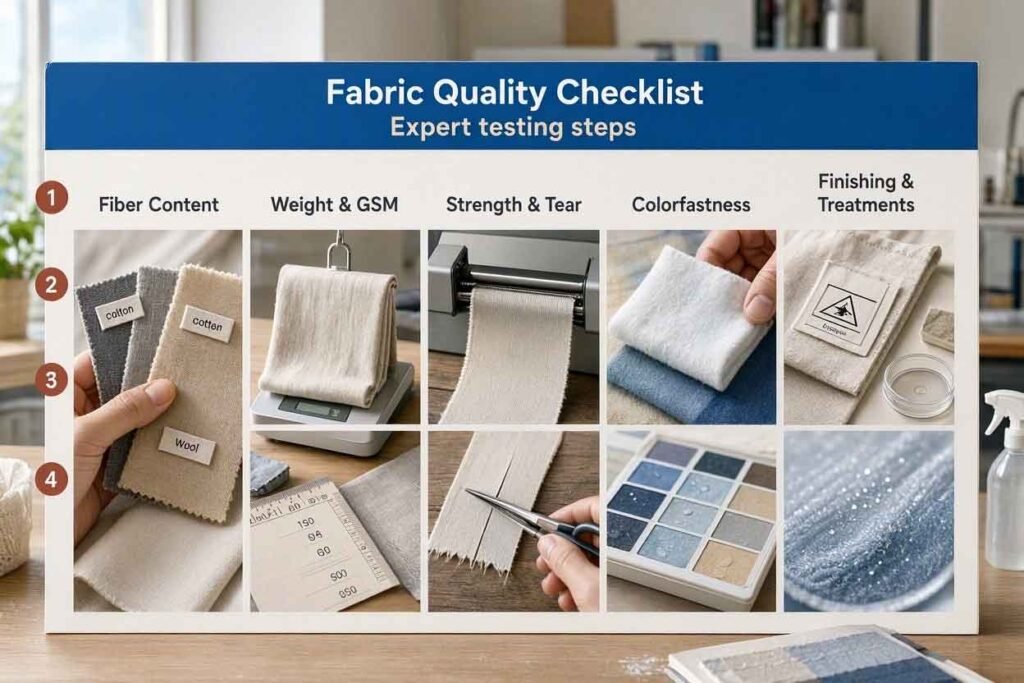
1. Fiber Content Verification
- Cotton: Affordable, durable, breathable.
- Linen: Absorbent, resistant to soil, durable.
- Wool: Warm, resilient.
- Silk: Lustrous, strong but delicate.
- Blends: May offer combined benefits but require testing for shrinkage and durability.
- Untwist yarn samples and observe fiber length and texture.
- Perform a burn test to differentiate fibers (e.g., cotton burns quickly with yellow flame, wool smells like burning feathers).
- Laboratory composition tests confirm fiber ratios.
2. Fabric Weight and Density (GSM and Thread Count)
- Heavier GSM usually means sturdier fabric.
- Thread count indicates how tightly the fabric is woven.
- Use a GSM cutter and digital scale to measure fabric weight accurately.
- Count threads per inch for woven fabrics or courses and wales for knits.
3. Strength and Durability Testing
- Breaking/Tensile Strength: Force required to break fabric.
- Tear Strength: Resistance to tearing once cut.
- Bursting Strength: Particularly for knits, resistance to pressure.
- ASTM D5034 grab test for tensile strength.
- Elmendorf tear test for tear resistance.
4. Color Consistency and Fastness
- Check color uniformity across different parts of the roll (center vs. selvedge, start vs. end).
- Test color fastness to washing, rubbing, light, and perspiration.
- Visual inspection under standardized lighting.
- Laboratory tests rated on a scale (e.g., 1-5) for fastness.
5. Fabric Hand Feel and Drape
- Softness, smoothness, weight, and flexibility should match the end product’s needs.
- Compare with reference samples for consistency.
- Physically touch and fold fabric samples.
- Evaluate how the fabric hangs and recovers from crushing.
6. Shrinkage and Dimensional Stability
- Wash fabric samples under intended care conditions.
- Measure dimensional changes before and after washing.
7. Finishing and Chemical Safety
- Verify finish durability and uniformity.
- Test for restricted substances (e.g., formaldehyde, heavy metals) to comply with safety standards like OEKO-TEX.
Step-by-Step Process: How to Test Fabric Quality Before Ordering
-
Request Detailed Fabric Specifications
Ask suppliers for fiber content, GSM, width, finishing details, and lab reports on strength, shrinkage, and colorfastness.
-
Conduct Visual and Tactile Inspection
Check for defects, color consistency, surface cleanliness, and hand feel.
-
Perform Physical Tests or Request Lab Testing
Utilize or request tests for tensile strength, tear strength, pilling, abrasion, shrinkage, and colorfastness.
-
Evaluate Sample Consistency
Review multiple samples from different rolls or dye lots to ensure production stability.
-
Check Certifications and Compliance Documents
Ensure OEKO-TEX or other relevant certifications are up-to-date and batch-specific.
-
Approve Samples with Clear Tolerances
Define acceptable variations in color, defects, roll length, and wash performance before bulk production.
How to Compare Suppliers and Reduce Order Risks
- Focus on Repeatability: A beautiful sample is not enough. Request test results from multiple production batches.
- Assess Supplier Support: Can they customize colors or finishes? Do they provide comprehensive documentation?
- Minimum Order Quantities (MOQ): Smaller MOQs allow testing fabric in real production conditions before committing large volumes.
- Transparency and Communication: Choose suppliers who provide clear specs, testing data, and are responsive to concerns.
Frequently Asked Questions (FAQs)
Q1: What is the minimum testing required before bulk fabric purchase?
A1: Composition verification, GSM, width, shrinkage, breaking strength, and colorfastness are essential. For sensitive products, chemical safety tests are also necessary.
Q2: How many samples should I check before approval?
A2: Ideally, more than one sample from different rolls or dye lots to detect inconsistencies.
Q3: Why are shrinkage and colorfastness critical?
A3: Shrinkage affects garment fit; colorfastness impacts appearance and customer satisfaction after washing.
Q4: How does small MOQ sourcing help?
A4: It reduces risk by allowing real-world testing before large-scale commitment.
Q5: What documents should suppliers provide?
A5: Specification sheets, test reports, packing details, certifications, and color tolerance standards if applicable.