There's a quiet deception running through the home textiles market. It's not exactly lying — nobody is forging certificates or making false claims under oath. It's more subtle than that: a careful use of language, a strategic ambiguity in product listings, a reliance on the fact that most shoppers don't know enough to ask the right questions.
The result is that 'damask' has become a word that describes two fundamentally different products — one woven, one printed — sold at overlapping price points, often side by side, with nothing on the label that clearly distinguishes them. Understanding the difference won't just save you money. It will change what you see when you look at fabric.
What You're Actually Buying: The Structural Difference
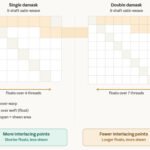
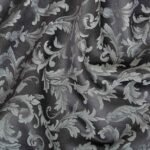
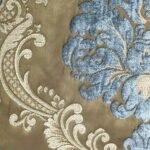
A genuine woven damask derives its pattern entirely from the weave structure. There is no ink, no dye applied to the surface, no print. The motif — the flower, the leaf, the palmette — exists because certain threads were raised and others lowered at specific points during weaving, creating areas of satin weave that reflect light differently from the surrounding ground weave. The pattern is, in the most literal sense, made of thread.
This has a consequence that sounds almost too simple: the pattern cannot be separated from the fabric, because the pattern is the fabric. There is no layer to wear off, no surface application to fade, no ink to crack or bleed. The contrast between motif and background is a structural property of the cloth, not a coating on top of it.
A printed damask imitation is a completely different object. It starts as a plain fabric — usually a solid-color base cloth, often with a slight sheen from a polyester or poly-blend construction — onto which a damask-style pattern has been applied using rotary screen printing, digital printing, or heat transfer. The pattern exists as a layer of pigment or dye sitting on or near the surface of the fabric.
The weave structure underneath that print is typically uniform and undifferentiated — the same over-under interlacing throughout, with no variation between where the motif appears and where the background appears. The visual effect of a damask pattern is being simulated by ink, not created by structure.
This distinction matters far more than it might initially seem, because structure and surface behave very differently over time and under use.
Why Woven Damask Ages Better: The Physics of Fading
Woven damask doesn't fade in the conventional sense because its pattern has no colorant to lose. The pattern contrast in a single-color woven damask is purely optical — it comes from the difference in how the satin floats and the ground weave reflect light. As long as the threads are intact, the pattern is intact. Sun exposure, repeated washing, and mechanical abrasion affect the fiber itself, but they don't selectively attack the pattern. A fifty-year-old linen damask tablecloth, if the fiber is sound, will show the same pattern clarity as a new one.
Printed imitations fade through an entirely different mechanism. Pigment-printed fabrics lose color when UV light breaks down the pigment molecules — a photochemical process that is cumulative and irreversible. Dye-based prints are slightly more stable because the colorant bonds more deeply with the fiber, but they still fade faster than woven structure. The critical issue isn't just overall color loss — it's differential fading. The printed motif and the background base cloth are often different materials or have different dye affinities, which means they fade at different rates. A printed damask that looks crisp and high-contrast when new can, after a few years of sun exposure, develop a washed-out quality where the background has faded faster than the print, or vice versa. The pattern doesn't disappear uniformly — it deteriorates unevenly, which looks worse than uniform fading would.
Washing compounds this. Machine washing subjects fabric to mechanical agitation and heat that gradually abrades the surface of printed fabric, physically removing pigment particles. This is why printed textiles often specify cold wash and gentle cycle — not to protect the fiber, but to preserve the surface treatment. Woven damask has no such vulnerability. The pattern is structural, so the washing instructions are about preserving the fiber, not the pattern.
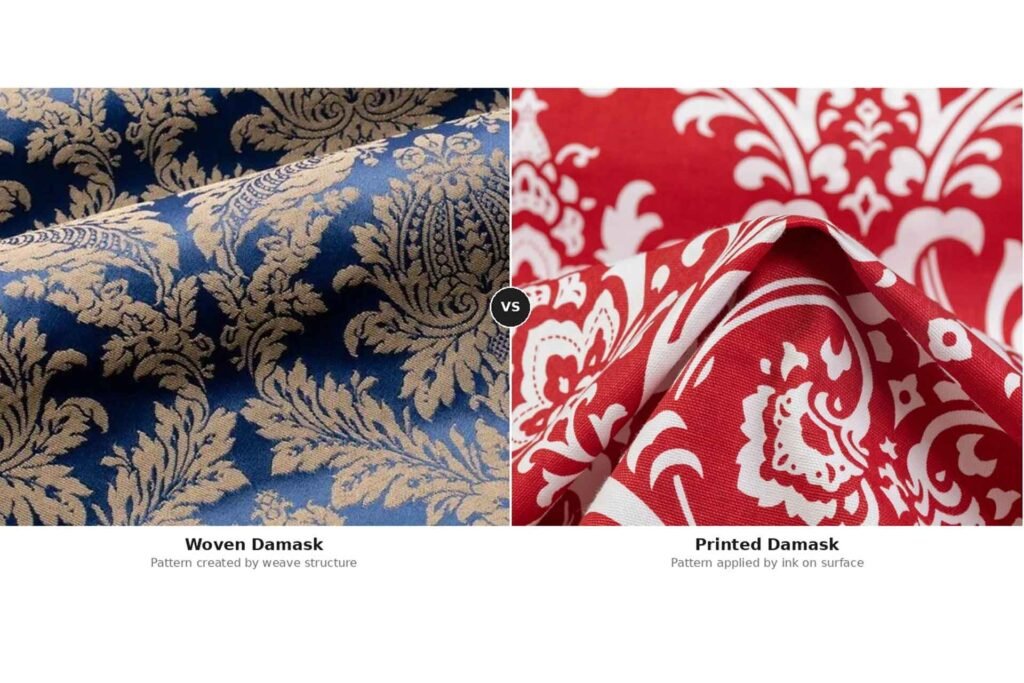
Woven Damask VS Printed Damask
Five Ways to Tell Them Apart Before You Buy
These tests work in a store, at a market, or when evaluating a fabric sample received by mail. None requires special equipment.
Test 1: The back of the fabric
This is the fastest and most reliable test. Pick up a corner of the fabric and look at the back.
A woven damask is reversible by definition. The same pattern appears on both faces, but with the relationship between motif and background inverted — what was the shiny satin motif on the front becomes the matte area on the back, and vice versa. The back will look like a photographic negative of the front: same pattern, same clarity, opposite contrast. This reversal isn't subtle. It's immediately obvious.
A printed imitation shows something completely different on the back. If it's a surface print, the back is either blank or shows a very faint ghost of the pattern. If it's a through-dyed base cloth with a print on top, the back may show the base color without the pattern at all. In either case, the back does not show a reversed, equally clear version of the front pattern. If you flip a fabric and the back doesn't immediately show you the mirror image of the front, you're holding a print.
Test 2: Oblique light
Hold the fabric at roughly 45 degrees to a direct light source — a window, a lamp, your phone's flashlight held to the side.
Woven damask will show a pronounced sheen differential between the motif and the background. The satin float areas catch directional light and reflect it back; the ground weave areas scatter it. The pattern appears almost three-dimensional — it seems to lift slightly from the surface. Rotate the fabric and the contrast shifts: what was bright becomes matte, and the pattern appears to reverse its depth. This light-dependent shifting is a fundamental property of woven structure and cannot be convincingly replicated by print.
A printed imitation under oblique light shows a much flatter surface. If the base cloth has any sheen, it's uniform — there's no variation between where the motif is and where the background is, because the weave structure is identical throughout. The pattern is visible as color contrast but not as light contrast. It looks like a picture of damask rather than damask itself.
Test 3: The damp cloth test
Dampen a white cotton cloth — a handkerchief, a piece of paper towel — and rub it firmly against the patterned surface of the fabric, then check the white cloth for color transfer.
On a woven damask, you should see little to no color transfer from this test, because there is no surface colorant to remove. Any color in the fabric is either in the dyed yarn (where it's locked inside the fiber) or it's the optical effect of the weave structure, which a damp cloth cannot affect.
On a pigment-printed imitation, you will often see noticeable color transfer, particularly if the fabric is relatively new. Pigment print sits on the surface and hasn't fully crosslinked; mechanical abrasion with a damp surface lifts some of it. Even well-fixed pigment prints will typically show more transfer than a woven fabric. This test is more reliable on newer fabric and less reliable on fabric that has been washed many times, since repeated washing removes much of the removable pigment early on.
Test 4: The stretch and distortion test
Grasp the fabric on either side of a pattern element — ideally a curved line within the motif — and apply moderate lateral tension, stretching the fabric slightly, then release.
On a woven damask, the pattern will distort under tension and return cleanly to its original form when released. The motif is made of thread, so it moves with the fabric and recovers with it. The pattern lines remain clear.
On a printed imitation, stretching can reveal the separation between the print layer and the base cloth. You may see slight cracking at the print edges, particularly on older fabric or on a design with dense ink coverage. The base cloth stretches, but the printed layer has less elasticity and can show micro-cracking under moderate stress. This is most visible on designs with fine lines or the interior detail of complex motifs. The cracks are often invisible in normal viewing but show up clearly when the fabric is stretched taut.
Test 5: The seam allowance
If you can access a cut edge of the fabric — at a hem, seam, or raw edge — look at how the pattern appears in the seam allowance area.
On a woven damask, the pattern continues uninterrupted into the seam allowance, right to the cut edge. There is no edge treatment needed to preserve the pattern because the pattern is structural. You'll see the same weave contrast in the last thread before the edge as you do in the center of the fabric.
On a printed imitation, the seam allowance often reveals the base cloth beneath or beside the print. Rotary screen prints and heat transfer prints rarely extend fully to the cut edge without some show of the unprinted base. More importantly, the seam allowance shows you the fabric's true construction: if the base cloth in the seam allowance looks uniform and structurally undifferentiated under the print, it confirms that the pattern is applied rather than woven.
The Language of Misdirection: How to Read a Product Listing
The textile industry has developed a vocabulary that allows sellers to describe printed imitations using language that sounds like it refers to genuine woven damask. Learning to parse this language is the most practical skill for online shopping, where you can't handle the fabric before buying.
Words that signal a printed imitation:
'Damask print' — the word 'print' is the tell. This is an accurate description of a printed damask-pattern fabric, and to the seller's credit it's not technically false. But it appears in product listings formatted and priced similarly to woven damask, relying on shoppers not registering the distinction.
'Damask pattern' or 'damask design' — these phrases describe the visual appearance of the fabric, not its construction method. Any fabric with a damask-style motif applied by any method qualifies. When you see 'pattern' or 'design' rather than 'weave' or 'woven,' treat it as a likely indicator of print.
'Damask effect' — a rarer phrase but more candid than most. 'Effect' explicitly acknowledges that the damask appearance is being achieved by means other than damask weaving.
'Jacquard print' — this is a genuine contradiction in terms that appears with some regularity. Jacquard is a weaving mechanism; it cannot produce a print. A fabric described as 'Jacquard print' is either a Jacquard-woven fabric (and should not have 'print' in the description) or a printed fabric (and should not have 'Jacquard' in the description). When you see this combination, treat it as a sign that the listing's author is using 'Jacquard' as a synonym for 'fancy pattern,' which tells you they may not be reliable on other technical details either.
Words that indicate genuine woven damask:
'Jacquard woven' — when 'woven' accompanies 'Jacquard,' it's a meaningful signal. Jacquard describes the loom mechanism used to produce the weave; 'woven' confirms the construction method.
'Self-patterned' — this is a traditional textile trade term specifically meaning that the pattern is created by the weave structure using a single color of yarn, not by applied color. It's used almost exclusively in the context of genuine woven damask and closely related fabrics.
'Reversible' — a genuine woven damask is structurally reversible and can be described as such. When a listing specifies that a fabric is reversible, it's implying (though not always stating explicitly) a woven construction. A printed fabric can be described as reversible only if both sides have been printed, which is unusual and would be specified differently.
Fiber content plus construction together — listings for genuine woven damask typically specify both the fiber ('100% linen') and a construction descriptor ('Jacquard woven' or 'woven damask'). Listings that specify fiber content but give no construction information are more likely to be printed fabrics, where the construction is less distinctive and less worth highlighting.
The price range test:
This isn't definitive, but it's useful as a cross-check. Genuine woven cotton damask in reasonable quality starts around $20–25 per yard and goes up from there. Linen damask starts around $35–40. If you're looking at a listing for something described as damask at $8–12 per yard, it is almost certainly a printed imitation regardless of what the title says. The cost of Jacquard weaving on a genuine damask structure cannot be recovered at those prices.
When the Printed Version Is Perfectly Fine
This is the part that most 'exposé' articles omit, because acknowledging when the cheaper option is sensible undermines the drama. But it's the honest answer.
Printed damask imitations are entirely appropriate — and the obviously correct choice — in several contexts:
Event and rental linen. Tablecloths and napkins used once or twice and returned for laundering don't benefit from the longevity advantages of woven damask. The durability argument for woven construction is a long-game advantage that only pays out over years of use. For a one-time event, the visual effect at table is similar and the cost difference is substantial. Use printed tablecloths for events without hesitation.
Children's rooms and high-wear spaces. The damask aesthetic in a child's bedroom — curtains, cushions, a bedspread — is subject to a rate of abuse that makes the long-term durability argument for woven damask largely irrelevant. If it's going to be replaced in three years anyway, the premium is hard to justify.
Temporary or trend-driven decorating. If you're furnishing a space to rent, staging a property for sale, or experimenting with a decorating direction you're not sure you'll keep, printed damask gives you the visual effect at a fraction of the cost of commitment. When the trend moves on, the loss is manageable.
Accent pieces with no mechanical stress. A printed damask cushion cover on a decorative pillow that nobody sits on, or a table runner used only for special occasions and stored carefully, won't experience the conditions that expose printed fabric's vulnerabilities. In these applications, a good printed imitation will look essentially indistinguishable from a woven version for years.
Large-area wallcovering on a budget. Covering an entire room in genuine woven damask wallcovering is prohibitively expensive. Printed damask wallpaper achieves a similar effect at a fraction of the cost, and in wallcovering applications — where there's no mechanical abrasion and UV exposure is indirect — the durability disadvantages of printed construction are minimized.
The principle, stated simply: buy woven when longevity, repeated washing, or direct sun exposure are part of the use case. Buy printed when the application is short-term, low-stress, or purely decorative.
The Uncomfortable Bottom Line
The ambiguity in how these products are marketed is not accidental. It persists because it's commercially useful to the people selling both products — the printed version benefits from association with the more prestigious woven construction, and the woven version benefits from a market where shoppers can't easily tell the difference and so often pay the premium without evaluating whether they need to.
The five tests described above take about ninety seconds to run on any fabric sample. Running them before buying is not about being difficult or distrustful. It's about making a clear-eyed decision: knowing what you're paying for, understanding what you need, and spending accordingly.
Sometimes that means paying more for genuine woven damask. Sometimes it means buying the print without guilt, because the print is exactly what the application calls for. Either decision, made with full information, is the right one. The problem is only when the choice is made in the dark.