
Choosing the right fabric is more than just about the price tag; it’s about how the garment feels against your skin, how it breathes, and how it lasts. When browsing textiles, you will likely encounter three giants: Viscose, Polyester, and Cotton. But how do they stack up? Is viscose natural fiber or synthetic? Is viscose cotton? Let’s break down the differences to help you make an informed choice.
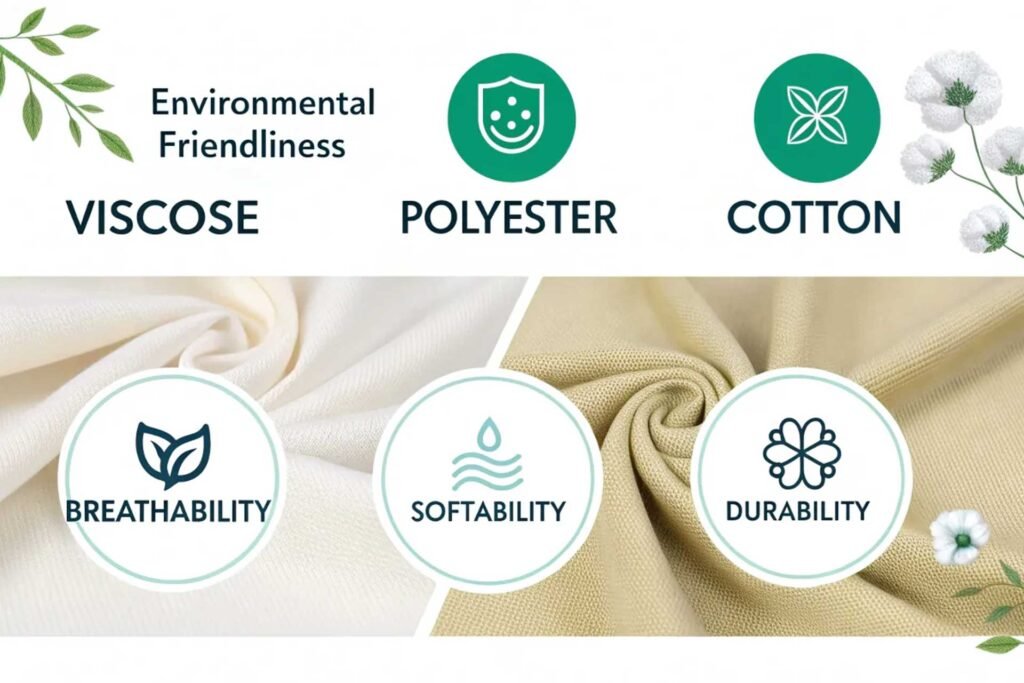
viscose vs polyester vs cotton
1. Viscose vs. Polyester: The Breathability Battle
When comparing viscose v polyester, the most significant difference lies in comfort and moisture management.
-
Viscose: As a plant-based regenerated fiber, viscose is exceptionally breathable. It can absorb significantly more moisture than cotton, making it ideal for summer wear. It feels cool to the touch and has a silk-like drape.
-
Polyester: A fully synthetic fiber derived from petroleum. While it is incredibly durable and wrinkle-resistant, it lacks breathability. Polyester tends to trap heat and sweat against the skin, which can be uncomfortable in humid climates.
The Verdict: Choose viscose for comfort and elegance; choose polyester for sportswear and durability.
2. Viscose vs. Cotton: Is Viscose Cotton?
A common misconception is that viscose is cotton. While both are made from cellulose, they are not the same.
-
Cotton: A 100% natural fiber harvested directly from the cotton boll. It is strong, easy to care for, and becomes stronger when wet.
-
Viscose: Often referred to as a 'man-made natural fiber' or viscose natural fiber (though technically semi-synthetic). It undergoes chemical processing to transform wood pulp into silk-like threads.
The Comparison: Compared to cotton, viscose is much smoother and has a more luxurious 'liquid' drape. However, cotton is more durable and easier to wash at home, whereas viscose requires more delicate handling.
3. Strength and Durability: The Achilles' Heel of Viscose
One critical technical point to remember is wet strength.
-
Cotton and Polyester maintain their integrity well when wet.
-
Viscose, unfortunately, loses about 30-50% of its strength when it becomes soaked.
This is why viscose garments often feel 'stiff' when wet and are more prone to tearing or stretching in the washing machine. This is the main reason many high-end viscose items are labeled as 'Dry Clean Only.'
4. What is a Fabric Similar to Viscose?
If you love the feel of viscose but are looking for alternatives, you might consider:
-
Modal: A 'second-generation' viscose that is stronger and more shrink-resistant.
-
Lyocell (Tencel): A more sustainable fabric similar to viscose that offers even better moisture wicking and a closed-loop production process.
-
Silk: The natural inspiration for viscose, though significantly more expensive.
Comparison Summary Table
| Feature | Viscose | Polyester | Cotton |
| Origin | Semi-Synthetic (Plant) | Synthetic (Petroleum) | Natural (Plant) |
| Breathability | Excellent | Poor | Good |
| Softness | Very Silky | Varies (Can be rough) | Soft/Matte |
| Wet Strength | Low (Vulnerable) | High | High |
| Drape | Fluid/Elegant | Stiff/Structured | Structured |